
Konjugate

- No match
Machine translation — the English original is authoritative.
The Story
We created Konjugate to make modeling complex dynamic systems intuitive and composable. Rather than writing monolithic differential equations, you describe individual component behavior and their interactions—the engine handles integration. It's open-source, visual-first, and executes native C++ simulations for digital twins and engineering applications.
AI Overview
AI-generatedBuilding complex dynamic systems typically forces engineers into a choice between mathematical rigor and practical usability. Modeling interactive components as a single monolithic differential equation demands expertise and produces brittle systems that resist changes. A new platform takes a different approach by letting engineers describe system components individually and their interactions, with the execution engine handling the mathematical integration.
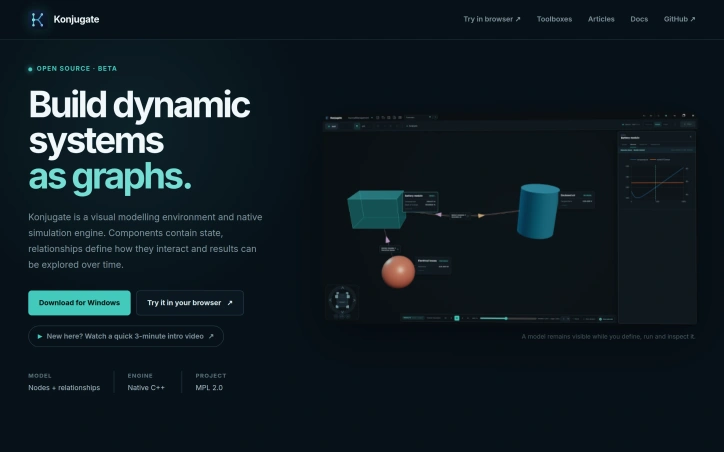
The core insight here is compositional modeling. Rather than writing one master equation, engineers define state owned by each component—a battery's temperature and charge, a coolant reservoir's fill level—and the specific relationships between them. This graph-based structure mirrors how real engineers think about systems: individual devices with properties that influence one another. The platform targets digital twin applications and engineering simulations where this decomposition directly reflects physical reality.
What distinguishes this approach is the combination of visual and native execution. The workbench lets users create nodes, connect them graphically, and define equations against explicit state and parameter references. Behind the scenes, simulations run as compiled C++ code for speed. Users can disable or delete components in place without restructuring the entire model, a practical feature that acknowledges real-world iteration.
The feature set addresses the gap between high-level design and low-level execution. A data recovery mode can import time-series CSV data and propose candidate components and relationships for review—essentially extracting model structure from historical behavior. An embedded model assistant accepts natural language descriptions of changes, validates them against the model structure, and presents structured proposals before committing anything to the workbench. This reduces both the risk of invalid models and the friction of iteration.
Extensibility is designed in from the start. An add-on interface lets users contribute custom visualizers for both live and completed simulations. The platform supports multiple AI providers—Ollama for local inference, OpenAI, NVIDIA, Hugging Face, and Gemini for hosted options—giving teams flexibility around where inference runs.
The source code is open, and the platform includes both a desktop application and command-line validator, suggesting a workflow that spans interactive modeling and automated validation pipelines. The geometric representation layer sits decoupled from model semantics, allowing engineers to visualize components with bundled shapes, library models, or custom CAD imports.
The offering is currently in beta, with the full pipeline from model composition through time-dependent analysis already functional.
Founder Diary
DevlogThe maker hasn't posted a diary entry yet.
Key Features
Compositional Modeling
Define system components individually and their interactions instead of writing monolithic differential equations
Visual Node-Based Workbench
Create and connect components graphically with compiled C++ execution for speed
Data Recovery Mode
Import time-series CSV data and automatically propose candidate components and relationships
AI-Powered Model Assistant
Describe system changes in natural language and receive validated structural proposals
Multi-Provider AI Integration
Choose between Ollama, OpenAI, NVIDIA, Hugging Face, and Gemini for inference
Use Cases
-
1
Digital Twin Applications
Engineers model complex interactive systems with compositional structure that reflects physical reality
-
2
Engineering Simulations
Decompose systems into individual components with relationships for practical iteration without restructuring entire models
-
3
System Design Validation
Extract model structure from historical data or validate design changes with AI assistance
FAQ
How does Konjugate differ from traditional differential equation modeling? ▾
Can I import existing data into Konjugate? ▾
What AI providers does Konjugate support? ▾
Is Konjugate open source? ▾
Tech Stack & Tags
Discussion
No comments yet — be the first!
Join the conversation — sign up to comment.
Sign up freeCommunity Support
Boost this project on Sell With boost