
PromptUnit
- No match
Machine translation — the English original is authoritative.
The Story
I built PromptUnit after watching engineering teams burn 3-5x their AI budget without knowing it. The problem isn't the models — it's that everyone defaults to GPT-4o for everything, including the simple tasks that a $0.15/MTok model handles just as well.
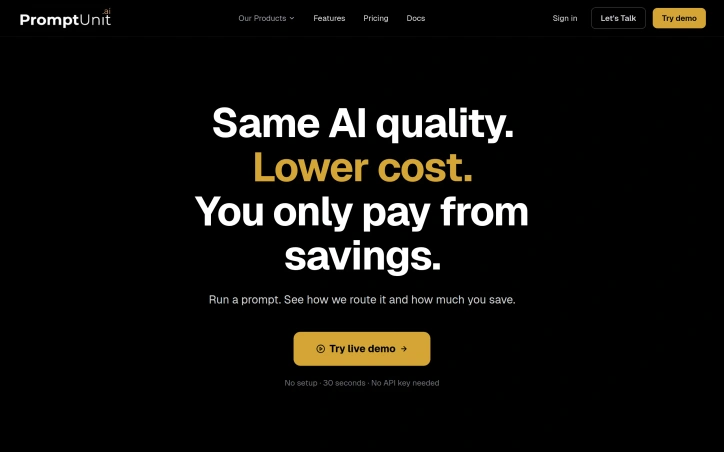
PromptUnit sits between your app and your AI providers. It classifies each request, routes it to the cheapest model that meets your quality bar, and shows you exactly where your money is going. One base URL change. No code rewrites. 14-day free observation before anything changes.
We charge 20% of verified savings only. If we save you nothing, you pay nothing.
AI Overview
AI-generatedBudget hemorrhage is the silent killer of every AI initiative that grew faster than the finance spreadsheet. PromptUnit attacks that problem head-on: it shows engineering teams exactly where their tokens bleed cash and then patches the wound without touching a line of code. Seed-stage startups accruing five-figure OpenAI bills and mid-market companies trying to rein in a mosaic of LLM providers finally have a single valve to turn.
The product deploys like an analytics layer that refuses to stay passive. Once you swap one environment variable—yes, truly one—the proxy begins logging every request in “shadow mode,” generating real-time dashboards that break cost, latency and usage down by model, feature and even individual prompt type. After a couple of weeks it presents an itemized forecast: keep current behavior and pay $12,400 next month, or let PromptUnit route intelligently and pay $6,960 instead. Enablement happens with a toggle, revertible just as fast.
Routing decisions are explained in English next to every call rather than buried in an inscrutable algorithm. If GPT-4o-mini can hit the quality bar for a routine summarization task, the dashboard explicitly credits the $0.07 saved; if a complex code-generation request stays on GPT-4o, the rationale is right there. Automatic failover means the proxy never becomes a single point of failure—it steps aside the moment it stumbles. GDPR residency controls and guarantees that your prompts never feed anyone else’s training set complete the enterprise hygiene checklist.
PromptUnit is chargeable only on verified savings, skimmed at a flat 20% of the delta. No savings, no invoice; turning it off permanently is always one click away. That alignment of profit motive and customer thrift turns loose change into an obvious install, not another procurement debate.
Founder Diary
DevlogThe maker hasn't posted a diary entry yet.
Key Features
Token Cost Visibility
Real-time dashboards breaking down costs, latency, and usage by model, feature, and individual prompt type
Shadow Mode Deployment
Deploys with a single environment variable swap and monitors requests without touching code
Cost Forecasting
Presents itemized forecasts comparing current spending to optimized spending with specific dollar amounts
Intelligent Routing
Routes requests intelligently with English explanations for each decision and associated savings
Automatic Failover
Ensures the proxy never becomes a single point of failure and reverts instantly if it fails
Enterprise Security
GDPR residency controls and guarantees that prompts never feed anyone's training set
Use Cases
-
1
Seed-stage Startups
Managing five-figure OpenAI bills and identifying unnecessary token spending
-
2
Mid-market Companies
Consolidating and optimizing costs across multiple LLM providers through a single platform
-
3
Engineering Teams
Identifying token waste and cost drivers without modifying existing code
FAQ
How much does PromptUnit cost? ▾
Will this require code changes? ▾
What if PromptUnit fails? ▾
Is my data private? ▾
Pricing
Charged at 20% of verified cost savings achieved, with no cost if no savings are realized
Tech Stack & Tags
Discussion
No comments yet — be the first!
Join the conversation — sign up to comment.
Sign up freeCommunity Support
Boost this project on Sell With boost