#api Startups & Tools
Discover the best api startups, tools, and products on SellWithBoost.
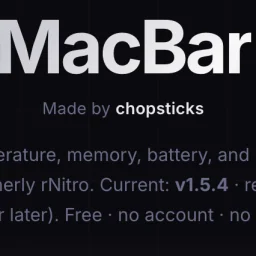
Menu bar system monitors solve a real friction point for Mac users: the need to quickly check CPU, memory, and thermal performance without opening Activity Monitor or third-party bloatware. MacBar addresses this with a lightweight, native alternative that stays out of the way until needed. The product installs entirely on your terms. Rather than downloading a prebuilt binary, the terminal installation command builds MacBar locally on your machine, with checksum verification to prevent tampering. This approach eliminates a common trust barrier between users and developer tools. The application collects no telemetry and requires no account, making it straightforward for privacy-conscious users to adopt without suspicion of data harvesting downstream. The monitoring capabilities deliver what users expect from a menu bar app: real-time CPU usage, temperature readings, clock speed, and memory stats. The interface includes a per-core CPU breakdown and a 60-second history graph, which adds useful context beyond the current snapshot. For Mac users who want to diagnose sudden slowdowns or track thermal behavior under load, this granularity matters. The technical implementation choices reinforce the privacy position. MacBar is built as native code and comes ad-hoc signed rather than notarized, a trade-off that keeps installation simple at the cost of a one-time security warning. The developers have committed to supporting Apple Silicon going forward while ending updates for Intel Macs after version 1.2.5, a pragmatic decision reflecting the real-world platform shift in the Mac ecosystem. Installation presents three paths: a hardened terminal command, a ZIP file, or compilation from source via Xcode. The terminal route is the default recommendation and avoids Gatekeeper friction entirely. This layered approach accommodates different user risk tolerances and technical comfort levels. The pricing model is straightforward: the application is free. This, combined with open-source development and no account requirements, positions MacBar as a genuine public service rather than a loss leader or future revenue trap. MacBar targets a specific audience: technical Mac users who want transparency in their system performance without the overhead of full-featured system utilities. It does not attempt to be everything; it stays in the menu bar and reports metrics. For users in that niche, it removes friction and requires no compromise on privacy.

Fraudulent signups remain a persistent issue in the digital landscape, bleeding resources from businesses through unnecessary transactional emails and wasted onboarding efforts. TrueUser offers a solution to this problem with its email verification API, specifically designed for businesses suffering from fake and disposable signups. By integrating TrueUser into their signup flow, companies can verify the authenticity of user email addresses in under 80 milliseconds. What stands out about TrueUser is its comprehensive approach to email verification, checking 14 signals that include disposable domain matching, MX and SMTP probing, and batch-velocity fingerprinting. This robust verification process enables businesses to identify not only disposable email addresses but also coordinated batch signup attacks. The company's dedication to staying ahead of emerging threats is evident in its active tracking of disposable domains, with over 5,439 domains monitored and a list that is updated regularly to include new providers. TrueUser provides businesses with a flexible system, allowing them to either directly use the verdict provided by the API or create their own policy based on the raw signals returned. Every API call is streamed to the company's dashboard, facilitating replay and tuning. The live verification stream demonstrates the API's effectiveness in real-time, showcasing its ability to quickly identify and block suspicious signups. The service starts free, with 1,000 free checks available, indicating a freemium model that allows potential customers to test the API before committing to a paid plan. Overall, TrueUser presents a compelling solution for businesses seeking to mitigate the financial and operational impacts of fake signups.

Image editing can be a tedious task, especially when it comes to removing backgrounds from photos. RMBG PRO's advanced AI-powered tool simplifies this process, making it an ideal solution for e-commerce businesses, professional photographers, and social media content creators. The platform's ability to automatically remove backgrounds from images in under five seconds is a significant time-saver, allowing users to focus on other aspects of their work. What stands out about RMBG PRO is its comprehensive suite of features that go beyond just background removal. The tool also allows users to remove watermarks and objects from images with precision, add custom background colors or images, and even upload logos or watermarks to brand their photos. The platform's batch processing capabilities and RESTful API integration make it an attractive option for businesses and developers looking to integrate background removal capabilities into their own applications. The RMBG Cloud Image Library is another notable feature, providing a centralized storage solution for processed images, allowing users to organize them into collections, share public portfolios, and track views. The seamless WordPress plugin integration is also a significant advantage for users with WordPress websites. Overall, RMBG PRO offers a robust set of features that cater to a wide range of image editing needs. Notably, the platform does not explicitly mention its pricing or business model, suggesting that users may need to explore the website further or contact the company directly to learn more about its costs and plans.

A collection of purpose-built AI utilities launched in 2026, this service addresses a consistent friction point in the AI tools market: premium functionality gated behind subscription costs that make no sense for creators and small teams. The problem is concrete. A content writer checking readability metrics should not need to commit to a $99 monthly subscription. A student asking for a code explanation should not negotiate an enterprise license. A freelance SEO consultant running keyword research for client work should not be locked into an annual contract just for access to basics. The founding team—Usman Shahid, M. Daniyal Fakahr, and Abdul Rehman—identified this pattern across years of content creation, product work, and engineering. Their response was direct: build a collection of focused, production-quality tools and keep them permanently free. Not a freemium trial. Not a limited-time offer. Actually free—no credit card required, no account creation, no expiration date, no data retention. The platform currently offers 11 tools covering writing, SEO, coding, and content optimization. These include an AI Text Analyzer for sentiment and readability scoring, a Code Explainer for translating technical code into plain language, a Keyword Research tool, a Prompt Generator for improving ChatGPT and Claude inputs, an AI Content Detector, a Text Summarizer, a Tone Rewriter, an AI Paraphraser, a Hashtag Generator, a Meta Tag Generator, and an Alt Text Generator. Each tool is scoped to a single task with no complex setup required—users pick a tool, paste their input, and retrieve results within seconds. What distinguishes this approach is its execution philosophy. Rather than building a bloated all-in-one platform, the founders deliberately created utilities that excel at one specific function. The product roadmap reflects user demand rather than speculative features. When content professionals asked for tone rewriting, it was added. When educators requested AI detection capabilities to identify student submissions, that tool was built. When SEO specialists wanted meta tag generation, it joined the collection. The business model itself is notable: zero cost, zero signup friction, and zero data collection. This removes the traditional barriers that keep individual creators and students from using professional-grade tools. Whether this model sustains long-term or serves as a user acquisition strategy remains to be seen, but in its present form, NexusAI represents a deliberate rejection of the subscription tax on basic AI utilities.

When building applications that rely on third-party JSON APIs, developers often face challenges with error handling and legacy dependencies. A new lightweight TypeScript HTTP client addresses these issues by providing a robust and maintainable solution. Developers of backend services written in TypeScript or JavaScript, particularly those targeting Node environments or browsers, are the primary beneficiaries of this client. It simplifies the process of consuming REST APIs from third-party services such as payment providers, CRM systems, or shipping integrations. Notably, this client's design prioritizes type safety, particularly in error handling. It achieves this through a tagged discriminated union approach, allowing for more precise error handling and narrowing by TypeScript. The absence of runtime dependencies, leveraging instead the platform's fetch and URL APIs, contributes to its lightweight nature. It is compatible with Node versions 20.10 and above, as well as browsers when used with a bundler. The client's API surface is intentionally minimal, consisting primarily of the createTrembita function, which returns an object with request and client capabilities. This simplicity, combined with its testable design that allows for the injection of a custom fetch implementation, makes it an attractive option for developers seeking a straightforward and maintainable HTTP client. The documentation provides a comprehensive learning path, ranging from a super quick start guide to a complete learning guide and system design overview. Real-world examples, including interactions with the GitHub API, payments, and microservices, further enhance its utility. The client is available for installation via npm, with optional OpenAPI helpers available in a separate package. No explicit pricing or business model details are provided, suggesting an open-source approach. Overall, this lightweight TypeScript HTTP client offers a compelling solution for developers seeking a robust, type-safe, and dependency-free way to interact with third-party JSON APIs.

Budget hemorrhage is the silent killer of every AI initiative that grew faster than the finance spreadsheet. PromptUnit attacks that problem head-on: it shows engineering teams exactly where their tokens bleed cash and then patches the wound without touching a line of code. Seed-stage startups accruing five-figure OpenAI bills and mid-market companies trying to rein in a mosaic of LLM providers finally have a single valve to turn. The product deploys like an analytics layer that refuses to stay passive. Once you swap one environment variable—yes, truly one—the proxy begins logging every request in “shadow mode,” generating real-time dashboards that break cost, latency and usage down by model, feature and even individual prompt type. After a couple of weeks it presents an itemized forecast: keep current behavior and pay $12,400 next month, or let PromptUnit route intelligently and pay $6,960 instead. Enablement happens with a toggle, revertible just as fast. Routing decisions are explained in English next to every call rather than buried in an inscrutable algorithm. If GPT-4o-mini can hit the quality bar for a routine summarization task, the dashboard explicitly credits the $0.07 saved; if a complex code-generation request stays on GPT-4o, the rationale is right there. Automatic failover means the proxy never becomes a single point of failure—it steps aside the moment it stumbles. GDPR residency controls and guarantees that your prompts never feed anyone else’s training set complete the enterprise hygiene checklist. PromptUnit is chargeable only on verified savings, skimmed at a flat 20% of the delta. No savings, no invoice; turning it off permanently is always one click away. That alignment of profit motive and customer thrift turns loose change into an obvious install, not another procurement debate.

Building AI agents that can operate in the real world requires bridging the gap between digital systems and traditional communication channels. AgentCall solves a critical problem: enabling AI agents to interact via phone—both making outbound calls and receiving inbound communication—without the friction and failures that plague existing VoIP-based approaches. The core offering is elegant in scope. Developers provision real SIM-backed phone numbers through an API, connect their agents with a single API key, and receive all incoming calls and SMS messages through webhooks. The platform handles provisioning in seconds, supports country and capability selection, and guarantees that numbers pass strict platform verification checks that typically block VoIP alternatives. For AI agents, this means actually being able to register accounts, complete SMS-based verification flows, and operate in environments where traditional virtual numbers get rejected. What distinguishes AgentCall is how it handles the full communication stack. Voice calls aren't just passive; agents initiate outbound calls with AI-powered conversation using one of eight distinct voice options—from the neutral "Alloy" to the energetic "Shimmer"—each tuned for different contexts. The AI voice system accepts a system prompt and autonomously manages the conversation, returning a full transcript. This makes customer service outreach and verification workflows genuinely practical. On the messaging side, agents get a dedicated SMS inbox per number, send and receive messages, and automatically extract verification codes from incoming SMS, delivering them to webhook endpoints in real-time. The architecture reflects strong security thinking. Each agent gets its own isolated number, preventing compromise of one agent from cascading across others. The async, webhook-based design eliminates the need for persistent connections or complex state management. The platform supports diverse use cases: agents test SMS-based authentication on their own apps, run outbound calling campaigns with follow-up SMS, maintain two-way SMS conversations, and handle inbound calls through webhook forwarding. This breadth indicates the founders understood the landscape of agentic workflows rather than optimizing for a single scenario. The "Works with MCP" mention signals integration with the Anthropic Model Context Protocol, positioning AgentCall within the broader AI infrastructure stack. For developers building sophisticated AI agents that need reliable phone capabilities, AgentCall delivers what the market currently lacks—a practical alternative to the constraints and unreliability of virtual number services.

Researchers spend considerable time wrestling with infrastructure rather than focusing on the work that matters—fine-tuning models and designing algorithms. Tinker addresses this friction by offering a lightweight API that handles the operational burden of model training while keeping researchers in control of their data and experimental approach. The platform targets an audience that values research velocity over infrastructure flexibility: academics, laboratories, and independent researchers exploring large language model training without wanting to manage compute clusters, scheduler complexity, or resource allocation manually. The core value proposition hinges on LoRA, an efficient fine-tuning technique that updates a trainable adapter layer rather than the full model weights. This approach reduces computational demands while maintaining learning performance comparable to traditional fine-tuning. For researchers with limited hardware budgets, this matters considerably. Tinker abstracts away scheduling, hardware management, and infrastructure reliability entirely, offering a deliberately minimal API surface: four core operations handle forward passes and gradient accumulation, weight updates, token generation, and state persistence. This simplicity contrasts sharply with the complexity of self-managed training pipelines. The platform's model roster demonstrates genuine breadth. Tinker supports dense and mixture-of-experts variants across multiple architectures—Qwen, Llama, DeepSeek, Kimi, and NVIDIA's Nemotron—ranging from 1B to 397B parameters. This range suggests the infrastructure can scale to serious research workloads while remaining accessible to those working with smaller models. What distinguishes Tinker from ad-hoc cloud compute solutions is the engineering philosophy reflected in user testimonials. Researchers emphasize that the platform lets them "focus on research rather than spending time on engineering overhead," that "infrastructure abstraction makes focusing on data and evals far easier," and that it enables "quick iteration without worrying about hardware." These aren't marginal improvements—they describe a fundamental shift in attention from operational concerns to scientific ones. The testimonials come from academics and practitioners actively working in reinforcement learning and model training, lending credibility to these claims. The platform appears designed specifically for the researcher segment that finds existing options unsatisfying: cloud GPUs require babysitting, on-premise infrastructure demands expertise, and managed services often impose opinionated constraints on training workflows. Tinker occupies a narrower niche but serves it deliberately. Access requires signup or organizational outreach, and pricing details remain undisclosed publicly. For researchers prioritizing iteration speed and research focus over cost optimization or total architectural control, the trade-off appears worth making.

AI-powered integration platforms have become increasingly crucial for companies looking to streamline their operations and automate tasks. Merge Agent Handler stands out as a comprehensive solution that addresses a significant pain point in this space – secure access to enterprise-ready tools. This platform caters specifically to developers, businesses, and enterprises with robust requirements for data governance and security. The problem it solves is rooted in the complexities of integrating multiple third-party tools and maintaining secure authentication, which can be time-consuming and resource-intensive. Merge Agent Handler mitigates this issue by providing a unified API that normalizes access to various chat and messaging platforms. What sets this product apart is its emphasis on enterprise-grade security, built-in authentication, and credential management. This ensures seamless and secure connections between AI agents and enterprise-ready tools. The platform's pre-built connectors eliminate the need for developers to spend time writing custom code, freeing up resources for more strategic tasks. Other notable features include Connector Studio, which allows users to modify existing connectors or create new ones with AI-assisted validation. Additionally, Merge Agent Handler's secure authentication flow is effortless and guided, ensuring that data access remains under control. Pricing details are not explicitly mentioned in the provided content. However, it does mention a free trial option for users to test the platform's capabilities before committing to a paid plan. This approach caters to companies looking to assess the efficacy of Merge Agent Handler without upfront costs.