
SEO Automation Hub



- No match
Machine translation — the English original is authoritative.
The Story
We built SEO Automation Hub to solve the core problem: agencies were drowning in SEO data across multiple platforms without a clear path to implementation. We created one operational workspace where teams automate audits, analyze competitors, generate content with AI, and track results—transforming scattered signals into actionable workflows that deliver real business results.
AI Overview
AI-generatedScattered SEO data across multiple platforms has become a critical pain point for agencies and internal teams trying to move from analysis to implementation. SEO Automation Hub addresses this by consolidating audits, competitor intelligence, and content generation into a single operational workspace designed around clear workflows rather than dashboard reporting.
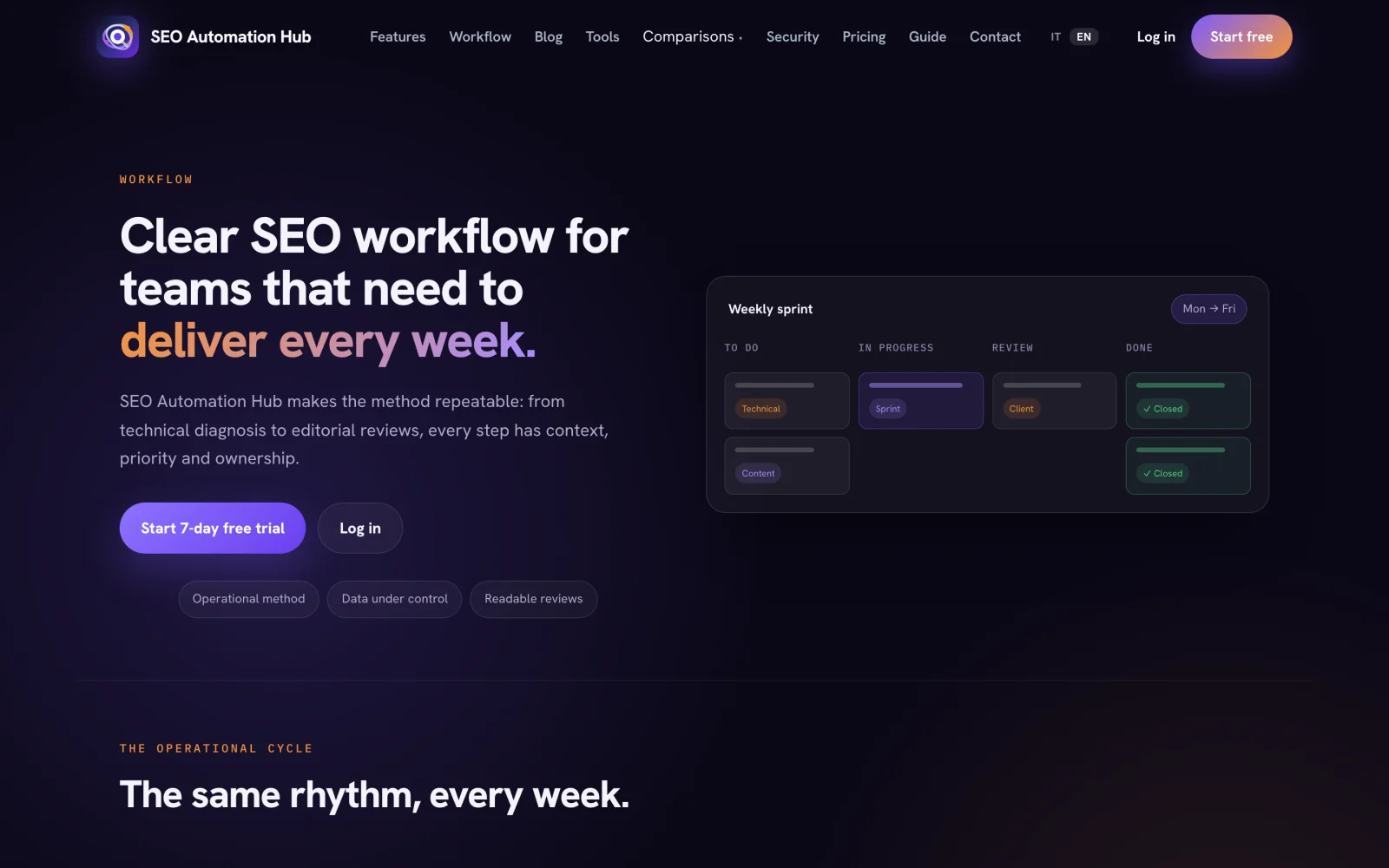
The platform targets three distinct user groups: agencies looking to standardize client deliverables, independent consultants seeking to demonstrate methodology and control, and internal teams needing alignment between SEO, content, and development functions. Each gets a workspace structured around a four-step progression: acquiring signals from connected sources, evaluating them to separate genuine urgencies from noise, assigning insights as concrete tasks with clear ownership, and measuring the results of interventions.
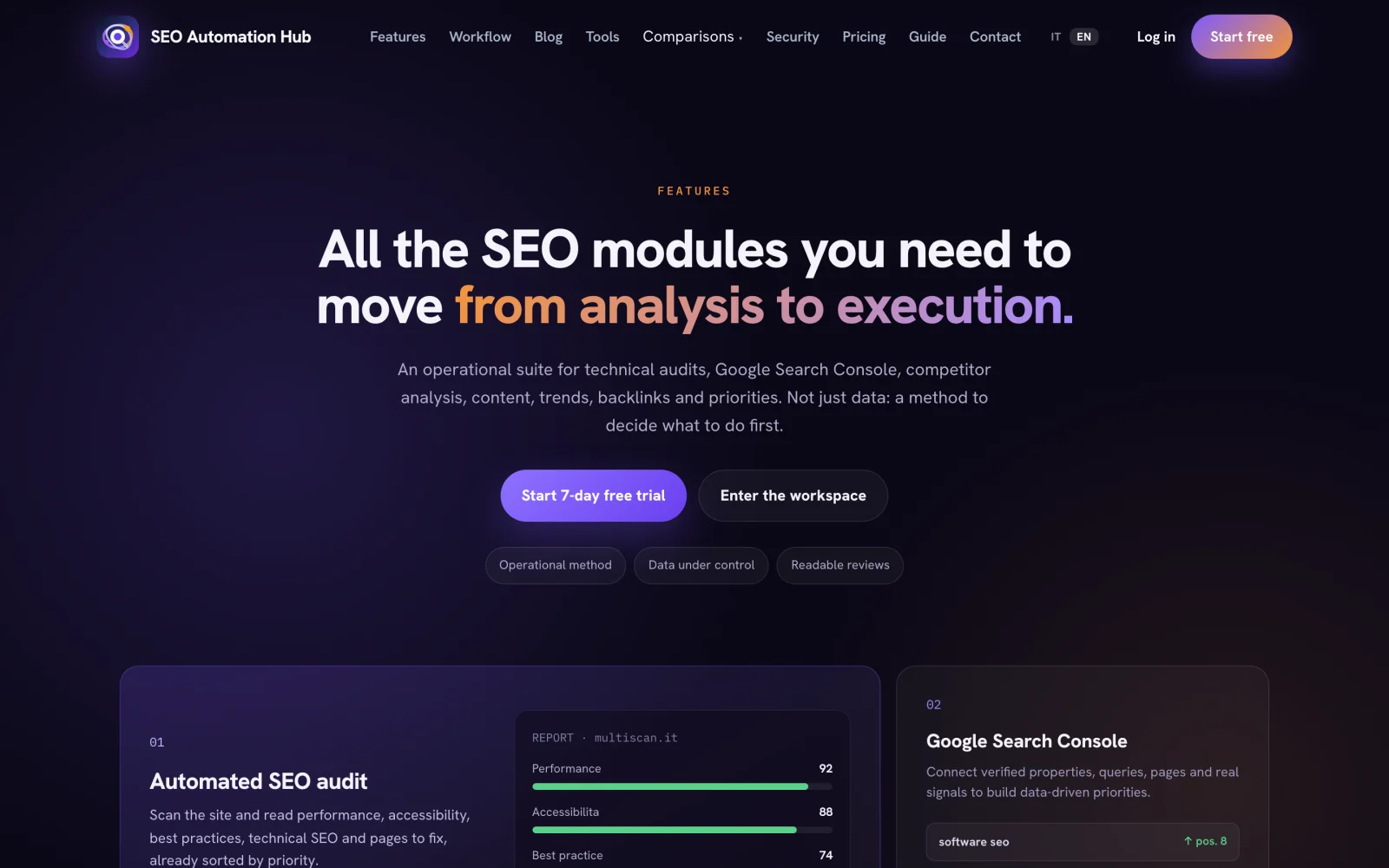
What distinguishes this product is its emphasis on actionability over metrics accumulation. The interface promises a readable path for decision-makers and executors alike, moving past the typical export-and-spreadsheet model that plagues multi-platform SEO work. The technical audit surfaces Lighthouse metrics, critical pages, and prioritized improvements in a structured roadmap. Google Search Console integration lifts query data, page performance, and competitive signals without requiring separate tabs and manual consolidation. The competitor analysis module goes beyond feature parity comparisons to identify strategic gaps and market positioning opportunities.
Content generation gets particular attention here. Rather than disconnected AI writing, the platform generates briefs, on-page structures, and full articles calibrated to the domain's existing performance and market context. Topic research feeds into this, uncovering trend-worthy subjects and backlink opportunities that convert to editorial tasks. The work management layer—labeled Pipeline SEO—bundles all of this into weekly workflows with prioritization logic based on impact and effort.
The product clearly positions itself for teams that have moved beyond one-off audits and now operate SEO as a continuous discipline with multiple stakeholders. An internal team might use this to keep content creators and developers aligned on shared SEO priorities. A consultant could use it to show clients not just what's broken but the method for fixing it systematically. An agency could scale delivery across clients without losing consistency.
The platform offers a seven-day free trial with limited reporting access, suggesting a freemium model, though specific pricing tiers are not detailed in available materials. This approach lowers barrier to evaluation while funneling users toward paid tiers as project scope grows.
Founder Diary
DevlogThe maker hasn't posted a diary entry yet.
Key Features
Technical Audit
Surfaces Lighthouse metrics, critical pages, and prioritized improvements in a structured roadmap.
Google Search Console Integration
Lifts query data, page performance, and competitive signals without requiring separate tabs.
Competitor Analysis
Identifies strategic gaps and market positioning opportunities beyond feature parity comparisons.
Content Generation
Generates briefs, on-page structures, and full articles calibrated to domain performance and market context.
Topic Research
Uncovers trend-worthy subjects and backlink opportunities that convert to editorial tasks.
Pipeline SEO
Bundles workflows into weekly prioritization logic based on impact and effort.
Use Cases
-
1
Agencies
Standardize client deliverables and scale delivery across multiple clients without losing consistency.
-
2
Independent Consultants
Demonstrate methodology and control to clients systematically rather than through one-off audits.
-
3
Internal Teams
Maintain alignment between SEO, content, and development functions on shared priorities.
-
4
Continuous SEO Operations
Manage multiple stakeholders coordinating on shared SEO priorities as an ongoing discipline.
FAQ
What does SEO Automation Hub consolidate? ▾
How does the platform organize work? ▾
Does it integrate with Google Search Console? ▾
What pricing options are available? ▾
Pricing
Seven-day free trial with limited reporting access; specific pricing tiers not detailed in available materials.
Tech Stack & Tags
Discussion
No comments yet — be the first!
Join the conversation — sign up to comment.
Sign up freeCommunity Support
Boost this project on Sell With boost
Meet the Founder

"Indie maker 🇮🇹 · I ship SaaS with Laravel · SEO Automation Hub · MailerEnergy · TargetBridge (open s..."
More in SEO tools

LinkNest
I noticed SEO professionals and independent blog...

Daybreaker.ai
Stop tracking random prompts. Find the exact pro...

Ai Visibility Audit
Businesses increasingly appear in AI-powered sea...

SubmitMap
I kept losing evenings to directory forms that w...

ClaroRank
I built ClaroRank to provide honest SEO tool rev...

Free GSC Keyword Analyzer — AI-Powered SEO Insights in 60 Seconds
Over the past few years, the digital landscape h...