
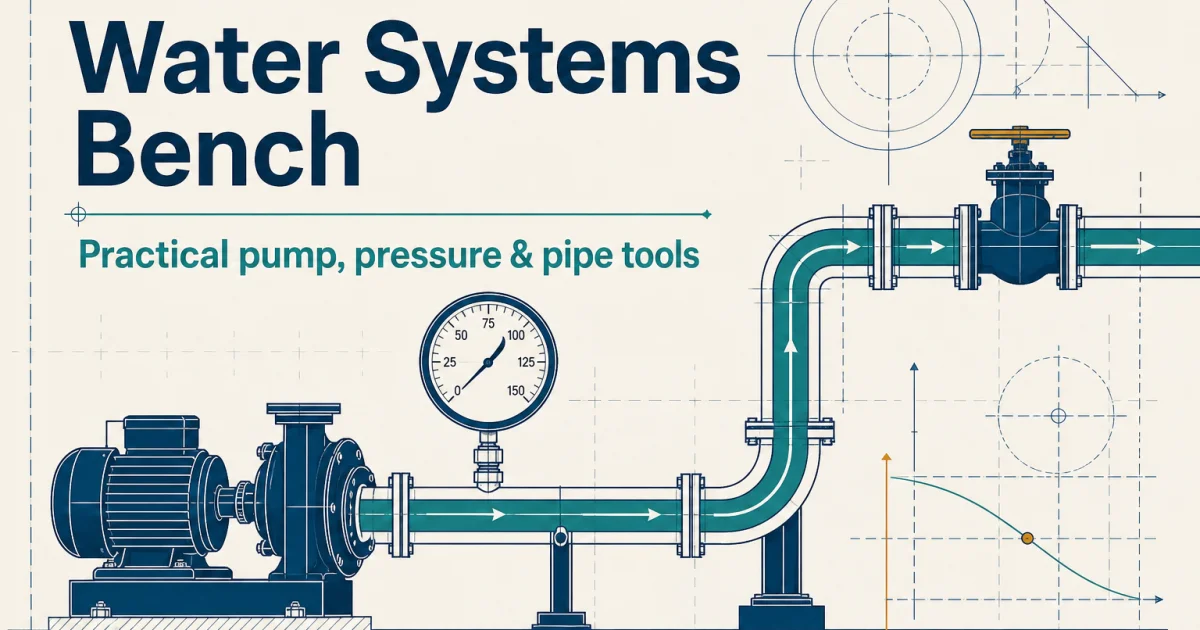
Water Systems Bench
- No match
Machine translation — the English original is authoritative.
The Story
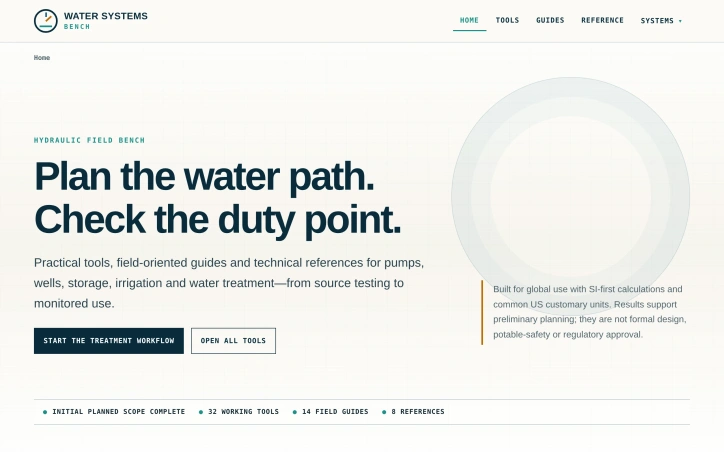
I built Water Systems Bench because water-system planning fragments across scattered references and spreadsheets. Engineers and planners need one place to size pumps, calculate pipe friction, design treatment trains, and follow water from source to use. This tool makes those interconnected decisions transparent with 32 working calculators, 14 field guides, and technical references all in one system.
AI Overview
AI-generatedCoordinating water infrastructure decisions requires holding multiple variables in mind simultaneously. Storage affects pump requirements. Pipe diameter determines friction losses. Treatment depends on water quality results. For decades, engineers and planners have scattered these calculations across spreadsheets and disconnected tools. Water Systems Bench consolidates this landscape by modeling systems as integrated wholes rather than isolated problems.
The platform addresses a specific inefficiency in planning. When one decision cascades into upstream and downstream changes, fragmentation creates blind spots. Changing pipe size requires recalculating friction and pressure. Adding treatment stages shifts system cost and power demand. The tool makes these dependencies visible by organizing work into four connected clusters: pump and pressure calculations, source and storage modeling, irrigation system design, and water quality treatment.
The product delivers 32 working calculators across these domains. Users can model pump duty points, size water softeners based on measured hardness, balance reverse-osmosis flows, or interpret laboratory test reports. The interface pairs calculators with 14 field guides covering practical topics like pump curve reading and troubleshooting, plus technical references for conversions, formulas, and pipe specifications.
What distinguishes this offering from generic engineering calculators is its architecture. Rather than isolated tools, the system models water flowing from source to endpoint. A designer building an irrigation system must address storage capacity first, which determines pumping duty, which affects pipe sizing and pressure requirements. This sequential logic reflects how decisions actually unfold in real planning work.
The interface emphasizes transparency in methodology. Each calculator shows underlying formulas and acknowledges limitations rather than presenting results as universal truths. Documentation directs users to verify calculations against manufacturer specifications, local regulations, and site conditions. This epistemic clarity prevents misuse of tools as substitutes for professional judgment.
For water infrastructure professionals managing multiple projects or advising clients on system design, the consolidated interface addresses a genuine friction point in current practice.
Founder Diary
DevlogThe maker hasn't posted a diary entry yet.
Key Features
Integrated System Modeling
Models water systems as connected wholes showing dependencies between storage, pumping, pipe sizing, and treatment.
32 Working Calculators
Provides ready-to-use calculators for pump duty points, water softener sizing, reverse-osmosis flows, and laboratory test interpretation.
Field Guides and References
Includes 14 practical guides on topics like pump curve reading and technical references for conversions and specifications.
Transparent Methodology
Displays underlying formulas and acknowledges calculator limitations to prevent misuse as substitutes for professional judgment.
Sequential Design Workflow
Reflects how real planning decisions unfold, where storage capacity determines pumping duty which affects pipe sizing.
Use Cases
-
1
Water infrastructure engineers
Need a consolidated platform to coordinate interconnected calculations across storage, pumping, pipe sizing, and treatment without spreadsheets.
-
2
Irrigation system designers
Must model sequential dependencies from storage capacity through pump requirements to pipe sizing and pressure calculations.
-
3
Water infrastructure consultants
Advise clients on system design with a transparent interface that shows formulas and limitations rather than presenting results as universal truths.
-
4
Multi-project infrastructure managers
Reduce friction when managing multiple projects by organizing work into four connected clusters rather than using disconnected tools.
FAQ
What calculators does Water Systems Bench include? ▾
How do I size a water softener? ▾
Can I use this for irrigation system design? ▾
Does this replace hiring an engineer? ▾
Tech Stack & Tags
Discussion
No comments yet — be the first!
Join the conversation — sign up to comment.
Sign up freeCommunity Support
Boost this project on Sell With boost
Meet the Founder

More by canghun13




More in Knowledge base software

ekstrakt
We built ekstrakt because people spend hundreds...

SetupScore
I kept losing evenings to the same ritual. Want...
CapyDB
I created CapyDB because existing game wikis are...

CheatGrid
I kept hitting the same annoying moment: needing...

iHateReading
I built iHateReading to break down complex topic...

Dutton Legacy
As a fan of the Yellowstone universe, I created...