WebAuditOS
- No match
Machine translation — the English original is authoritative.
The Story
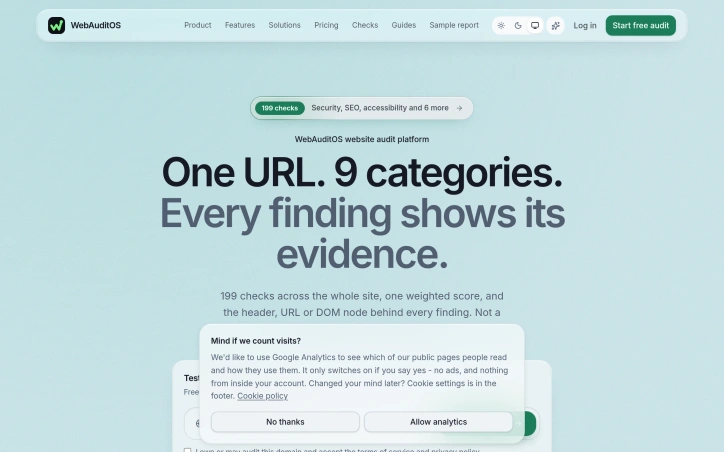
I built WebAuditOS because most website audit tools hand you a score and expect you to trust it. WebAuditOS runs 199 checks across 9 categories (security, performance, SEO, accessibility, UX quality, technical, compliance, mobile readiness and browser compatibility) and rolls them into one weighted score. Every finding shows its evidence: the exact header, URL or DOM node behind it, so you can verify it and fix it fast. Agencies and freelancers get a dashboard of every site they look after, continuous re-scans and white-label reports. There is a free plan to start.
AI Overview
AI-generatedTransparency in web auditing has been the industry's blind spot. Most tools hand users a score and expect them to accept it as gospel. This platform addresses that directly by making every finding verifiable. The system runs 199 checks across nine categories and, crucially, does not hide behind its calculations. Each result points to the exact header, URL, or DOM node that triggered it, letting practitioners confirm the finding and move straight to fixing it.
The product targets a well-defined audience: agencies and freelancers managing multiple client sites. The core tension it resolves is familiar to anyone who has done client work. You receive an audit report and must either spend hours verifying claims or explain to a client why you trust an unknown vendor's black box. This platform opts for radical transparency instead.
What distinguishes the product operationally is how it handles the mechanics of auditing at scale. The nine categories—Security, Performance, SEO, Accessibility, UX Quality, Technical, Compliance, Mobile Readiness, and Browser Compatibility—carry weighted scores that trace back to the pages examined. A crucial detail: unmeasured results are reported as unmeasured rather than forced into a score, which prevents garbage calculations when the browser cannot render a page or partial scans artificially inflate numbers. Page captures render at mobile, tablet, and desktop widths, so stakeholders see what the audit was actually examining.
For ongoing work, the platform includes scheduled re-scans with regression detection. Alerts fire only when scores drop, not on every scan, which cuts through noise. The crawl is deterministic—scanning twice produces identical page sequences—so before-and-after comparisons are reliable. Findings map to standards like OWASP ASVS, WCAG 2.2, relevant RFCs, and Core Web Vitals thresholds, giving practitioners the citations they need when working with clients or internal stakeholders.
The business model appears built for agencies: a dashboard centralizes every managed site, continuous monitoring replaces one-off scans, and white-label reports let agencies sell the service under their own name. A free tier exists to reduce friction at signup with no credit card required. A Pro plan offers a seven-day trial, though specific pricing is not disclosed publicly. The transparency philosophy extends to access—the platform crawls only public pages and respects robots.txt.
Founder Diary
DevlogThe maker hasn't posted a diary entry yet.
Key Features
Verifiable Findings
Each result points to the exact header, URL, or DOM node that triggered it.
Comprehensive Auditing
Runs 199 checks across nine categories including Security, Performance, SEO, Accessibility, UX Quality, Technical, Compliance, Mobile Readiness, and Browser Compatibility.
Multi-device Rendering
Page captures render at mobile, tablet, and desktop widths to show what was actually examined.
Regression Detection
Scheduled re-scans with alerts that fire only when scores drop, filtering out noise.
Standards Mapping
Findings map to OWASP ASVS, WCAG 2.2, RFCs, and Core Web Vitals thresholds.
Use Cases
-
1
Agencies managing multiple client sites
Centralizes all managed sites in one dashboard with white-label reports for reselling under their own brand.
-
2
Freelancers
Reduces hours spent verifying audit claims or explaining findings to clients without needing to trust a black box.
-
3
Continuous monitoring
Scheduled re-scans and regression detection replace one-off manual audits for ongoing compliance.
FAQ
How does WebAuditOS show me why an audit failed? ▾
What standards does it check against? ▾
Can it track improvements over time? ▾
What are the requirements to get started? ▾
Pricing
Free tier requires no credit card; Pro plan available with seven-day trial but specific pricing not publicly disclosed.
Tech Stack & Tags
Discussion
No comments yet — be the first!
Join the conversation — sign up to comment.
Sign up freeCommunity Support
Boost this project on Sell With boost
Meet the Founder

More in Website analytics

Glazed AI
Glazed creates and ships tracking events from Fi...
Website Auditor
I built Website Auditor to help small businesses...

GA Lite
Understanding how your websites are doing should...

Leakly
We built Leakly because we saw businesses throwi...

Skippership
Get full session replays, interactive heatmaps,...
QueryTrace
I built QueryTrace because every company cares a...