#avatar generators Startups & Tools
Discover the best avatar generators startups, tools, and products on SellWithBoost.

Viral meme replication typically demands either technical skill with video editing software or expensive creator services. Rumpelstiltskin AI solves this by reducing the barrier to near zero: upload a photo or two, pay $8.99, and receive a finished 15-second video ready to post. The product targets TikTok creators and social media users who want to participate in meme trends without learning editing timelines or committing to subscriptions. It operates on a template model, inserting user faces into a pre-shot sequence of the "tip toeing in my Jordans" meme. This is not face-swapping. The company films eight distinct shots with physical sets and actors, then composites the user's face into five to seven of those cuts depending on role selection. The remaining shots stay as original footage, typically showing hands, feet, or angles where face insertion would be unnecessary or uncanny. What distinguishes this product is its refusal of friction. There is no account creation, no prompt engineering, no timeline scrubbing. The user selects one or two photos, chooses a role (the imp, the girl, or both), clicks "cast," and the rendering begins. The company handles casting, filming, and compositing without asking for granular controls. The output is a silent MP4, intentionally design-limited so that users must attach audio on TikTok itself, which is where the meme lives. The pricing model reinforces this simplicity: $8.99 per video, no recurring charges, no cancellation mechanics. The company demonstrates transparency about its methods. The website explicitly states which shots are newly filmed and which are always pre-made footage, differentiating itself from services that promise total customization. Uploads are deleted 24 hours after rendering, and videos are private by default. The acceptable use policy requires confirmation that all people in uploaded photos are adults who consented and are not public figures, which attempts to preempt the most obvious legal and ethical misuses. The fixed edit structure is both a feature and a limitation. The 8-shot sequence never varies; cuts always land on the beat. This predictability means faster rendering and consistent output quality, but it also means zero creative deviation. Users cannot request different choreography, camera angles, or scene variations. At $8.99 for a one-time creation, the product is positioned as an impulse purchase rather than a production tool. It targets participants in trend cycles rather than professional creators, and it prices accordingly.

Capitalizing on a viral dembow moment that swept through Latin media in October 2026, this tool converts a single selfie into a 12-second vertical video of the user lip-synced to a freestyle verse that generated tens of millions of views across platforms. The service addresses a specific use case: enabling social media users to participate in a cultural trend without requiring video production skills, equipment, or account creation. The product's core strength is its radical simplicity. Users upload one clear facial photograph, verify they own the likeness, and pay $8.99 for a rendered MP4. No editing interface, no customization prompts, no strategic decisions beyond image selection. The output arrives as a mobile-ready vertical clip with lip-sync timing calibrated to the beat. The silent video design—users add audio when posting—keeps the production pipeline focused and the tool's scope deliberately narrow. Several design choices reveal intentional restraint. Uploaded images disappear within 24 hours, treating data minimization as a feature rather than a policy footnote. The service operates without accounts or subscriptions, eliminating authentication friction and the pressure to grow monthly active users. The creator frames this as an unofficial fan tool with no artist affiliation, setting clear expectations while sidestepping brand partnership complications. The one-time payment model at $8.99 per video signals the creators understand their own market constraints. This is a trend-capture product built for a moment, not a platform engineered for perpetual engagement. The business structure treats each video as a discrete transaction: pay once, receive an asset, the relationship ends. Users retain no profile, no library, no reason to return except to make another video during the trend's active window. The limiting factor is self-evident: viral moments in music have finite lifespans. The tool's entire value depends on sustained participation in the Bulin 47 trend. Should interest fade, so does relevance. The product makes no attempt to extend utility beyond the specific cultural moment it targets, which appears intentional rather than an oversight. This focus, while commercially risky long-term, makes the offering honest about what it is and what it actually does.

Creating viral social media content typically requires either significant technical skills or expensive tools. This AI video generator addresses that friction by packaging a single trending format into an extremely focused product that requires nothing more than two photos and $8.99. The core service transforms a pair of user-supplied images into 15-second TikTok videos matching the "Hotel Lobby" trend, where one photo raps into a hanging microphone while the other dances in an orange booth. The template is pre-configured, meaning users skip the usual AI video workflow of writing prompts, selecting models, or tweaking parameters. The service handles lip-syncing automatically to the established trend sound, and the output arrives pre-formatted in 720p MP4 at 16:9 aspect ratio—ready to post directly. What distinguishes this product is its deliberate simplicity. Most AI video tools force users to learn their systems, experiment with settings, and make creative decisions. This one does the opposite: it eliminates options. There is no account signup requirement, no creative customization, no editing phase. Users select two images, confirm they have permission to use them, and submit payment. The philosophy of constraint-driven design shows throughout. The product even includes a feature to swap performer positions before payment, eliminating a common source of regret with one-way transactions. Privacy receives explicit attention in the product design. The service deletes photos within 24 hours, whether the generation succeeds or fails. The terms explicitly address consent, prohibiting use of images containing minors, celebrities, or public figures—a meaningful guardrail against the misuse that plagues many generative tools. The pricing structure removes subscription friction entirely. At $8.99 per video with no recurring charges, the transaction is transparent and one-off. Failed generations automatically refund credits, eliminating the anxiety that often surrounds experimental features. The target user is clear: social media creators who want to participate in a specific trend without spending hours learning software or acquiring new skills. This narrowness is intentional. The product refuses the temptation to become a general AI video tool, instead excelling at a single outcome. That focus, combined with the frictionless workflow and transparent pricing, creates a compelling value proposition for anyone who sees the trend and wants in without the complexity.
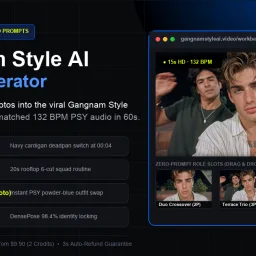
Viral dance videos have become a cultural phenomenon, but creating professional-quality versions requires technical skills most people lack. This AI video generator tackles that barrier by letting users transform 1-3 portrait photos into synced 15-second Gangnam Style dance videos without writing a single text prompt. The target audience spans casual creators who want shareable content quickly, social media enthusiasts looking for a novel way to feature photos, and anyone nostalgic for the 2012 phenomenon seeking to recreate it with modern faces. What distinguishes this tool is its singular focus. Rather than being a generalist video generator, it commits entirely to one dance and three preset choreography templates, eliminating decision paralysis. Users select between the Blue Tux Solo, Street Duo, or Terrace Trio formation, upload their photos to marked role slots, and receive an MP4 in under a minute. The 132 BPM audio syncing to PSY's original track happens automatically, and the platform claims 98.4% facial accuracy across fast-moving choreography, a technical claim that matters given how video synthesis typically fails on rapid motion. The product supports both landscape (16:9) and portrait (9:16) aspect ratios, accommodating TikTok creators alongside desktop viewers. Users can generate in either 720p or 1080p Full HD. Photo requirements are practical: clear, front-facing waist-up portraits with natural lighting, which aligns with smartphone capabilities. The business model prioritizes simplicity and trust. Pricing starts at $9.90 for a single 720p generation, with 1080p available through a credit system. There is no subscription; each generation is a one-time purchase. The platform offers a 3-second auto-refund guarantee and purges uploaded photos after 24 hours, directly addressing privacy concerns that plague photo-based AI tools. The core limitation doubles as the core strength: this solves a highly specific problem for a specific trend. It cannot serve users wanting unlimited choreography variety or custom music. For the narrow use case it addresses, however, the no-prompt interface, preset role system, and automatic audio syncing eliminate friction between idea and output. The one-time pricing without subscriptions positions it as a novelty purchase rather than a recurring service, which suits its entertainment-focused positioning.

Creative professionals looking for inspiration when facing project blocks have found a dedicated tool in this hybrid creature generator. Built for artists and game designers, the platform combines random selection across 2,500+ animal species into single creatures with eleven distinct body parts, creating endless drawing prompts and character concepts on demand. The product's strength lies in its structured approach to randomization. Rather than selecting a single species at random, users click through eleven separate slots—base body, head, ears, eyes, nose, legs, feet, tail, coat, color, and an extra feature—each pulling from the deep animal database independently. This part-by-part assembly creates far more varied and unusual combinations than simple species selection would allow. Users immediately receive a text prompt describing their hybrid creature, which they can copy for sketching, sharing, or direct use in creative work. The platform targets several specific use cases effectively. Aspiring artists use the generated prompts as drawing practice exercises. Game designers and tabletop role-playing groups draw character concepts from the descriptions. Social media users share their generated creatures as community challenges or portfolio pieces. A gallery of featured community creations demonstrates how the AI-generated images from successful hybrids look in practice, showing pairs of creatures alongside the animal-part prompts that produced them. Monetization enters once users unlock the full feature set. Free usage includes revealing all eleven parts and generating the text prompt. Signing in unlocks AI image generation using GPT Image 2, though the platform also offers a hand-drawn concept sketch option credited at one unit. The combination of free core functionality with optional premium image generation creates accessibility without eliminating a path to revenue. The database draws from diverse animal categories including mammals, birds, reptiles, insects, recognized breeds, and lesser-known species, providing the breadth necessary for the tool to remain fresh across repeated use. The straightforward mechanics—click to spin each slot, reveal parts sequentially, copy or generate—require no tutorial or learning curve. For creative professionals seeking structured randomization rather than pure chance, or for anyone needing quick character design inspiration, this generator delivers focused utility within a narrow, well-executed scope.

Avatar creation tools rarely balance simplicity with aesthetic personality, but Square Face Generator succeeds at both. This browser-based avatar maker targets creative professionals, gaming communities, and casual social media users who want distinctive profile icons without learning design software or committing to complex creation systems. The tool addresses a genuine gap: the need for quick, expressive avatars that feel personal rather than corporate. The product's visual identity anchors its appeal. Rather than adopting generic neutral tones, Square Face Generator embraces a Japanese anime aesthetic complete with soft pink and lavender backgrounds, sticker-like avatar cards, and hand-drawn styling cues. School-uniform details, gentle blush marks, and carefully designed hair silhouettes create avatars that feel intentionally cute rather than accidentally childish. This visual coherence extends to the interface itself, which presents the gallery as a creator booth rather than an admin dashboard, reinforcing that avatar-making here is meant to be playful exploration. Mechanically, the tool works through a layering system. Users select from categories including face shapes and skin tones, clothes, hair, eyebrows, eyes, mouths, glasses, hats, and accessories, then adjust colors for each element. The interface supports rapid experimentation—a randomize button generates unexpected combinations, and a reset option returns to defaults. The final output is a crisp 256x256 PNG with transparency, optimized for social platforms like Discord, TikTok, and X, as well as game development and community projects. The feature set is deliberately constrained. Rather than offering infinite customization or 3D rendering, Square Face Generator maintains the square pixel canvas as its defining visual unit. This constraint actually sharpens the tool's purpose: it generates avatars specifically designed to read clearly at small sizes and feel cohesive across gaming, streaming, and community contexts. The documented face shape styles suggest moderate part variety without overwhelming choice paralysis. Square Face Generator is free to use with no mentioned restrictions on commercial deployment, and exports happen directly to the local disk. The stated goal—removing barriers to personal, playful avatar creation—translates directly into product decisions that prioritize speed and personality over feature bloat. For communities and creators seeking an alternative to generic avatar factories, it delivers both functional simplicity and distinctive aesthetic character.