#email marketing Startups & Tools
Discover the best email marketing startups, tools, and products on SellWithBoost.

Marketing professionals frustrated by subscription sprawl have encountered a familiar pain point: managing separate services for email automation, content creation, image generation, and code assistance. NexiaTools addresses this friction by packaging over 30 specialized AI applications into a single platform designed specifically for agencies and freelancers scaling their operations. The platform targets users who lack technical expertise, offering pre-built workflows for common business tasks rather than requiring complex prompt engineering. Its feature set covers the marketing and sales workflows that agencies typically rely on: SEO-optimized article generation, proposal writing with dynamic sales structures, LinkedIn and Instagram content creation, and cold email campaign automation. Each tool accepts natural language descriptions and delivers outputs in seconds, positioning the software as a practical alternative to manually orchestrating outputs across separate AI services. The value proposition rests on consolidation economics. Rather than paying for ChatGPT Plus, Claude Pro, dedicated image generators, and copywriting specialists individually—a scenario the company quantifies at approximately 85 dollars monthly—the platform bundles these capabilities at a fraction of that cost. For freelancers and small agencies, this consolidation matters: fewer logins, consistent styling controls, and unified workflows reduce operational friction while lowering recurring software expenses. The product's strength lies in its specificity. Unlike general-purpose AI assistants, NexiaTools packages capability into task-oriented tools. A proposal generator includes templates for pricing structures and timelines; the social media tool maintains brand voice across platforms; the email automation tool focuses on high-open-rate subject lines and persuasive calls to action. This pre-structure removes decision fatigue compared to blank-canvas prompting. The marketing positioning emphasizes ease of use, a meaningful differentiator for non-technical founders who may find Claude or ChatGPT intimidating. The platform doesn't require learning prompt frameworks or API integration. Describing your goal in plain language and selecting the appropriate tool remains the primary workflow. Limitations aren't addressed in available materials—feature depth, output quality compared to standalone tools, and platform reliability remain unknowns. For agencies heavily invested in existing workflows or demanding highly specialized customization, NexiaTools' breadth-over-depth approach may not suit deeper needs. The platform represents a sensible option for teams prioritizing efficiency and cost reduction over maximum capability in any single function.
Simplifying email marketing for small businesses and creators is a crucial task, and MailDrip is a tool that aims to accomplish this. The problem it solves is the complexity of automation tools that often hinder businesses from effectively leveraging email marketing. It is designed for everyone from small business owners and solopreneurs to digital marketers and software developers, essentially anyone who believes in the power of email marketing. What stands out about MailDrip is its focus on simplicity and ease of use. It is designed with a clean and intuitive interface that allows users to write and create email campaigns freely and creatively. The tool is geared towards driving revenue and helping businesses reach their goals by streamlining email marketing efforts with automation and workflow capabilities. Key features of MailDrip include the ability to segment subscribers based on various criteria such as geo-location and interests, and to automate messages that are delivered to customers' inboxes at set intervals. It also offers robust analytics and reporting tools to track the performance of email campaigns. Additionally, MailDrip is designed to generate recurring revenue through drip campaign emails that can be set up to sell digital products and subscriptions over time. MailDrip's pricing model is noteworthy, as it offers a free account with access to 1,000 free emails and unlimited contacts, along with free in-built templates and email scheduling. The platform also operates on a Pay As You Go (PAYG) addon model, where users only pay for what they need. This flexible pricing strategy makes it accessible to businesses of various sizes and stages.

Shoppers abandon carts when urgency and context disappear. GrooveJar tackles that gap with a compact, four-in-one funnel that lets any merchant set persuasive timing devices, embed branching video popups, and automate follow-up email sequences without juggling separate apps. The latest rebuild, distilled from seven years of e-commerce feedback, aims squarely at small to midsize online stores who want more performance out of their existing traffic without waiting for developers. Central to the pitch is the interactive branching video popup: viewers click story paths tailored to their interest, stay longer, and leave an email address at the exact moment of highest engagement. The feature runs inside the same script that drives countdown timers pitched as “real” rather than cosmetic, and the dashboard gives visibility on which moments convert. Pairing this with immediate email journeys that fire while the brand sleeps rounds out the promise of an end-to-end micro-funnel. Speed is another differentiator. Installation advertises a five-minute live window, implying a lightweight script and ready templates instead of days of configuration. A free plan is available, so teams can test funnel variants without a card, and the pricing tiers live on the same page for transparent upgrades when volume or advanced branching logic kick in. No complex biographies, no spec-sheet inflation—the material simply claims a fresh codebase and the same mission. GrooveJar speaks to merchants who have outgrown single-purpose popup widgets but are not ready for enterprise suites or agency retainers; its scope from first popup to post-purchase sequence fits that slice precisely without promising to run the entire CRM.

Consolidating developer workflows into a single workspace remains a persistent challenge in modern software development. Pyzit addresses this fragmentation by bundling online courses, developer utilities, API access, and documentation into one integrated platform, targeting developers, students, and technical teams who spend too much time context-switching between tools and learning resources. The platform's core value proposition centers on eliminating context-switching friction. Rather than sourcing courses from one provider, utility tools from another, and documentation from yet another, developers can access a curated collection of 50-plus courses, 20-plus tools, and educational resources all within the same environment. The company operates with an explicit focus on privacy-aware design and fast execution, principles reflected in its security certifications and stated 99.9% uptime commitment. What distinguishes Pyzit among its competitors is the breadth of its feature set. The DevKit component alone comprises over 25 utilities spanning formatters, validators, encoders, and converters—the kinds of small utilities developers typically gather from scattered online sources. Beyond this, Pyzit offers specialized services like Temp Mail Detector for blocking disposable email addresses during user signup, an enterprise-grade encryption service, a code editor for testing HTML, CSS, and JavaScript snippets, and Sendit, a bulk email marketing platform with performance analytics. The company also integrates file conversion, invoice generation, and meta tag generation tools, though some of these feel more like ancillary features than core offerings. The platform has attracted over 10,000 developers and teams, with approximately 10,000 students actively using the learning resources. The company claims SOC 2 compliance and maintains 24/7 support, addressing enterprise-level trust concerns. However, the website provides limited transparency on the business model. While courses are mentioned as part of the offering, no explicit pricing is stated for individual tools, courses, or enterprise plans. The platform appears to operate a freemium model given references to free access, but the distinction between free and paid tiers remains unclear from the available information. This ambiguity could signal either a generously accessible platform or insufficient clarity about monetization strategy. Pyzit's strength lies in offering developers a genuine alternative to the fragmented tool landscape, but potential customers would benefit from clearer pricing and tier definitions before committing to the platform.
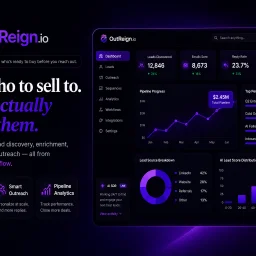
Finding qualified leads remains a significant bottleneck in B2B sales, with teams traditionally drowning in boolean searches and manual research that consumes hours without guarantees of quality prospects. SalesOS tackles this problem by automating the entire discovery process, allowing sales teams to describe their ideal customer profile in natural language and receive ranked, enriched leads within minutes. The platform's core strength lies in its approach to qualification. Rather than overwhelming users with complex filtering options, it leverages AI to score prospects against custom ICPs and surfaces the most likely-to-convert candidates first. The claim of delivering a first lead in under two minutes reflects a genuine efficiency gain for teams accustomed to days-long prospecting cycles. The AI-driven matching reportedly achieves an 85 percent accuracy rate against ideal customer profiles, a measurable validation of its targeting capability. Beyond prospecting, SalesOS extends into the broader sales workflow. Its AI email generation feature personalizes outreach based on prospect profile data, job title, and company information, supporting the 2-4x higher reply rate claim mentioned in the marketing materials. The platform also includes lead scoring automation, smart meeting scheduling, pipeline visibility with forecasting tools, and real-time coaching for objection handling during calls. A workflow builder allows teams to construct automated follow-up sequences without requiring code, reducing friction for non-technical users. The pricing model reflects a credit-based approach layered with subscription tiers. The free plan provides dashboard access with sample data. Paid plans start at thirty-nine dollars monthly for four hundred prospects with email data, scaling to one hundred seventy-nine dollars monthly for three thousand prospects and unlimited sequences. Credits are consumed when revealing contact details—one credit per email, five per phone number—while searching and filtering remain free. This structure creates natural monetization around data access while allowing exploration without friction. The three-times faster prospecting claim, while valuable, would benefit from independent substantiation. For B2B sales teams struggling with traditional lead generation methods and seeking to accelerate their discovery process, SalesOS presents a credible alternative that combines automation with intelligence. The platform's design prioritizes speed and ease of use over customization complexity, making it most relevant for teams prioritizing velocity in lead finding over granular control.