#sales enablement Startups & Tools
Discover the best sales enablement startups, tools, and products on SellWithBoost.

Finding your ideal clients on LinkedIn takes discipline that most founders don't have. In the endless scroll of industry discussions, the vast majority of relevant-looking posts come from competitors, not potential customers. This tool addresses that friction by automating the discovery phase of community engagement, while keeping the actual sales conversation human. Handful identifies posts from people in your target market who are asking for help, then drafts responses in your voice based on your communication style and value proposition. Rather than spending an hour daily hunting through search results, users receive a curated email with a handful of opportunities, each paired with a ready-to-post comment. The tool also suggests a follow-up direct message to open a conversation after someone sees your public comment. Several design decisions reveal the creator's understanding of lead generation at scale. The platform limits users to five posts per day, treating this as a ceiling rather than a quota. This constraint prioritizes signal over volume, ensuring that suggestions reflect genuine relevance rather than padding a list to appear valuable. Comments are never generic templates like "Great insights!" but instead respond specifically to what each person actually wrote. Users dissatisfied with a draft can request rewrites before posting. The engagement model deserves attention. Handful reads public posts and sends emails, but never touches a user's LinkedIn account. Every comment must be pasted manually, which protects against automation rules while ensuring that each outreach reflects intentional choice rather than bot behavior. This approach acknowledges a hard truth: sustainable lead generation requires real judgment, not a fire-and-forget system. Pricing reflects a no-subscription philosophy. Users start free with five dollars of credit, enough to test the tool for several days without entering payment information. Additional credit comes in ten, twenty-five, and fifty dollar packs. Charges only apply when the tool actually runs, and unused paid credit is fully refundable. This model eliminates the pressure to use the service to justify a monthly fee. The gap Handful fills is genuine. Founders and consultants who have successfully built pipelines through thoughtful community engagement see real value in reducing search time. For those skeptical of comment-based lead generation, Handful offers little benefit. The tool assumes you already know your ideal customer profile and that reaching them where they ask questions works for your business.
Financial teams still rely on email to share sensitive documents like pitch decks and term sheets, creating a transparency black hole where senders never know who actually engaged with their materials or what sparked interest. SendNow addresses this gap by layering engagement analytics onto document sharing, letting deal teams see who opened their pitches, which pages captured attention, and how many times prospects returned for another look. The platform serves investment professionals, corporate development teams, and anyone moving capital who needs visibility into document consumption. Rather than wondering whether recipients even opened an attachment, users get live notifications when a document is accessed, detailed page-level engagement metrics showing which sections received focus, and exportable audit logs for compliance records. What distinguishes SendNow is its focus on the complete deal workflow. The product bundles documents into branded deal rooms that sit behind a single link, eliminating the chaos of email chains and scattered attachments. Security is not an afterthought: documents come encrypted end-to-end, with AES-256 encryption at rest, and the platform defaults to controls like watermarking with viewer identification, screenshot blocking, and link expiration. Teams can set access rules, require NDAs before viewing, and lock down document downloads entirely. The analytics layer reveals behavioral signals that raw document delivery cannot. Beyond basic open rates, SendNow tracks which pages received the most time, when viewers returned to specific sections, and whether they completed a full read versus skimmed selectively. These signals matter for deal teams trying to gauge investor interest or identify which aspects of a pitch deck warrant clarification. Integration with notification systems like Slack and CRM tools keeps deal momentum visible without forcing users into a new workflow. The platform handles compliance requirements head-on with GDPR compliance, US data residency, and audit trails that finance and legal teams can export on demand. SendNow operates on a freemium model with paid tiers available, though specific pricing is not detailed in available materials. The platform's core value lies in transforming document sharing from a one-way delivery mechanism into a data source for deal intelligence, giving teams the confidence to follow up at precisely the right moment based on documented engagement patterns rather than instinct.
Sales teams often juggle separate tools to capture leads, nurture prospects, and process invoices, fragmenting workflows and losing momentum. SUMMECA consolidates this scatter by integrating four specialized AI and SaaS applications into a single platform: SiteAgent AI captures website visitors as leads, LeadFollow AI generates and sends follow-up emails, ProposalFlow AI drafts client proposals, and InvoiceFlow handles billing. The platform addresses a genuine operational pain point. Rather than toggling between email, CRM, proposal software, and accounting tools, users manage the entire sales cycle from visitor to paid invoice in one workspace. This consolidation appeals to small business owners and freelancers who need efficiency without complexity. What distinguishes SUMMECA is its approach to AI assistance. LeadFollow AI generates follow-up email drafts based on lead information and workflow notes, but users review and approve each message before sending, preventing the tone-deaf automation that plagues less thoughtful tools. ProposalFlow AI similarly creates proposals from a client brief rather than offering generic templates, suggesting the product understands that context matters in business communication. This human-in-the-loop design builds trust in an AI-powered workflow. The pricing model reflects a direct-to-consumer strategy. SiteAgent AI costs $39 as a lifetime purchase, LeadFollow AI $59, and ProposalFlow AI $19. This one-time-fee approach contrasts sharply with the subscription model dominating SaaS, potentially appealing to cost-conscious solopreneurs wary of recurring charges. It positions SUMMECA as significantly more affordable upfront than traditional solutions like HubSpot or Pipedrive. Product design emphasizes usability. Workspaces shown in marketing materials display clean layouts with clear lead pipelines, invoice summaries, and client lists—nothing appears cluttered or overwhelming. Sample AI-generated follow-ups read naturally, though with the caveat that these are curated examples. SUMMECA's potential weakness lies in scope. Bundling four capabilities risks trying to do too much for teams with immediate, narrow needs, though focused feature sets per tool suggest the founders have resisted bloat. Integration details with existing business tools like email or accounting software remain sparse, which could limit adoption among teams with established tech stacks. For small businesses seeking an integrated alternative to sprawling sales tool suites, SUMMECA offers a coherent, if early-stage, solution centered on moving deals forward with less friction.
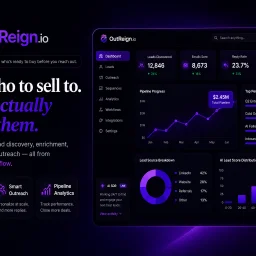
Finding qualified leads remains a significant bottleneck in B2B sales, with teams traditionally drowning in boolean searches and manual research that consumes hours without guarantees of quality prospects. SalesOS tackles this problem by automating the entire discovery process, allowing sales teams to describe their ideal customer profile in natural language and receive ranked, enriched leads within minutes. The platform's core strength lies in its approach to qualification. Rather than overwhelming users with complex filtering options, it leverages AI to score prospects against custom ICPs and surfaces the most likely-to-convert candidates first. The claim of delivering a first lead in under two minutes reflects a genuine efficiency gain for teams accustomed to days-long prospecting cycles. The AI-driven matching reportedly achieves an 85 percent accuracy rate against ideal customer profiles, a measurable validation of its targeting capability. Beyond prospecting, SalesOS extends into the broader sales workflow. Its AI email generation feature personalizes outreach based on prospect profile data, job title, and company information, supporting the 2-4x higher reply rate claim mentioned in the marketing materials. The platform also includes lead scoring automation, smart meeting scheduling, pipeline visibility with forecasting tools, and real-time coaching for objection handling during calls. A workflow builder allows teams to construct automated follow-up sequences without requiring code, reducing friction for non-technical users. The pricing model reflects a credit-based approach layered with subscription tiers. The free plan provides dashboard access with sample data. Paid plans start at thirty-nine dollars monthly for four hundred prospects with email data, scaling to one hundred seventy-nine dollars monthly for three thousand prospects and unlimited sequences. Credits are consumed when revealing contact details—one credit per email, five per phone number—while searching and filtering remain free. This structure creates natural monetization around data access while allowing exploration without friction. The three-times faster prospecting claim, while valuable, would benefit from independent substantiation. For B2B sales teams struggling with traditional lead generation methods and seeking to accelerate their discovery process, SalesOS presents a credible alternative that combines automation with intelligence. The platform's design prioritizes speed and ease of use over customization complexity, making it most relevant for teams prioritizing velocity in lead finding over granular control.