#pcgames Startups & Tools
Discover the best pcgames startups, tools, and products on SellWithBoost.
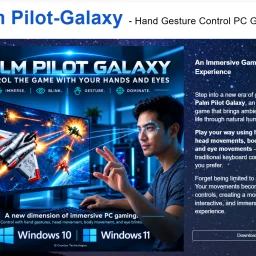
Gesture-based control has remained largely confined to niche applications, but Palm Pilot Galaxy challenges this limitation by bringing natural human movement into mainstream PC gaming. The game transforms hand gestures, head movements, eye tracking, and body positions into direct game inputs, eliminating the intermediary of traditional controllers and keyboards. The product targets players seeking a more embodied gaming experience. Rather than treating input devices as abstractions between intention and action, Palm Pilot Galaxy positions the body as the control mechanism itself. This appeal extends beyond casual users to anyone interested in accessibility, hand-free interaction, or simply a departure from conventional gaming input. The core game itself is straightforward: a space-rescue narrative where players pilot a spacecraft to retrieve crew members from destroyed pods and retrieve a station commander. The gameplay centers on dodging hazards, destroying enemies, and managing object collection under pressure. This familiar arcade-style structure serves as the testing ground for the gesture recognition technology rather than demanding mechanical depth. What distinguishes Palm Pilot Galaxy is the breadth of its control modes. Eight distinct options allow players to isolate hand control, combine eye tracking with head movement, integrate palm gestures with lean sensing, or fall back to traditional keyboard input. This flexibility acknowledges that not all players have access to high-quality camera hardware or the physical capability to perform certain movements reliably. The ability to switch modes mid-game provides crucial accessibility and reduces friction across different player contexts. The customization layer runs deep. Players configure pause detection timeouts, select from multiple connected cameras, and tune spacecraft handling parameters including turn speed, top speed, and braking intensity. These settings address the reality that gesture recognition performance varies significantly across hardware configurations and physical environments. Technical specifications indicate a modest footprint at 235 megabytes for version 1.1.0. The title operates on a freemium model with both free and paid versions available, expanding its addressable market by lowering initial barriers to trial. The global leaderboard provides social motivation through competitive ranking, offering asynchronous competition that suits a game centered on alternative input methods. Real-time multiplayer coordination would introduce technical friction unnecessary for the core experience. Palm Pilot Galaxy occupies an intentional market position: not attempting to redefine the spaceship-piloting genre, but rather demonstrating that gesture recognition can sustain coherent gameplay sessions with meaningful player agency and broad accessibility across different hardware configurations.