#photo analysis Startups & Tools
Discover the best photo analysis startups, tools, and products on SellWithBoost.
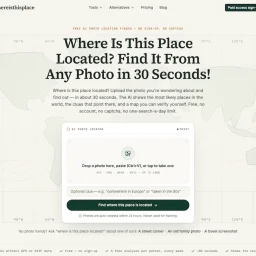
Finding a location from a photo should be straightforward, but current solutions disappoint. Google Lens returns visually similar but geographically wrong results, general chatbots confidently pinpoint places without revealing their reasoning, and once GPS data vanishes, the photo becomes a mystery. Where Is This Place addresses this friction by turning photo location identification into a transparent, verifiable process. The service accepts any image without requiring an account or signup. Users upload a photo, screenshot, or paste directly, and receive ranked candidate locations within approximately 30 seconds. The product's core differentiation lies in its commitment to reasoning transparency. Rather than offering a single confident answer, it displays the top three candidate places alongside the visual evidence that led to each ranking: architectural features, street signs, landscape characteristics, and infrastructure details. Each analysis includes a confidence label that acknowledges the limits of what the image can support, deliberately avoiding false GPS-level precision. The interface separates candidate locations from verified pins, making clear the distinction between the AI identifying a place as a likely match and having definitive evidence for an exact location. This distinction matters for users who need trustworthy answers rather than speculative ones. Users can inspect unedited model outputs, view source photos with their original licenses and documented coordinates, and verify conclusions independently on maps. The product publishes reproducible production runs rather than handwritten demos, with file hashes and independent ground-truth checks retained in reports. The platform extends beyond geolocation into privacy protection. A browser-based EXIF viewer allows users to inspect their own photo metadata before sharing, and a metadata removal tool addresses the flip side of the problem: preventing others from extracting location data from personal photos. On the free tier, users receive five analyses per week without cost. Uploaded photos are deleted within 24 hours and never used for model training. An optional paid tier unlocks deeper evidence such as exact pins and Street View comparisons when the underlying analysis supports that level of precision, though specific pricing is not disclosed. Where Is This Place targets photographers, travelers, researchers, and anyone with photos of unknown origin. The emphasis on explainable results and privacy protection positions it directly against generic AI image analysis tools, appealing to users who want to understand the reasoning behind answers, not just the answers themselves.
Understanding facial features has traditionally been either superficial (makeup tips) or clinical (orthodontic assessment). My Face Blueprint positions itself between these poles, offering structured analysis of facial structure, symmetry, and proportions through an AI analyzer that runs entirely in a user's browser. The problem the tool addresses is twofold. First, many people lack a clear framework for understanding their own facial geometry beyond casual observation. Second, camera distortion creates persistent confusion; a wide-angle selfie makes cheeks appear broader while a longer-distance camera narrows the face. My Face Blueprint attempts to solve both by separating true facial structure from photographic artifacts. The product delivers eight distinct analyses from a single portrait: face shape classification, symmetry testing, golden ratio calculations, canthal tilt measurement, jawline rating, eye shape detection, hunter eyes assessment, and facial width-to-height ratio computation. These feed into a comprehensive Face Blueprint that synthesizes cheekbone width, jawline angle, eye spacing, and facial thirds into a visual map. The tool includes practical guidance on proper camera distance, lighting, and angle to capture more accurate portraits. Privacy receives prominent treatment. Photos never leave the browser, no login is required, and results remain accessible without payment. The product targets photography enthusiasts, people interested in facial structure, and anyone curious about how camera conditions distort their appearance rather than those seeking cosmetic improvement or medical assessment. The business model relies on a one-time $7.99 purchase for premium insights, which expands the free analysis with a downloadable PDF report and high-resolution keepsake card. The credit system (100 credits per purchase, with complete blueprints consuming 10) suggests room for additional premium analyses. Notably, free analysis remains functional and permanently visible, reducing friction for trial and exploration. The tool's positioning avoids cosmetic or self-esteem framing, instead emphasizing technical understanding and practical photography guidance. For those genuinely interested in facial geometry rather than vanity metrics, My Face Blueprint offers structured, accessible analysis without data harvesting or mandatory subscriptions.
Planning to visit a salon without knowing which haircut actually suits your face shape is a gamble most people lose. Face Shape Detector solves this by analyzing your facial structure and recommending styles that work with your actual proportions—then previewing them on your face before you commit. The service targets anyone tired of barber regret: people prepping for dates, job interviews, or simply wanting to avoid another expensive mistake. The core differentiator is its rejection of the reductive "oval face" or "square face" labels that dominate the category. Instead, the tool maps what it calls a face shape blend, quantifying your proportions as a mix (80% Oval, 20% Heart, for example). This approach grounds recommendations in actual facial geometry rather than forcing users into a single category. It pairs this with symmetry analysis to show left-right balance, useful for styling decisions beyond just hair. The tool also generates what it calls a Personal Style Signature—a profile of whether your structure suits clean, textured, sharp, or bold aesthetics. The feature set reflects practical barber-shop needs. Users get nine AI-generated haircut previews rendered directly onto their uploaded photo, split into three categories: professional, date-ready, and everyday. Alongside these previews comes a Barber Script, essentially templated language to describe what you want to your stylist—eliminating the common friction of bad communication across the salon chair. A maintenance guide then explains how to keep the cut in shape between appointments. The company emphasizes privacy, deleting photos immediately after analysis and requiring no signup. The site claims trust from over 10,000 users and promises results in seconds. A Golden Ratio Analysis feature maps proportions against classical aesthetic benchmarks, adding rigor to what could otherwise feel like arbitrary guidance. The product clearly targets a real pain point—haircut indecision driven by not knowing your face structure—and bundles practical tools around that insight. Whether the AI previews and style recommendations are actually accurate in practice requires testing the product itself, which the available content doesn't demonstrate.