Best AI Coding Agents Startups & Tools

Agents that refactor, debug, and integrate with editors/repos/APIs for faster builds across teams.

Recently Listed

3 launches

Sort
Roseram

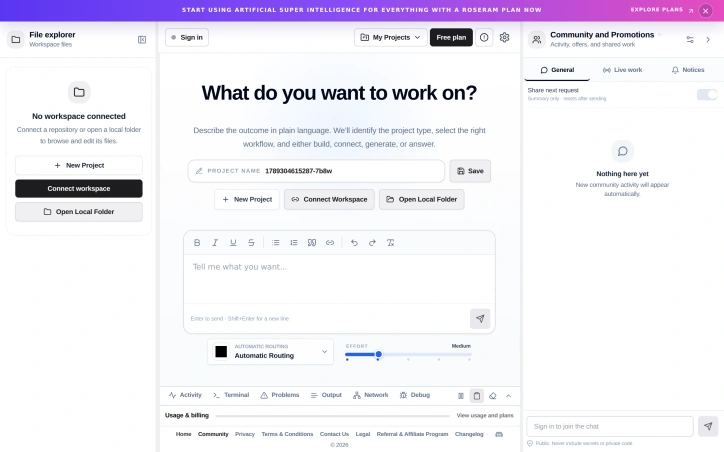
Developers juggling multiple AI assistants to find the right tool for each task now have a unified entry point through Roseram, a platform designed to route development work through the AI model best suited for the job. Rather than forcing users to evaluate the tradeoffs between Claude, ChatGPT, Gemini, and Grok before starting a project, Roseram automatically selects the optimal model based on the task at hand, eliminating the friction of tool selection that has plagued AI-driven development workflows. The platform targets developers and technical teams building applications who want to move faster without getting trapped in decision paralysis or vendor lock-in. By orchestrating multiple foundation models transparently, Roseram positions itself as an abstraction layer that lets developers focus on describing their desired outcome in plain language rather than optimizing for a specific AI system. Several capabilities stand out in the product's execution. The workspace model allows developers to save projects, maintain conversation history, and preserve pending changes locally within the browser, creating continuity across development sessions. The ability to connect external services suggests integration with development tools and infrastructure, while the option to open local folders indicates the platform works alongside existing development environments rather than forcing wholesale adoption of a new system. Usage and billing transparency appears built into the core experience rather than bolted on as an afterthought. The framing around "super intelligence" hints at ambitions beyond simple model routing—the interface emphasizes that developers can describe outcomes in natural language and let the system identify the project type and select workflows automatically. This suggests Roseram is attempting to abstract not just model selection but also the workflow orchestration around different classes of development tasks, whether building, connecting services, generating code, or answering questions. A free tier exists, though the scraped text provides no detail on pricing tiers, per-seat costs, or token usage billing. The platform's business model likely centers on usage-based pricing or premium tier subscriptions, though this remains opaque from the available information. The core insight—that developers shouldn't need to become experts in the relative strengths of four competing AI models to get work done—addresses real friction in current developer experience. Whether the multi-model orchestration delivers measurable improvements in speed or quality over single-model alternatives remains an open question that existing users will need to answer through practice.

Ai-coding-agents
R
Roseram.com

Developers juggling multiple AI assistants to find the right tool for each task now have a unified entry point through Roseram, a platform designed to route development work through the AI model best suited for the job. Rather than forcing users to evaluate the tradeoffs between Claude, ChatGPT, Gemini, and Grok before starting a project, Roseram automatically selects the optimal model based on the task at hand, eliminating the friction of tool selection that has plagued AI-driven development workflows. The platform targets developers and technical teams building applications who want to move faster without getting trapped in decision paralysis or vendor lock-in. By orchestrating multiple foundation models transparently, Roseram positions itself as an abstraction layer that lets developers focus on describing their desired outcome in plain language rather than optimizing for a specific AI system. Several capabilities stand out in the product's execution. The workspace model allows developers to save projects, maintain conversation history, and preserve pending changes locally within the browser, creating continuity across development sessions. The ability to connect external services suggests integration with development tools and infrastructure, while the option to open local folders indicates the platform works alongside existing development environments rather than forcing wholesale adoption of a new system. Usage and billing transparency appears built into the core experience rather than bolted on as an afterthought. The framing around "super intelligence" hints at ambitions beyond simple model routing—the interface emphasizes that developers can describe outcomes in natural language and let the system identify the project type and select workflows automatically. This suggests Roseram is attempting to abstract not just model selection but also the workflow orchestration around different classes of development tasks, whether building, connecting services, generating code, or answering questions. A free tier exists, though the scraped text provides no detail on pricing tiers, per-seat costs, or token usage billing. The platform's business model likely centers on usage-based pricing or premium tier subscriptions, though this remains opaque from the available information. The core insight—that developers shouldn't need to become experts in the relative strengths of four competing AI models to get work done—addresses real friction in current developer experience. Whether the multi-model orchestration delivers measurable improvements in speed or quality over single-model alternatives remains an open question that existing users will need to answer through practice.

Roseram preview

Key features

  • Automatic Model Routing: Intelligently selects between Claude, ChatGPT, Gemini, and Grok based on task requirements.
  • Browser-Based Workspace: Save projects, maintain conversation history, and preserve pending changes locally across sessions.
See full listing
Archlint

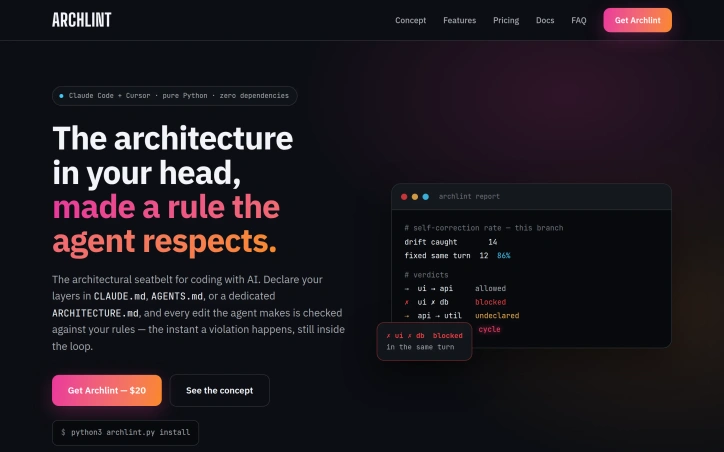
Architectural decay in AI-assisted coding happens fast. As code agents like Claude Code and Cursor generate multiple edits across dozens of tool-calls in a single session, violations of project structure can slip through undetected until they accumulate into technical debt. Archlint addresses this by moving architectural validation from the CI pipeline into the agent's editing loop, catching violations the moment they occur so corrections happen immediately rather than weeks later during code review. The tool works by declaring a project's layer structure and dependency rules upfront—defining which components can import from which others—then validating every edit the agent makes against those rules in real time. It supports six languages: Python, TypeScript and JavaScript, Go, Rust, Java, and C#, with import resolution sophisticated enough to handle real-world complications like tsconfig path aliases, Python src/ layouts, and Go module paths. The system doesn't require an architectural blueprint; teams new to Archlint can run its initialization tool to generate rules from their existing directory structure and import patterns, then refine them in minutes. What distinguishes Archlint is its positioning as a guardrail for AI agents rather than a general architecture linter. The product's own telemetry shows an 86 percent self-correction rate—meaning the agent detects violations and fixes them within the same session 14 times out of roughly 16 when drift is introduced. This metric captures something important: the tool's value isn't primarily about stopping bad code but about catching it early enough that remediation is trivial. The implementation is spare. Archlint is pure Python with no external dependencies, keeping deployment friction low and the attack surface minimal. It integrates with both Claude Code and Cursor, delivering per-edit feedback in Claude Code and end-of-turn summaries in Cursor. For teams adopting it into existing codebases with established architectural violations, the baseline mode allows rules to be adopted gradually—flagging only new drift rather than demanding immediate compliance with historical violations. The product is sold at a flat $20 price, making it accessible to individual developers and teams. For organizations where architectural integrity matters—teams managing microservices, plugin architectures, or domain-driven designs where layer violations compound into significant problems—the cost justifies itself through prevented rework.

Ai-coding-agents
M
Marcelo Kanhan

Architectural decay in AI-assisted coding happens fast. As code agents like Claude Code and Cursor generate multiple edits across dozens of tool-calls in a single session, violations of project structure can slip through undetected until they accumulate into technical debt. Archlint addresses this by moving architectural validation from the CI pipeline into the agent's editing loop, catching violations the moment they occur so corrections happen immediately rather than weeks later during code review. The tool works by declaring a project's layer structure and dependency rules upfront—defining which components can import from which others—then validating every edit the agent makes against those rules in real time. It supports six languages: Python, TypeScript and JavaScript, Go, Rust, Java, and C#, with import resolution sophisticated enough to handle real-world complications like tsconfig path aliases, Python src/ layouts, and Go module paths. The system doesn't require an architectural blueprint; teams new to Archlint can run its initialization tool to generate rules from their existing directory structure and import patterns, then refine them in minutes. What distinguishes Archlint is its positioning as a guardrail for AI agents rather than a general architecture linter. The product's own telemetry shows an 86 percent self-correction rate—meaning the agent detects violations and fixes them within the same session 14 times out of roughly 16 when drift is introduced. This metric captures something important: the tool's value isn't primarily about stopping bad code but about catching it early enough that remediation is trivial. The implementation is spare. Archlint is pure Python with no external dependencies, keeping deployment friction low and the attack surface minimal. It integrates with both Claude Code and Cursor, delivering per-edit feedback in Claude Code and end-of-turn summaries in Cursor. For teams adopting it into existing codebases with established architectural violations, the baseline mode allows rules to be adopted gradually—flagging only new drift rather than demanding immediate compliance with historical violations. The product is sold at a flat $20 price, making it accessible to individual developers and teams. For organizations where architectural integrity matters—teams managing microservices, plugin architectures, or domain-driven designs where layer violations compound into significant problems—the cost justifies itself through prevented rework.

Archlint preview

Key features

  • Real-Time Validation: Catches architectural violations the moment agents make edits, enabling immediate correction within the same session
  • Multi-Language Support: Supports Python, TypeScript, JavaScript, Go, Rust, Java, and C# with sophisticated import resolution
See full listing
Eden Stack

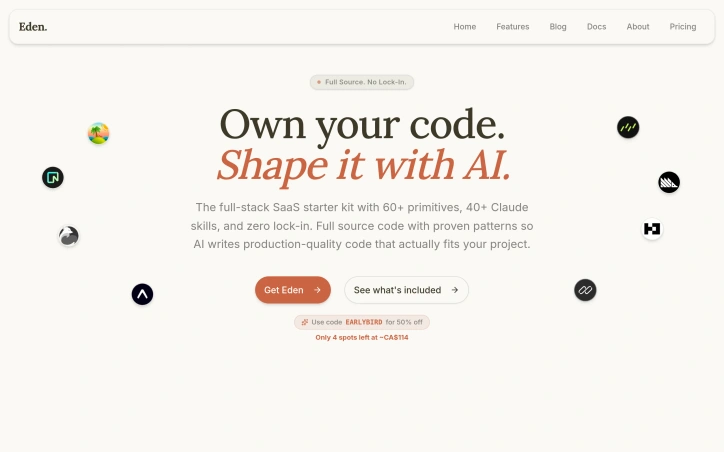
Full-stack development has long required juggling separate codebases, build systems, and deployment targets—one for web, another for mobile, yet another for the backend API. Eden Stack collapses this friction by offering a unified SaaS starter kit designed for teams building multi-platform applications where speed and code consistency matter. The core promise is straightforward: developers get a single codebase that spans web and native mobile frontends, a type-safe API layer, and integrated AI capabilities—all with transparent, auditable source code. The "no lock-in" positioning is deliberate; founders can fork the project entirely, own the infrastructure, and modify anything without vendor dependency. What distinguishes this offering is the depth of integration rather than breadth. The kit ships with over 60 UI primitives and 40 Claude-powered skills, which amounts to pre-built AI agent behaviors that developers can invoke from the chat interface. The demo screenshots show an AI assistant querying databases, triggering email sends via Resend, and scheduling delayed jobs through Inngest—actions chained together with Claude reasoning in the loop. This isn't a generic chatbot wrapper; the architecture treats Claude as a controllable execution layer tied to your application's own backend. The type-safety story runs throughout. Eden uses Elysia for the API layer with a pattern called Eden Treaty to ensure types flow consistently between frontend and backend, reducing the runtime surprises that plague many full-stack projects. Authentication, business logic, and data schemas share definitions across all three tier—web, mobile, and API. The included demo is functional enough to reveal the intended workflow. It showcases onboarding flows, API rate limiting, Stripe webhook handling, email template rendering, and session management—genuine infrastructure concerns rather than trivial examples. These patterns suggest the kit targets founders and small teams shipping real SaaS products, not tutorial projects. Pricing follows a typical early-access model: the EARLYBIRD discount offers 50% off at $99 per license, though the full pricing structure beyond this limited cohort isn't detailed in the available content. The scarcity messaging (14 spots claimed) is standard founder playbook, but the pricing anchor itself is reasonable for a full-stack template with this level of integration. Eden Stack is fundamentally a bet that developers would rather own and customize their SaaS foundation than stay locked into a platform. For teams shipping multi-platform applications and willing to maintain their own deployment, this approach trades platform convenience for sovereignty and flexibility.
Ai-coding-agents
M
Magnus Rødseth

Full-stack development has long required juggling separate codebases, build systems, and deployment targets—one for web, another for mobile, yet another for the backend API. Eden Stack collapses this friction by offering a unified SaaS starter kit designed for teams building multi-platform applications where speed and code consistency matter. The core promise is straightforward: developers get a single codebase that spans web and native mobile frontends, a type-safe API layer, and integrated AI capabilities—all with transparent, auditable source code. The "no lock-in" positioning is deliberate; founders can fork the project entirely, own the infrastructure, and modify anything without vendor dependency. What distinguishes this offering is the depth of integration rather than breadth. The kit ships with over 60 UI primitives and 40 Claude-powered skills, which amounts to pre-built AI agent behaviors that developers can invoke from the chat interface. The demo screenshots show an AI assistant querying databases, triggering email sends via Resend, and scheduling delayed jobs through Inngest—actions chained together with Claude reasoning in the loop. This isn't a generic chatbot wrapper; the architecture treats Claude as a controllable execution layer tied to your application's own backend. The type-safety story runs throughout. Eden uses Elysia for the API layer with a pattern called Eden Treaty to ensure types flow consistently between frontend and backend, reducing the runtime surprises that plague many full-stack projects. Authentication, business logic, and data schemas share definitions across all three tier—web, mobile, and API. The included demo is functional enough to reveal the intended workflow. It showcases onboarding flows, API rate limiting, Stripe webhook handling, email template rendering, and session management—genuine infrastructure concerns rather than trivial examples. These patterns suggest the kit targets founders and small teams shipping real SaaS products, not tutorial projects. Pricing follows a typical early-access model: the EARLYBIRD discount offers 50% off at $99 per license, though the full pricing structure beyond this limited cohort isn't detailed in the available content. The scarcity messaging (14 spots claimed) is standard founder playbook, but the pricing anchor itself is reasonable for a full-stack template with this level of integration. Eden Stack is fundamentally a bet that developers would rather own and customize their SaaS foundation than stay locked into a platform. For teams shipping multi-platform applications and willing to maintain their own deployment, this approach trades platform convenience for sovereignty and flexibility.

Eden Stack preview

Key features

  • Unified Codebase: Single codebase spanning web, mobile, and backend platforms
  • AI Agent Skills: 40 Claude-powered skills for intelligent backend operations
See full listing