Best AI Metrics and Evaluation Startups & Tools

Measure and benchmark AI quality, speed, and reliability across real-world tasks.

Recently Listed

2 launches
Sort
AISA

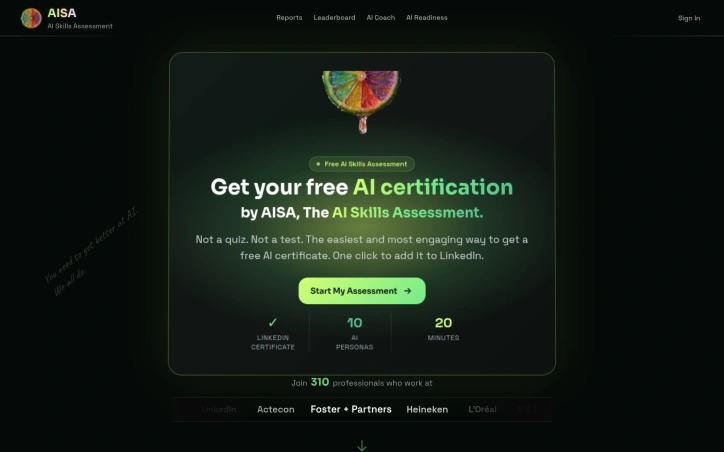
The need for accurate AI skills assessment is growing as companies increasingly integrate AI into their operations. Traditional methods of evaluating AI proficiency, such as multiple-choice quizzes, often fall short because they don't accurately reflect real-world AI usage. AISA addresses this issue by providing a conversational AI literacy test that measures how individuals actually use AI. What stands out about AISA is its interactive approach, engaging users in a twenty-minute conversation with Aisa, an AI interviewer that adapts to the user's role and experience. This conversation is evaluated in real-time by a second AI, which scores the user's strengths, gaps, and growth path across five dimensions. The result is a personalized report, including a persona classification, dimension scores, and a prioritized learning plan, culminating in a certificate that can be added to LinkedIn in one click. AISA's key features include its conversational assessment, a deep report that provides detailed insights into a user's AI skills, and a global AI skills leaderboard that allows users to compare their abilities with others. Additionally, AISA offers personalized AI coaching on WhatsApp, with daily lessons tailored to the user's assessment results. The platform is geared towards individuals looking to demonstrate their AI proficiency and towards teams and hiring managers seeking to assess their workforce's AI readiness. Notably, AISA provides its AI certification online for free, with no requirement for prior courses or training programs. The certification is derived directly from the conversational assessment, making it a unique and efficient way to validate AI skills. While AISA's pricing model for its additional features and services for teams is not explicitly detailed, the core AI certification assessment is free, making it an accessible entry point for individuals and organizations.
Ai-metrics-and-evaluation
O
Ozan Dagdeviren

The need for accurate AI skills assessment is growing as companies increasingly integrate AI into their operations. Traditional methods of evaluating AI proficiency, such as multiple-choice quizzes, often fall short because they don't accurately reflect real-world AI usage. AISA addresses this issue by providing a conversational AI literacy test that measures how individuals actually use AI. What stands out about AISA is its interactive approach, engaging users in a twenty-minute conversation with Aisa, an AI interviewer that adapts to the user's role and experience. This conversation is evaluated in real-time by a second AI, which scores the user's strengths, gaps, and growth path across five dimensions. The result is a personalized report, including a persona classification, dimension scores, and a prioritized learning plan, culminating in a certificate that can be added to LinkedIn in one click. AISA's key features include its conversational assessment, a deep report that provides detailed insights into a user's AI skills, and a global AI skills leaderboard that allows users to compare their abilities with others. Additionally, AISA offers personalized AI coaching on WhatsApp, with daily lessons tailored to the user's assessment results. The platform is geared towards individuals looking to demonstrate their AI proficiency and towards teams and hiring managers seeking to assess their workforce's AI readiness. Notably, AISA provides its AI certification online for free, with no requirement for prior courses or training programs. The certification is derived directly from the conversational assessment, making it a unique and efficient way to validate AI skills. While AISA's pricing model for its additional features and services for teams is not explicitly detailed, the core AI certification assessment is free, making it an accessible entry point for individuals and organizations.

AISA preview

Key features

  • Conversational Assessment: measures AI skills through a conversation with an AI interviewer
  • Deep Report: provides detailed insights into a user's AI skills across five dimensions
See full listing
CanIShip

Indie hackers reinvent QA every Thursday by typing “npm test” and calling it a day, then wonder why no one sticks around after launch. CanIShip extracts that wishful thinking and submits the product to the same nine-point safety regime merchants use when their cargo crosses an international border. You copy your URL, write one sentence about what the app does, and in fifteen minutes get back a thumbs-up or a red stop sign alongside detailed receipts. The service runs its full battery on every pass: functional tests that drive flows with Playwright, axe-core accessibility scans against WCAG 2.1 AA, Lighthouse tight core-web-vitals benchmarks, header audits drawn from OWASP checklists, network link validation, mobile viewport diagnostics at 375 px, plus an extra layer that flags business or regulatory red flags such as illegal products, fake engagement, or platform policy marshes. Nothing to install and no access tokens traded away; the runner just needs the publicly reachable site. Three inspections per month cost exactly zero euros, and after that the published plan shows only paid tiers without surprises. Founders who equate “ship” with “upload” receive instead a short essay explaining why their little rocket is about to explode—or why it is cleared to leave orbit. Ultimately useful only for web front-ends today, yet within that narrow corridor the breadth is unmatched: one submission produces data a full QA team would normally cobble together from five separate tools, spreadsheet gymnastics, and at least one collaborator whose eyes glaze over at pytest. Solo builders shipping AI-generated code will understand exactly what still needs human editing, and they will understand it before the Hacker News headline goes live.

Ai-metrics-and-evaluation
H
Hani Mebar

Indie hackers reinvent QA every Thursday by typing “npm test” and calling it a day, then wonder why no one sticks around after launch. CanIShip extracts that wishful thinking and submits the product to the same nine-point safety regime merchants use when their cargo crosses an international border. You copy your URL, write one sentence about what the app does, and in fifteen minutes get back a thumbs-up or a red stop sign alongside detailed receipts. The service runs its full battery on every pass: functional tests that drive flows with Playwright, axe-core accessibility scans against WCAG 2.1 AA, Lighthouse tight core-web-vitals benchmarks, header audits drawn from OWASP checklists, network link validation, mobile viewport diagnostics at 375 px, plus an extra layer that flags business or regulatory red flags such as illegal products, fake engagement, or platform policy marshes. Nothing to install and no access tokens traded away; the runner just needs the publicly reachable site. Three inspections per month cost exactly zero euros, and after that the published plan shows only paid tiers without surprises. Founders who equate “ship” with “upload” receive instead a short essay explaining why their little rocket is about to explode—or why it is cleared to leave orbit. Ultimately useful only for web front-ends today, yet within that narrow corridor the breadth is unmatched: one submission produces data a full QA team would normally cobble together from five separate tools, spreadsheet gymnastics, and at least one collaborator whose eyes glaze over at pytest. Solo builders shipping AI-generated code will understand exactly what still needs human editing, and they will understand it before the Hacker News headline goes live.

CanIShip preview

Key features

  • Functional Testing: Playwright-driven automation that validates complete user flows
  • Accessibility Audits: WCAG 2.1 AA compliance scanning with axe-core
See full listing