Catalyst Healthspan Audit
Personal trainers typically sell training sessions. This startup reversed the equation by building assessment first, mak...
Launchory
We built Launchory to solve the discoverability problem for startups. Our platform offers instant approval, permanent do...
Best Databases and backend frameworks Startups & Tools
Tools for storing data and powering server logic: databases, API frameworks, and hosting platforms.
Recently Listed
2 launches
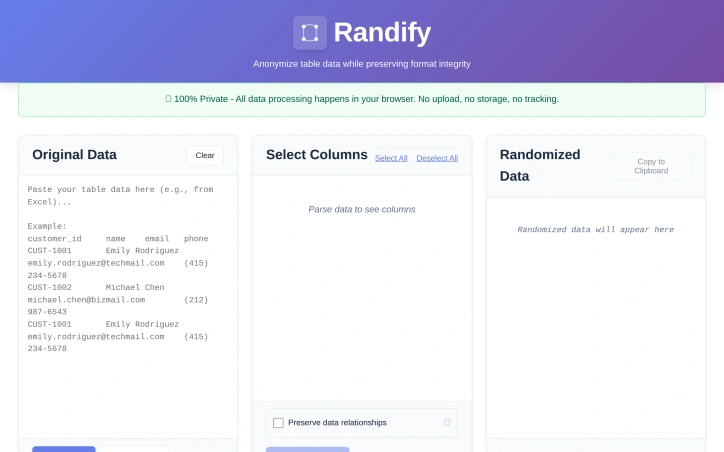
Privacy-conscious organizations managing sensitive data have long faced a troubling choice: anonymize customer or patient information for testing and demonstrations, or upload it to third-party services and accept the compliance and security risks. Randify eliminates that tension by processing all anonymization within the browser, never transmitting anything to external servers. The problem it targets is concrete. Development teams, QA engineers, and data analysts regularly need realistic test datasets without exposing actual customer records. Healthcare organizations must anonymize patient data for testing while maintaining HIPAA compliance. Financial services firms need to randomize customer information for development while staying PCI-compliant. SaaS companies want to demonstrate products with convincing but fabricated data. Randify addresses these scenarios through a single architectural commitment: all data stays local. What distinguishes the tool is its execution of this privacy-first model. It requires no registration and works offline, with zero network requests—users can verify this in their browser's developer console. For organizations subject to data protection regulations, this eliminates an entire class of security and compliance risk. The feature set reflects genuine practical needs. Rather than indiscriminately scrambling content, Randify lets users specify which columns to randomize and which to preserve, maintaining referential integrity so identical input values consistently produce identical outputs. The tool automatically detects PII patterns including email addresses, phone numbers, dates, names, addresses, and company names, applying appropriate formatting rules during randomization so results look realistic rather than obviously synthetic. It accepts data in multiple formats: CSV, TSV, pasted tables from spreadsheets, and SQL INSERT statements. Multi-language support for names and regional data patterns demonstrates attention to genuinely global use cases. The ability to preview changes before applying them reduces mistakes and friction. Randify is free and carries no monetization messaging in available materials, making it an accessible entry point for privacy-conscious teams. For organizations already skeptical of third-party data handling, a purpose-built, client-side-only solution occupies meaningful space in an otherwise server-dependent tooling landscape.

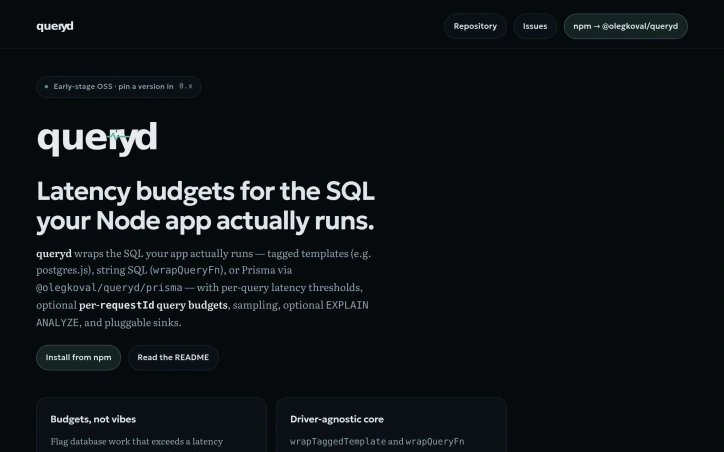
Catching database performance regressions before they reach users requires both visibility into query execution and the discipline to enforce latency budgets. Queryd addresses this gap by instrumenting SQL queries in Node.js applications with measurable performance guardrails. The tool wraps database clients at multiple levels—supporting postgres.js tagged templates, raw query functions, or Prisma—to intercept queries and measure their execution time against configurable thresholds. The product solves a real pain point for teams building latency-sensitive applications. Query performance degrades gradually, and without systematic detection, slow queries often go unnoticed until they cause visible impact. Queryd brings three mechanisms to prevent this: per-query latency thresholds that flag individual slow queries, per-request query budgets that set cumulative limits on database work within a single user request, and sampling controls that keep observability costs minimal in production. What distinguishes queryd is its pragmatic design philosophy. Rather than requiring a complete database abstraction or architectural restructuring, it integrates at the query execution layer across multiple driver APIs. The sampling-first approach acknowledges that continuous monitoring of all queries in high-traffic applications becomes prohibitively expensive; instead, teams can set sampling rates to stay within their observability budget while still surfacing meaningful regressions. Optional EXPLAIN ANALYZE integration allows deeper investigation of offending queries when needed, shifting between cheap signal and expensive detail. The implementation provides useful context awareness through request-scoped budgets—tracking not just individual query times but also cumulative query volume and duration within a single request. This catches a different class of performance issues: endpoints that perform many quick queries instead of fewer optimized ones. The configurable sink architecture suggests thoughtful extensibility, allowing teams to route alerts to their existing monitoring systems rather than forcing a new workflow. As an early-stage open-source project, queryd makes a modest but useful contribution to the Node.js observability ecosystem. It fills a specific niche—SQL query latency monitoring with minimal overhead—without attempting to be a comprehensive database performance platform. Teams already running SQL databases in production and concerned with query regressions will find the tool immediately applicable to their latency budgeting workflow.