Catalyst Healthspan Audit
Personal trainers typically sell training sessions. This startup reversed the equation by building assessment first, mak...
Launchory
We built Launchory to solve the discoverability problem for startups. Our platform offers instant approval, permanent do...
Best Marketing automation platforms Startups & Tools
Automate repetitive marketing tasks across channels.
Recently Listed
6 launches
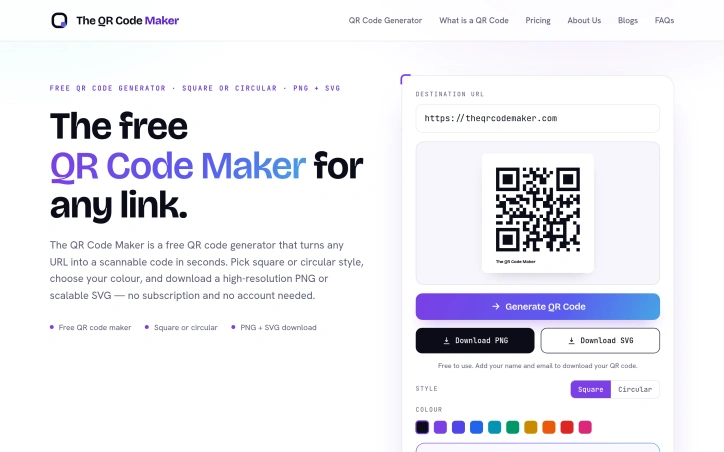
Connecting physical materials to digital destinations has become essential for businesses across sectors, yet the landscape of QR code generators remains cluttered with friction points. Most free tools bury their core functionality behind account requirements, usage restrictions, or subscription walls that undermine their value proposition. The QR Code Maker addresses this directly by offering genuine frictionless generation: enter a URL, receive a scannable code, download it. No mandatory registration, no artificial limits, no paywalls. The product targets a broad constituency. Crypto and blockchain teams use QR codes to share wallet addresses and DApp links. AI product groups point users to demos and research resources. Financial services companies streamline onboarding flows. Educational institutions embed codes in learning materials. Healthcare providers eliminate typing friction from patient intake forms. The underlying principle applies wherever physical materials need to bridge to digital experiences, making the tool relevant to marketers, event organizers, publishers, and any business managing a tangible-to-digital workflow. What distinguishes The QR Code Maker is its philosophical clarity. Rather than treating the free tier as a limited trial for paid features, it delivers complete core functionality without gatekeeping. Users generate unlimited QR codes, choose between square and circular styles, select custom colors, and export in both scalable SVG and high-resolution PNG. The codes encode URLs directly into their pattern at generation time, ensuring they remain functional offline and scan instantly on any modern smartphone. This technical simplicity—no intermediate services, no URL shorteners, no ongoing tracking dependencies—makes codes robust and portable. The product acknowledges market segmentation without letting it compromise the free experience. Pro customization options exist: logo overlays, frames, gradient fills, multiple style variations, and watermark removal. These features appeal to brands with design requirements, but their absence doesn't diminish utility for basic use cases. Print readiness emerges as a practical strength often overlooked by web-first QR generators. The ability to export scalable vector graphics means posters, packaging, and signage maintain crisp codes regardless of size. High-resolution PNG output handles digital deployment. This dual-export approach acknowledges that QR codes serve physical and digital contexts simultaneously. The QR Code Maker succeeds by staying disciplined about scope. It solves a specific, well-defined problem with minimal complexity. For users seeking fast, accountless QR code generation without navigation through sales funnels, it delivers exactly what its name promises.

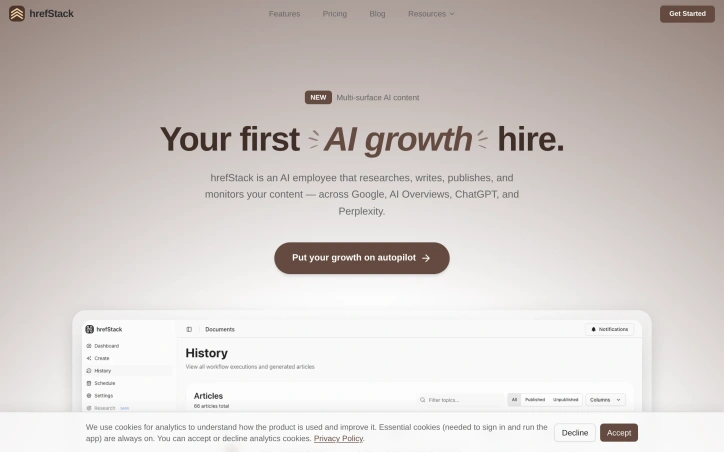
Hi, I'm Arsalan. I come from a data science and analytics background and I build SaaS and mobile apps. Building is the easy part. Distribution is the hard part. What I struggled with before building hrefStack: - No budget for a content marketer - One good article took a full day - AI writers only give you a draft - Publishing to the blog was manual work - No idea which articles actually worked - Traffic stayed flat while I kept building So I built an AI agent to do the whole job. That became hrefStack.

Marketing professionals frustrated by subscription sprawl have encountered a familiar pain point: managing separate services for email automation, content creation, image generation, and code assistance. NexiaTools addresses this friction by packaging over 30 specialized AI applications into a single platform designed specifically for agencies and freelancers scaling their operations. The platform targets users who lack technical expertise, offering pre-built workflows for common business tasks rather than requiring complex prompt engineering. Its feature set covers the marketing and sales workflows that agencies typically rely on: SEO-optimized article generation, proposal writing with dynamic sales structures, LinkedIn and Instagram content creation, and cold email campaign automation. Each tool accepts natural language descriptions and delivers outputs in seconds, positioning the software as a practical alternative to manually orchestrating outputs across separate AI services. The value proposition rests on consolidation economics. Rather than paying for ChatGPT Plus, Claude Pro, dedicated image generators, and copywriting specialists individually—a scenario the company quantifies at approximately 85 dollars monthly—the platform bundles these capabilities at a fraction of that cost. For freelancers and small agencies, this consolidation matters: fewer logins, consistent styling controls, and unified workflows reduce operational friction while lowering recurring software expenses. The product's strength lies in its specificity. Unlike general-purpose AI assistants, NexiaTools packages capability into task-oriented tools. A proposal generator includes templates for pricing structures and timelines; the social media tool maintains brand voice across platforms; the email automation tool focuses on high-open-rate subject lines and persuasive calls to action. This pre-structure removes decision fatigue compared to blank-canvas prompting. The marketing positioning emphasizes ease of use, a meaningful differentiator for non-technical founders who may find Claude or ChatGPT intimidating. The platform doesn't require learning prompt frameworks or API integration. Describing your goal in plain language and selecting the appropriate tool remains the primary workflow. Limitations aren't addressed in available materials—feature depth, output quality compared to standalone tools, and platform reliability remain unknowns. For agencies heavily invested in existing workflows or demanding highly specialized customization, NexiaTools' breadth-over-depth approach may not suit deeper needs. The platform represents a sensible option for teams prioritizing efficiency and cost reduction over maximum capability in any single function.


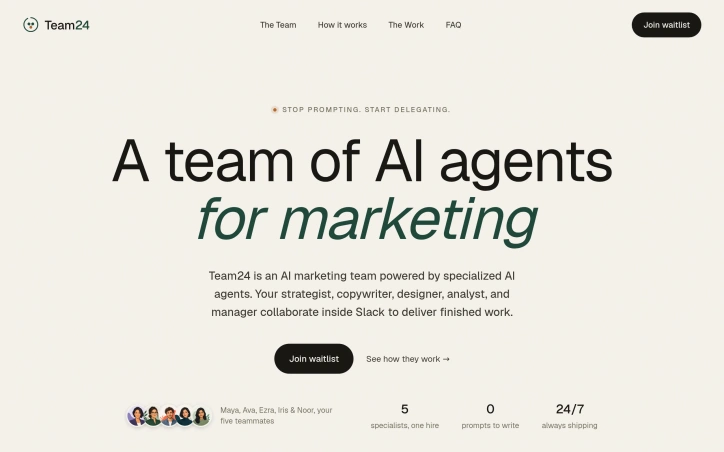
Marketing teams today operate in a state of constant tool sprawl. They switch between ChatGPT for strategy, Claude for copy, Midjourney for visuals, and a dozen analytics dashboards, each requiring separate logins and repeated context. Every transition means re-explaining the brief, starting over with new prompts, and losing the thread of prior conversations. This creates friction that makes it harder for marketing departments to move quickly, even with AI assistance. Team24 attacks this inefficiency by consolidating an entire marketing team into Slack, the communication hub most marketing organizations already inhabit. Rather than routing requests to different tools, users message a shared Slack channel and receive work from five specialized AI agents: a strategist who sets positioning and messaging, a copywriter who produces copy and email sequences, a designer who builds landing pages and ad creatives, an analyst who tracks performance, and a manager who orchestrates the workflow. Each agent has a distinct persona and expertise, and they collaborate with each other to produce integrated deliverables without additional user guidance. The key differentiator is not the individual agents but the internal collaboration between them. A copywriter doesn't write in isolation; the strategist's positioning informs the copy, which then informs the designer's creative direction, which feeds back to the analyst's recommendations. This interdependence mirrors how a real marketing team works, except all conversation and file sharing happens in a single thread with shared context preserved throughout. The product delivers finished work, not suggestions. Users submit a brief like "Launch our Q3 product to mid-market SaaS buyers," and Team24 returns completed landing pages, ad campaigns, positioning decks, and performance reports. This stands in contrast to most AI tools that generate drafts requiring further refinement and assembly. The emphasis on delivery over iteration changes the value proposition: instead of augmenting a marketer's output, Team24 positions itself as a replacement for routine marketing work. The product covers a comprehensive marketing workflow spanning strategy, copywriting, design, paid media, email marketing, and analytics. For bootstrapped startups and small-to-mid-market companies that lack dedicated marketing teams, this consolidation could reduce both tool costs and cognitive load. For larger departments, Team24's value hinges on how well the AI's output meets brand standards and performance expectations. No pricing details are disclosed in available materials, leaving the business model unclear. Whether Team24 charges per request, by subscription, or through other models will significantly affect adoption decisions for budget-constrained teams.
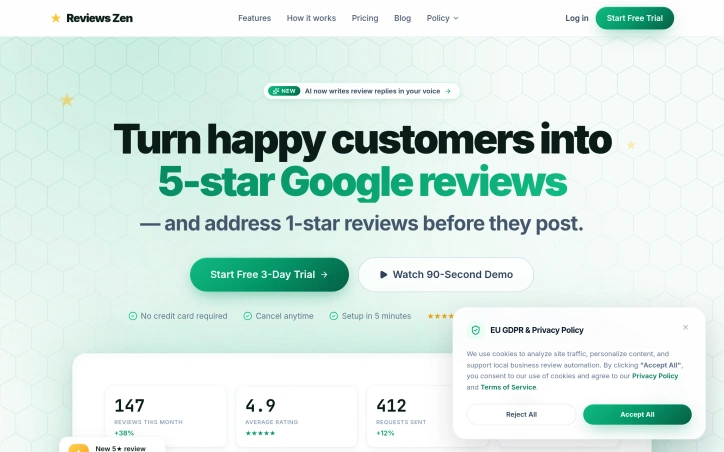
Local businesses struggle to maintain a strong online reputation, often losing customers due to a mismatch between their service quality and online reviews. Reviews Zen is designed to address this issue by automating review management for local businesses across various niches. The platform acts as a reputation autopilot, streamlining the process of generating and managing online reviews. What stands out about Reviews Zen is its use of AI to write review replies in the business owner's voice, significantly reducing the time and effort required to respond to customer feedback. The platform's ability to catch negative reviews privately and respond promptly is particularly valuable, as it helps mitigate the damage caused by unfavorable reviews. The key features of Reviews Zen include its branded email funnels, which send review requests to customers under the business's name and branding, and its negative-review interceptor, which captures low-rated feedback before it appears on Google. The platform also integrates with various business tools, such as Jobber and QuickBooks, to simplify the process of importing customer data and automating review requests. Reviews Zen offers a straightforward pricing model, with a starter plan available for $29 per month for a limited time as part of its founders' launch offer, which normally costs $79. The platform provides a three-day free trial with no credit card required, and customers can cancel their subscription at any time. Overall, Reviews Zen is a compelling solution for local businesses seeking to improve their online reputation and attract more customers through positive reviews.

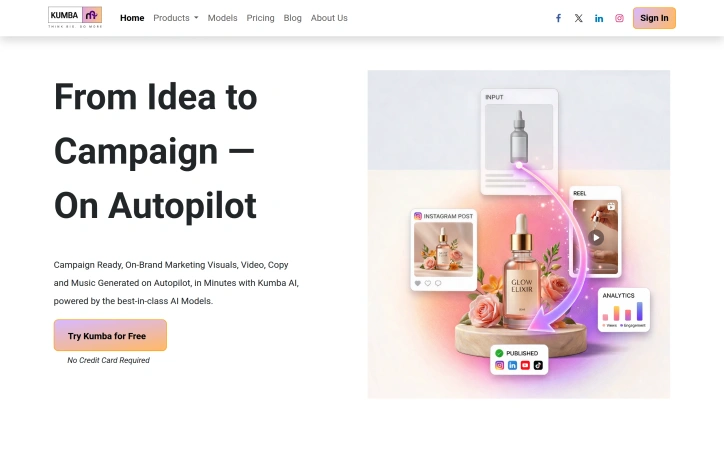
Marketing teams waste thousands of hours juggling design tools, video editors, copywriting platforms, and scheduling software. Kumba consolidates these into a single AI-native workspace that handles the entire content creation pipeline—from initial concept to cross-platform publishing. The platform targets marketing departments stretched thin by rising content demands. Agencies can amplify client output without expanding headcount. Brands managing multiple product lines gain centralized control over creative consistency. Startups with limited resources access enterprise-grade content production. Retail businesses can refresh campaigns at the velocity modern commerce demands. What distinguishes Kumba is its scope. Rather than offering point solutions, it generates visuals, video, copy, and music simultaneously from simple text prompts. The platform operates through three modalities: Power Studios for rapid asset generation, Automated Workflows for structured production of product videos and professional advertisements, and AI Agents that guide users through the ideation-to-publication journey. This breadth eliminates the friction of switching between specialized tools. The publishing layer compounds the efficiency gain. Kumba adapts content for platform-specific requirements—adjusting dimensions, format, and messaging for Instagram, Facebook, LinkedIn, and TikTok. It publishes across all channels from a single action, reducing the manual labor that typically consumes half of a marketer's creative workflow. The platform demonstrates this capability by generating variations of identical product messaging tailored for each platform's audience and medium. The platform serves established users across 1500+ countries and has generated over 100,000 AI assets. Its accessibility—offering a free trial without requiring payment information—lowers the barrier to evaluation. Kumba's positioning hinges on a straightforward value exchange: it promises to compress weeks of cross-functional creative work into minutes while maintaining brand consistency. For organizations that consistently generate content, the leverage is substantial. The claim of delivering 10x output without 10x headcount rests on reducing friction at every stage, from ideation through publication. The platform operates without disclosed pricing tiers in available materials, though the free tier appears calibrated to demonstrate core capabilities. Teams evaluating Kumba will need to assess whether the AI-generated content meets their brand standards and whether the automation genuinely replaces their existing tool stack or supplements it.