Catalyst Healthspan Audit
Personal trainers typically sell training sessions. This startup reversed the equation by building assessment first, mak...
Launchory
We built Launchory to solve the discoverability problem for startups. Our platform offers instant approval, permanent do...
Best Marketing & Sales Startups & Tools
Recently Listed
84 launches
Indie developers and makers often face a friction problem in their career trajectories: each new project operates in isolation, unaware that visitors landing on one creation might be fascinated by others in their portfolio. Make Taksh addresses this discovery gap by embedding a lightweight, customizable badge directly into a creator's websites that surfaces their entire body of work. The core mechanism is straightforward. A developer installs a single line of code on each site they own, and a small badge appears in the corner. Visitors who tap it discover the full catalog of what the creator has built, along with links to their social profiles—all without leaving the page or completing any signup process. When a new project launches, the creator updates their hub once, and every badge across their existing web properties reflects the addition within minutes. What distinguishes Make Taksh from similar portfolio solutions is its architectural lightness and business model. The embedded script weighs just under 8 kilobytes when gzipped, making it negligible overhead for any website. The customization options are substantial: creators can choose from 24 color palettes and 17 animated background presets, or specify their own brand color through hex codes, ensuring the badge feels native to each site's design rather than an afterthought. The analytics layer adds another dimension. The dashboard surfaces concrete metrics: which installed sites are driving traffic, which apps in the portfolio attract the most clicks, and which copy variations resonate with visitors. This transforms the badge from a nice-to-have branding element into a measurable acquisition channel. Creators can discover that an old project quietly accumulates traffic and now becomes a discovery ramp for newer work—patterns that intuition alone might never surface. Equally notable is the pricing structure. Make Taksh operates on a one-time five-dollar purchase model with lifetime access and no expiration, contrasting sharply with the subscription-first defaults of most software-as-a-service products. This aligns the incentives of maker and company: there is no need to continually extract value from the relationship once the initial transaction completes. The product targets a specific but growing segment: builders who have successfully shipped multiple independent projects and want to leverage existing traffic to accelerate discovery of future work. It assumes technical competence sufficient to paste script tags and navigate a dashboard, placing it squarely in the indie developer and bootstrapped founder space.

Research on emerging companies and ventures has historically required piecing together information from scattered sources—financial databases, news articles, LinkedIn, and company websites. StartupWiki consolidates this fragmented landscape into a single research directory designed for investors, competitive analysts, job seekers, and anyone needing comprehensive intelligence on deep-tech startups. The platform serves a clear market need: the difficulty of evaluating startups across emerging sectors like AI, Biotech, CleanTech, FinTech, Cybersecurity, and Quantum Computing. Rather than manually aggregating data from multiple sources, users access centralized profiles that combine multiple dimensions of startup information. This approach acknowledges that startup evaluation requires understanding both quantitative performance and qualitative context—who is founding the company, what similar competitors are raising, and how a venture positions itself in its market. What distinguishes StartupWiki is its multifaceted data integration. Beyond listing basic company information, the directory incorporates funding histories, financial metrics, competitive positioning, and team composition into single profiles. This combines practical research requirements that would otherwise demand manual data gathering across disparate platforms. The community-driven model is worth noting. Rather than relying solely on editorial teams to maintain coverage, the platform invites user contributions and validation. This structure enables faster scaling across startups and sectors compared to traditional databases, though the implications for data quality and verification aren't clarified in the available materials. The directory supports multiple browsing patterns. Users can explore by sector categories, browse a complete alphabetical listing, or engage with narrative analysis through an associated blog focused on startup insights and deep dives. This structure positions StartupWiki not merely as a reference tool but as an analysis platform, offering interpretive content alongside structured data. The platform's categorization across seven major sectors—including AI and Machine Learning, Quantum Computing, and others—reflects the current innovation landscape and investor interest in deep-tech ventures. The inclusion of financial metrics and competitive analysis signals that the product targets sophisticated users conducting formal due diligence rather than casual market browsing. For investors, corporate development teams, and market researchers, the platform addresses a genuine operational challenge in startup research. The combination of structured company data, competitive context, and team information creates a foundation for investment decisions and market positioning that would otherwise require considerable manual research effort across multiple databases and news sources. This consolidation has clear value for professionals who evaluate startups as part of their core work.


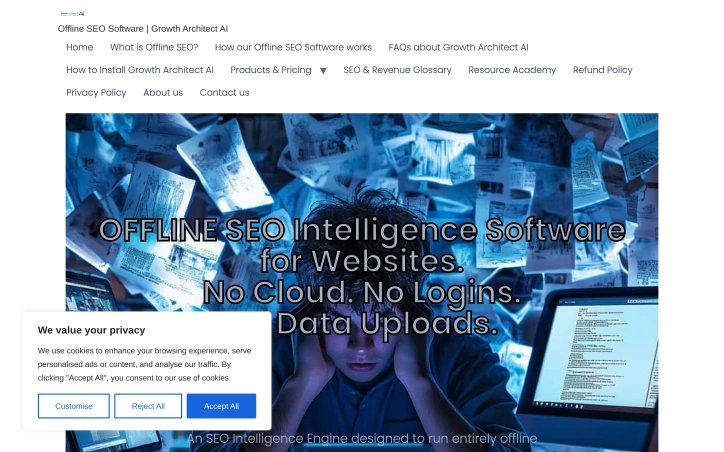
For SEO professionals tired of fragmented workflows and data exposure, this offline analysis platform offers a compelling alternative to the cloud-first tools that dominate the market. The software tackles a real pain point: the need to consolidate insights from Google Analytics, Google Search Console, and Screaming Frog SEO Spider without surrendering data to third-party servers. The core differentiation lies in its commitment to local processing. Rather than uploading client data or proprietary website intelligence to external systems, the platform runs entirely on the user's own computer using Microsoft Excel as its analysis engine. This appeals directly to agencies and consultants managing sensitive client information, as well as individual practitioners concerned about data control and privacy. No cloud infrastructure, no subscription tracking, no ongoing account management needed. The platform delivers structured automation through ten built-in deep-dive analyses that surface specific, actionable problems: pages receiving traffic but generating no revenue, rankings without clicks, missing landing pages, thin content that still indexes, and other blind spots that typically require manual investigation across fragmented tools. The interface prioritizes speed and clarity, diagnosing issues in under a minute without requiring users to build custom dashboards or configure complex workflows. What sets this apart from competitors is both its positioning and its limitations. The offline-first approach appeals to a genuine subset of the market skeptical of cloud dependencies, but it also constrains real-time collaboration and data freshness in ways cloud solutions don't. The software functions as an integration layer rather than a replacement for existing tools, accepting exports from each platform and processing them locally. This workflow requires some manual orchestration compared to API-driven alternatives, but also eliminates dependency on third-party API stability. The licensing model operates on a time-based structure, contrasting with the monthly subscriptions typical of SaaS competitors, though specific costs are not disclosed in available materials. The value proposition centers on privacy, control, and cost predictability rather than feature breadth or collaboration capabilities. The software targets a specific buyer: professionals who already use the standard SEO toolkit and want faster analysis without compromising data handling. It succeeds most clearly where privacy concerns, regulatory requirements, or competitive sensitivity make cloud storage untenable. For teams requiring real-time collaboration or agencies handling large volumes of properties, the offline constraint may feel restrictive. For solitary practitioners or tightly controlled client relationships, it offers a genuine productivity advantage.

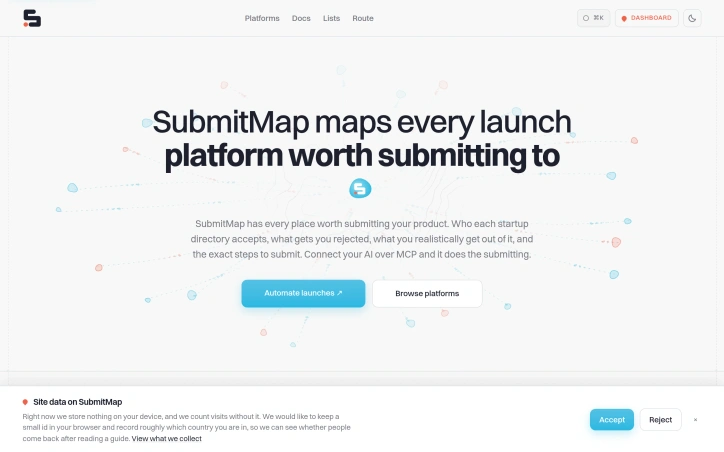
Launching a product means navigating hundreds of startup directories, each with different requirements, approval processes, and link quality. Most founders waste hours on forms that ultimately reject them or provide valueless backlinks. This directory aggregator cuts through that problem by curating verified information on 823 platforms and automating the submission process. The core value lies in its research foundation. Rather than guessing which directories accept their product type, founders get transparent data on acceptance criteria, approval timelines, and link quality metrics like domain rating. The filtering system lets users narrow down by product category (AI tools, SaaS, developer tools, etc.), pricing model, and approval speed. Each directory entry includes specific details: whether the link is nofollow or followed, domain authority, and exactly what the submission form requires. This upfront transparency prevents the wasted effort the founder experienced when filling in elaborate forms only to face rejection. What distinguishes this from a simple directory listing is the MCP integration. By connecting an AI agent to SubmitMap through Model Context Protocol, founders can automate qualification and submission across multiple platforms simultaneously. The agent evaluates which directories match the product profile, plans the submission sequence, and executes forms without manual intervention. For AI-native product teams, this shifts launch logistics from a tedious evening task to a configured workflow. The product selection is notably rigorous. The curated list spans established platforms like Product Hunt and Hacker News alongside niche directories for specific categories. Domain ratings range from 60+ to 97, helping founders distinguish between high-authority directories and smaller specialized boards. Some directories offer free listings (324 platforms), while others operate on freemium or paid models. This variety ensures founders can build a launch strategy suited to their resources and visibility goals. The absence of explicit pricing for SubmitMap itself in the scraped content leaves the business model unclear—it may operate as a free service, a freemium tool, or a paid subscription. Regardless, the value proposition is direct: founders eliminate hours of form-filling research, gain visibility into which directories actually matter, and for those using agents, delegate the entire submission workflow. SubmitMap answers a specific, recurring founder pain point with thoroughness. By combining hand-researched directory data with automation capability, it treats product launches as a solved problem rather than a recurring friction point.

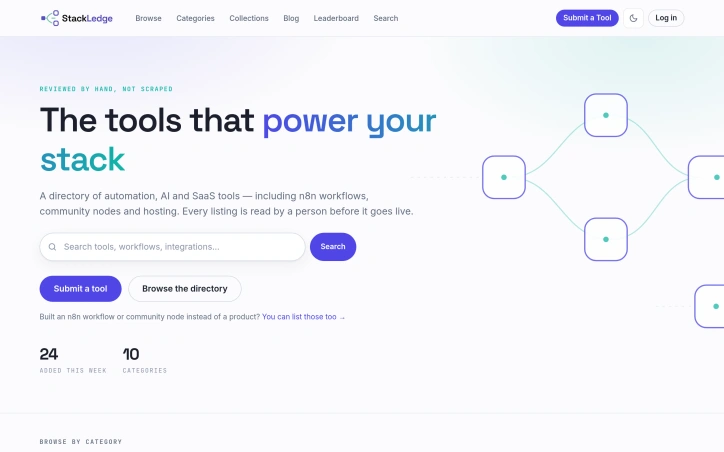
I built StackLedge because most software directories are filled with spam and abandoned projects. I wanted a clean, hand-curated platform dedicated strictly to APIs, developer tools, and AI agents. Every submission is manually reviewed. We do not accept low-effort wrappers or thin content. We also run a badge-trade program to help early-stage founders build their domain authority while growing our community.

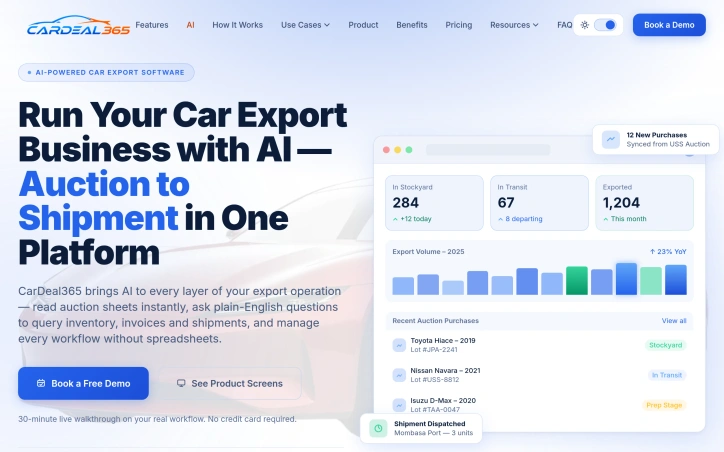
Used car exporters working with Japanese auction houses have traditionally managed operations through a patchwork of spreadsheets, emails, and manual coordination across multiple systems. CarDeal365 consolidates this fragmented workflow into a single platform designed specifically for the operational realities of used car export: managing purchases from competing auction sources, tracking inventory across multiple stockyards, handling export documentation, coordinating with international buyers, and maintaining real-time visibility into margin performance. The platform addresses six distinct pain points that characterize current export operations. Auction purchase records from suppliers like USS, TAA, and IAA arrive scattered across separate communications channels, forcing teams to manually cross-reference data. Vehicle tracking across stockyards happens without centralized visibility, creating blind spots around location and condition. Export documentation remains a manual, error-prone process prone to delays and customs complications. Buyer management is fragmented across WhatsApp, email, and phone without a unified record. Operational decision-making runs on intuition rather than real-time data. And team collaboration suffers from silos when multiple employees work on the same deals without a shared source of truth. What distinguishes CarDeal365 from generic workflow platforms is the integration of AI throughout the operation rather than as an afterthought. The system reads auction sheets automatically, accepts plain-English queries about inventory and shipments, and surfaces document compliance gaps before departure dates arrive. This architectural choice reflects the founder's background running a car export operation and losing margin to organizational chaos. The product consolidates thirteen integrated modules across the entire auction-to-shipment pipeline and promises onboarding within three to seven days. The platform displays live operational metrics: current stockyard inventory, vehicles in transit, and monthly export volumes. It logs auction sources on every purchase and enables filtering by auction house, lot number, or purchase date. Buyer quotations and shipment status share a single record rather than living in scattered messages. Document checklists surface missing fields early rather than at the dock. CarDeal365 positions itself as a solution for export businesses ready to replace manual spreadsheet workflows with real-time operational data and consolidated inventory management. No pricing details are publicly mentioned; the company encourages prospects to book a free demo with no credit card required.

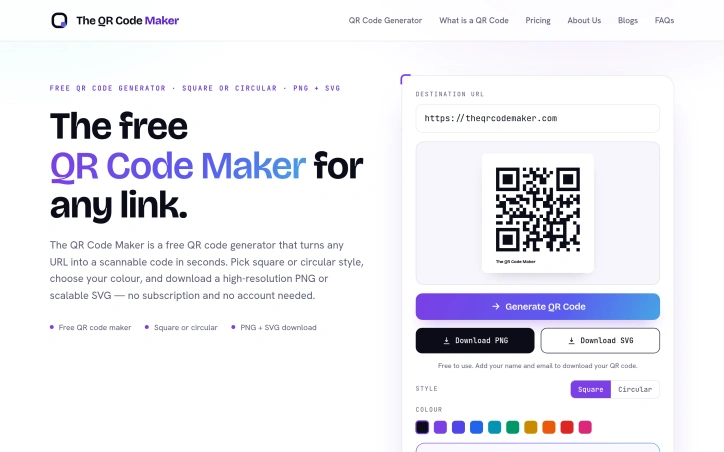
Connecting physical materials to digital destinations has become essential for businesses across sectors, yet the landscape of QR code generators remains cluttered with friction points. Most free tools bury their core functionality behind account requirements, usage restrictions, or subscription walls that undermine their value proposition. The QR Code Maker addresses this directly by offering genuine frictionless generation: enter a URL, receive a scannable code, download it. No mandatory registration, no artificial limits, no paywalls. The product targets a broad constituency. Crypto and blockchain teams use QR codes to share wallet addresses and DApp links. AI product groups point users to demos and research resources. Financial services companies streamline onboarding flows. Educational institutions embed codes in learning materials. Healthcare providers eliminate typing friction from patient intake forms. The underlying principle applies wherever physical materials need to bridge to digital experiences, making the tool relevant to marketers, event organizers, publishers, and any business managing a tangible-to-digital workflow. What distinguishes The QR Code Maker is its philosophical clarity. Rather than treating the free tier as a limited trial for paid features, it delivers complete core functionality without gatekeeping. Users generate unlimited QR codes, choose between square and circular styles, select custom colors, and export in both scalable SVG and high-resolution PNG. The codes encode URLs directly into their pattern at generation time, ensuring they remain functional offline and scan instantly on any modern smartphone. This technical simplicity—no intermediate services, no URL shorteners, no ongoing tracking dependencies—makes codes robust and portable. The product acknowledges market segmentation without letting it compromise the free experience. Pro customization options exist: logo overlays, frames, gradient fills, multiple style variations, and watermark removal. These features appeal to brands with design requirements, but their absence doesn't diminish utility for basic use cases. Print readiness emerges as a practical strength often overlooked by web-first QR generators. The ability to export scalable vector graphics means posters, packaging, and signage maintain crisp codes regardless of size. High-resolution PNG output handles digital deployment. This dual-export approach acknowledges that QR codes serve physical and digital contexts simultaneously. The QR Code Maker succeeds by staying disciplined about scope. It solves a specific, well-defined problem with minimal complexity. For users seeking fast, accountless QR code generation without navigation through sales funnels, it delivers exactly what its name promises.
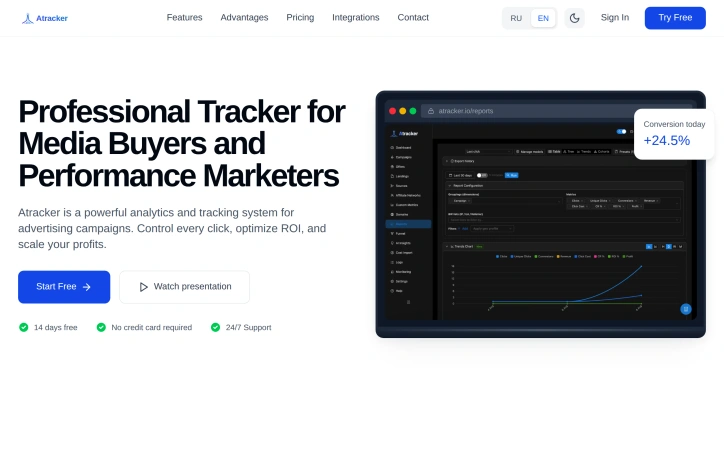
Fragmented data haunts performance marketing teams. Atracker addresses this with a unified analytics and tracking platform designed specifically for media buyers and performance marketers who need granular visibility into their advertising spend. The product tackles a concrete problem: organizations managing paid traffic campaigns often lack a centralized view of campaign performance across channels. Atracker consolidates this data into a single dashboard, offering real-time analytics and unified tracking that lets teams monitor individual clicks and campaign ROI. This centralization enables faster decision-making, allowing teams to identify underperforming campaigns and shut them down before wasting additional budget, while simultaneously scaling strategies that deliver results. What distinguishes Atracker from basic analytics tools is its explicit focus on the media buying workflow. Rather than generic event tracking, the platform emphasizes ROI optimization and campaign control as primary functions. The real-time analytics capability is particularly relevant for performance marketers who operate in high-velocity environments where delayed insights translate directly to wasted spend. The platform includes integrations with other tools in the marketing stack, indicating recognition that media buyers work across multiple platforms and need data to flow seamlessly. The single-dashboard approach reduces the friction of context-switching between systems, a genuine pain point in the industry. Atracker offers an accessible entry point through a 14-day free trial that requires no credit card, lowering the barrier for teams evaluating tools. The inclusion of 24/7 support suggests the company positions itself as a service rather than a self-service tool, acknowledging that performance marketers often operate outside standard business hours and may need immediate assistance. The product explicitly targets performance marketers and media buying teams—a narrow but underserved segment. These organizations typically operate on thin margins where even small optimization improvements compound quickly, making tools that promise ROI control and campaign-level transparency attractive. No explicit pricing details appear in available materials, though the free trial model and support positioning indicate a subscription-based business model likely targeting small to mid-market agencies and in-house marketing teams managing substantial advertising budgets.

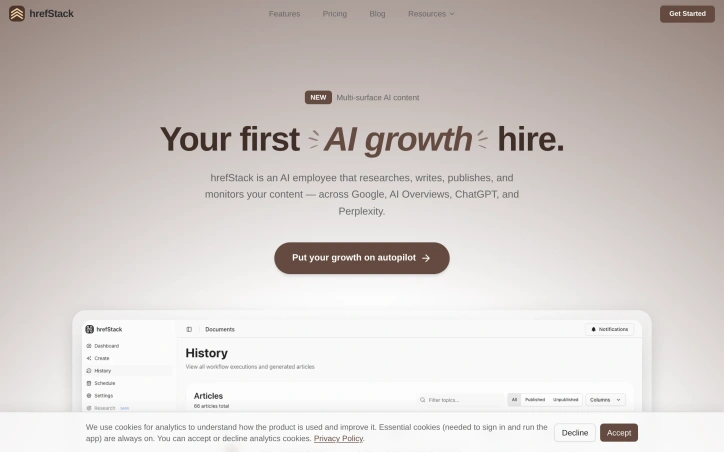
Hi, I'm Arsalan. I come from a data science and analytics background and I build SaaS and mobile apps. Building is the easy part. Distribution is the hard part. What I struggled with before building hrefStack: - No budget for a content marketer - One good article took a full day - AI writers only give you a draft - Publishing to the blog was manual work - No idea which articles actually worked - Traffic stayed flat while I kept building So I built an AI agent to do the whole job. That became hrefStack.

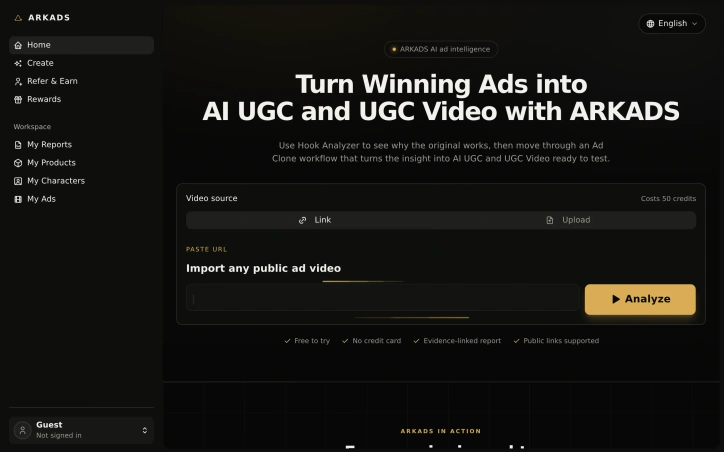
Marketing teams waste countless hours reverse-engineering winning ads, scrubbing through video, taking notes, and manually rebuilding those insights into new creative. ARKADS automates this loop by combining two functions: Hook Analyzer, which dissects what works in existing ads, and Ad Clone, which transforms those findings into finished AI UGC videos ready for testing. The core problem is clear. Ad analysts need to understand why a reference creative performs, then hand those insights to writers and producers who regenerate the concept. That handoff is inefficient and loses context. ARKADS collapses this workflow into a single connected process that keeps research evidence connected to every downstream decision. What distinguishes the product is its commitment to evidence linking. Rather than offering generic recommendations, Hook Analyzer ties each finding to the specific frame or transcript segment that supports it. When Ad Clone builds a brief from the analysis, those insights carry forward as structured inputs—audience, problem, promise, proof, transformation—that can be edited before scripting and rendering. This approach replaces guesswork with cited reasoning. The product targets marketing teams managing paid social campaigns at volume. It accepts ads from TikTok, Instagram, Facebook, or direct video upload. The Hook Analyzer is free to try without a credit card, lowering the friction to experimentation. Video analysis costs 50 credits. The Ad Clone workflow then renders individual hook variations and clips on demand, with per-clip charging and refunds if a take fails, plus free merging for final assembly. This modular pricing model means failed experiments don't carry unnecessary cost. Visual consistency is another practical strength. Rather than managing multiple actors across different UGC takes, Ad Clone carries one actor reference through the entire workflow, solving a common friction point in production. The product sits between research tools and production software. It assumes marketing teams have winning ads to learn from and need a faster path from insight to testable video. For teams running rapid test-and-iterate creative cycles, that speed advantage is meaningful. For teams building one campaign at a time, the ROI may be harder to justify. The main question is execution depth. The website shows illustrative outputs but disclaims them as non-customer results. Real-world performance remains unclear.

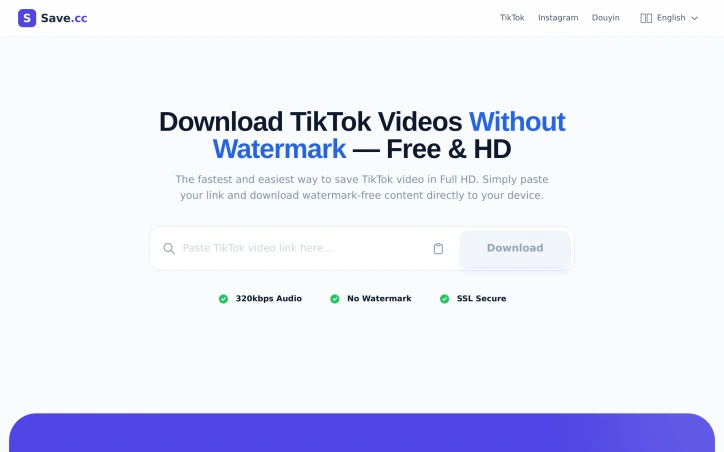
Downloading TikTok videos without watermarks or additional apps remains a common need, whether for content creators backing up their work or casual users saving clips to watch offline. Ssave.cc positions itself as the solution for this problem—a web-based downloader that handles video and audio extraction without the friction most competitors introduce. The service operates with a straightforward value proposition: no ads, no CAPTCHA verification, no app installation, and no storage of user data. Users simply paste a TikTok link into the platform and select their preferred output format—either watermark-free video or MP3 audio. The technical execution appears competent, with the tool extracting videos in HD when available and audio at 320kbps quality, supporting iOS, Android, Windows, and Mac browsers. What distinguishes Ssave from the crowded downloader category is its explicit focus on user experience simplification. The competitor set is often polluted with intrusive ads, mandatory verification screens, and paywall mechanics. Ssave advertises zero of these friction points, presenting itself as a genuinely free service with unlimited downloads and no caps on daily usage. The privacy statement clarifies that no video files or download history are retained on servers, though technical logs like IP addresses are kept for security purposes—a fairly standard posture in this space. The platform works entirely through the browser with no app required, reducing the barrier to accessing it on mobile devices. The three-step workflow (copy link, paste URL, click download) is cleanly communicated, suggesting the product prioritizes accessibility over complexity. From a business model perspective, Ssave operates as a completely free service with no subscription tier or freemium upsell mentioned. This raises implicit questions about monetization and sustainability that sit somewhat outside the scope of the user experience itself. The core value delivered here is straightforward: fast, ad-free TikTok video downloads in high quality. For users fatigued by competitor ad loads and verification screens, this positions itself as the cleaner alternative in a crowded category.

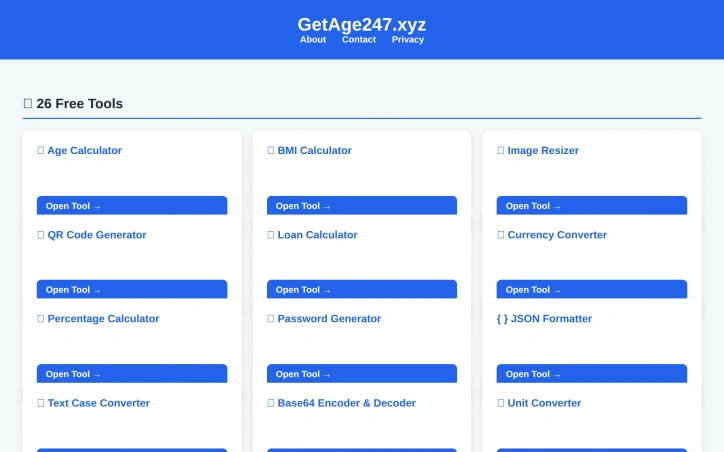
Browser-based utility platforms fill a genuine gap for people who need quick digital solutions without the friction of downloading software or creating accounts. GetAge247 positions itself as a comprehensive collection answering this need, aggregating 26 tools across multiple categories from basic calculations to content generation. The platform targets a broad spectrum: students managing coursework, freelancers handling client work, developers needing SEO utilities, content creators editing media, and casual internet users tackling everyday tasks. This breadth reflects a recognition that utility needs are fragmented but often similar across professions and skill levels. What distinguishes GetAge247 is its categorical organization rather than minimalism. Rather than offering one or two multipurpose tools, it provides focused single-purpose utilities: separate age, BMI, and GPA calculators; dedicated image and document conversion tools; distinct generators for UUIDs, passwords, QR codes, and resume content. This approach trades interface simplicity for comprehensiveness, allowing users to find a tool purpose-built for their specific task. The tool set itself shows practical curation. Technical users get utilities like JSON formatting, Base64 encoding, robots.txt generation, and schema markup creation. Productivity-oriented users access resume builders, invoice generators, and cover letter assistants. Casual users benefit from calculators, converters, and media tools. Image resizing and JPG to PDF conversion address common content creation needs. The inclusion of a YouTube thumbnail downloader suggests attention to creator workflows. All tools operate in the browser without requiring installation or account creation, removing traditional friction points. This accessibility model aligns with the stated positioning around simplicity for non-technical users. The platform's monetization model remains implicit from available information, though the founder describes it as entirely free. The emphasis on adding tools and guides based on user feedback suggests an ongoing service approach rather than a static collection. This positions GetAge247 less as a launched product and more as a continuously maintained utility repository. The core value proposition is straightforward: aggregated, accessible web utilities eliminating the need to hunt across multiple sites or install software. For users who run into diverse digital tasks and prefer centralized, no-friction solutions, the breadth of offerings creates genuine utility, even if individual tools might be duplicated elsewhere online.

Many e-commerce merchants face a costly disconnect: their ad platforms optimize for revenue and ROAS, but profitability tells a different story. After accounting for COGS, fulfillment fees, transaction costs, and VAT, orders that look profitable in Google Ads or Meta often destroy margins. Profit Bid targets this exact pain point, positioning itself as a bridge between online stores and advertising platforms that prioritizes actual profit over vanity metrics. The core innovation is straightforward but powerful. Rather than relying on traditional conversion signals based on revenue, Profit Bid ingests real cost data from e-commerce platforms, calculates true order-level and SKU-level profitability, and feeds margin-adjusted signals back to ad networks. This means Smart Bidding in Google Ads, optimization in Meta, and similar algorithms across TikTok, Microsoft, Pinterest, and Amazon all learn from profit signals instead of revenue. The platform achieves this through a first-party tracking pixel that matches ad clicks to resulting orders and uploads weighted conversion data with profit margins baked in. The product ecosystem is comprehensive. On the store side, Profit Bid integrates with six major platforms: Shopify, WooCommerce, BigCommerce, PrestaShop, Shopware, and OpenCart. Ad platform coverage spans Google Ads, Meta, TikTok, Microsoft Ads, Pinterest, and Amazon, meaning merchants can update their entire media stack with profit data in one integration. The claimed 50ms sync time and 99.99% uptime suggest serious infrastructure investment, though no transparency is offered on how these metrics are calculated or monitored. Feature-wise, the dashboard consolidates the metrics that matter: POAS, margins, ad spend, and net profit after advertising costs. A product labeling system automatically sorts SKUs into winners and losers based on profit contribution, then syncs these tags to ad platforms for cleaner campaign targeting. The addition of Proby, an AI agent, hints at a future where profit optimization becomes increasingly autonomous, though specifics on what this agent actually recommends remain vague. For merchants struggling with unprofitable growth or those managing complex SKU portfolios with varying margins, Profit Bid addresses a real problem that most platforms ignore. The breadth of integrations is noteworthy, as is the commitment to calculating true profitability rather than asking merchants to estimate it. Pricing details are absent from available materials, though the platform offers a free tier to start.


Website optimization has traditionally demanded either expensive agency engagement or significant technical expertise. SEO Rank addresses this friction by delivering comprehensive site analysis through a free platform accessible to marketers, agencies, developers, and business owners of any skill level. The product bundles over twenty automated checks and seventeen tools into a single interface designed for speed. Rather than requiring hours of investigation, users receive instant insights into on-page optimization, content quality, technical SEO health, and mobile usability. The tool evaluates title tags, meta descriptions, heading structure, image alt text, Open Graph and Twitter Card setup, canonical tag usage, internal link quality, schema markup, security protocols, and accessibility compliance among other factors. What distinguishes this platform within the crowded SEO audit space is its integrated Google Search Console connection. This addition directly addresses a critical gap that frustrated early users: audit scores revealed problems, but offered no visibility into whether fixes actually improved performance. By surfacing real metrics like search impressions, clicks, and keyword rankings alongside audit results, the platform enables users to quantify the impact of their optimization efforts and compare performance across time periods. The feature roster also includes practical utilities beyond site auditing. A schema markup generator helps users create properly formatted structured data for articles, products, FAQs, and local business listings. A Google SERP preview tool shows how page titles and meta descriptions render in search results across desktop and mobile. Additional offerings include domain rating assessment, meta tag generation, and keyword density analysis. The roadmap indicates expansion is planned, with XML sitemap validators, robots.txt testing, backlink checking, and AI-powered content optimization flagged as coming features. This signals an ambition to evolve beyond diagnostic tools toward a more complete optimization suite. By eliminating cost barriers and condensing extensive analysis into seconds rather than days, SEO Rank targets a market segment genuinely underserved by premium SEO platforms. For small agencies and independent marketers managing multiple sites, or for business owners seeking baseline performance metrics without professional consultant fees, the product delivers clear utility. The Search Console integration particularly strengthens its position by connecting diagnostic data to real-world search performance, transforming audit scores from abstract recommendations into measurable outcomes.


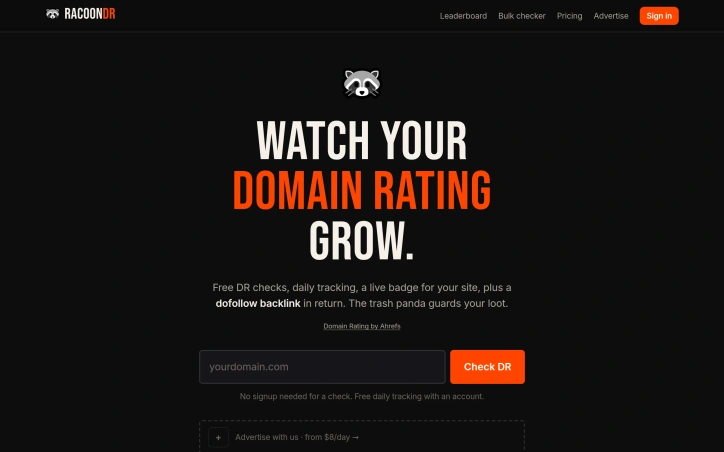
Getting domain rating data has traditionally required either expensive SEO tools or signing up for accounts you might not want. RacoonDR addresses this friction by offering free, instant DR checks without requiring any registration, plus daily tracking once you create an account. The service targets website owners and SEO professionals who want to monitor how their domain rating evolves over time without paying subscription fees or dealing with signup barriers. The product's core appeal lies in its simplicity and the incentive structure built around it. Rather than charging upfront, RacoonDR offers its tracking service free and generates value by placing lightweight SVG badges on participating sites. When a user displays the badge on their website, RacoonDR automatically verifies its placement and converts the link to the site into a dofollow backlink. This creates a mutually beneficial exchange where site owners gain free tracking and a small badge, while RacoonDR builds a network of dofollow links. For users unwilling to display the badge, a Pro tier priced at $5.99 per month provides 15 dofollow links without any badge requirement. The feature set supports the core use case effectively. Users can look up any domain's rating instantly and view historical charts tracking how that rating changes. Each checked domain gets its own public page, and the service displays global rank and domain age alongside the rating. A leaderboard highlights top gainers each month, adding a competitive element. The badge itself is impressively lightweight at under 3 kilobytes, reducing performance impact for sites that choose to display it. By making DR lookup and tracking free and frictionless, RacoonDR democratizes access to domain rating intelligence that competitors often gate behind paywalls. The badge-for-backlink model is clever, turning users into advocates who actively market the tool by hosting its badge. This approach bootstraps both user growth and SEO value simultaneously. For websites with modest domains seeking free tracking or those willing to trade a small badge display for a dofollow link, RacoonDR presents a genuine alternative to paid SEO tools.

Digital marketing teams often operate in silos—web design separate from social strategy, branding disconnected from performance analytics. Joyno Media consolidates these functions by offering integrated services across web design, branding, social media marketing, and SEO. The agency differentiates itself through a stated commitment to combining creative execution with data-driven strategy. Rather than treating digital channels as isolated initiatives, they position social media, web design, and branding as interconnected elements of a customer journey. This integrated approach is sound: brand coherence across touchpoints drives stronger results than fragmented efforts. The service lineup addresses core digital marketing needs. Web development emphasizes responsive design and performance optimization. Social media campaigns are framed as adaptive and personalized to individual customer behavior. Branding services build distinctive visual identities. SEO is included as a component, reflecting the importance of organic visibility. The company reports over a decade of operating history, 200+ client relationships, and 500+ completed projects, along with a claimed 98% success rate. These metrics remain unvalidated—there is no definition of what constitutes success, nor supporting case studies or client testimonials. The agency emerged from recognizing that businesses struggle with the technical and strategic complexity of managing multiple digital channels simultaneously. This positions them as a solution for organizations lacking dedicated in-house expertise but requiring professional-grade presence and marketing execution. A notable gap: the available information contains no pricing details, service packages, contract terms, or engagement models. Prospective clients would need this information to evaluate cost and commitment levels. Joyno Media's core proposition—integrated digital marketing with equal weight on creative quality and measurable results—is sound in theory. Success depends on whether the team possesses sufficient strategic depth, project management discipline, and expertise to execute this across diverse client needs. Assessing actual delivery against positioning requires direct engagement with the agency.

Finding the right discount code for hosting, VPN, or AI tools often means jumping between dozens of vendor websites and hoping the codes actually work. Coupons1 aggregates verified promo codes across these categories, centralizing what would otherwise be a frustrating scavenger hunt into a single searchable directory. The service targets two audiences: cost-conscious developers and businesses looking to reduce infrastructure and software spending, as well as vendors seeking to distribute promotional offers to relevant buyers. The core value proposition centers on verification—each code is tested and confirmed active before listing, directly addressing the common frustration of expired or non-functional coupon codes littering the internet. The platform catalogs over 500 active deals spanning more than 50 providers, ranging from established services like Hostinger and DigitalOcean to specialized offerings like Proxy-Seller and various VPN providers. The breadth is notable: discounts cover hosting infrastructure, privacy tools, data services, and generative AI products, making the service useful across multiple buyer personas. Featured weekly deals highlight specific savings opportunities, with discounts reaching up to 90 percent on certain services. The site displays individual vendor ratings—Hetzner at 4.9 stars, ExpressVPN at 4.8, Hostinger at 4.8—providing quality signals that extend beyond coupon availability alone. A subtle design choice reinforces credibility: codes include usage counts showing how many times each has been redeemed, which serves as implicit social proof that the code works. This transforms the platform from a simple listing into a minimal feedback mechanism. The pricing model remains implicit from the available content. No subscription fees or freemium tiers are mentioned, suggesting a free-to-use model likely supported by affiliate commissions when users click through to vendors. This aligns naturally with incentives: the platform benefits when users successfully complete purchases through its links. The execution is straightforward and functional, avoiding unnecessary complexity. Codes are presented with savings amounts and vendor information without excessive marketing language. For developers and teams managing multiple software subscriptions, Coupons1 offers genuine convenience—consolidated savings without the overhead of independently tracking down working discounts. The platform succeeds by removing friction from a specific but real pain point in software purchasing. Whether verification consistency holds at scale or how the service differentiates as competitors enter the space remains to be seen, but the foundation addresses a legitimate problem.


Many website owners focus on Google rankings without considering how AI systems understand their brand. A growing group of startups and established businesses now face an unfamiliar problem: they rank well in traditional search but remain invisible to ChatGPT, Gemini, Copilot, and Perplexity. These AI-powered search engines rely on different signals than Google, and most businesses have no insight into where their visibility breaks down. This audit service directly addresses that blind spot. Rather than guessing why AI systems overlook a business, founders and business owners can run a comprehensive assessment that measures how AI systems interpret their website. The assessment covers six key dimensions: technical readiness (crawlability, indexing, structured data, metadata), entity clarity (who you are and what you offer), citation signals, content architecture, authority and trust signals, and competitor positioning relative to AI recommendations. The audit produces a measurable AI Visibility Score paired with specific findings rather than vague observations. This appeals to founders who want concrete data instead of assumptions. The underlying framework emphasizes clarity (defining what the business is), answer-driven content (pages structured around buyer questions), authority (building citations and trusted mentions), and technical fundamentals (schema, hierarchy, internal links). The target audience is clear: D2C and ecommerce brands, service consultants, agencies, and small businesses building visibility beyond Google. These segments typically invest in search optimization but lack strategies for AI discovery. The service fills a genuine gap in how businesses think about discoverability, moving beyond a single search engine to a landscape where multiple AI systems drive traffic. What makes this particularly relevant is timing. As AI-powered search gains adoption, early-moving businesses can optimize for these systems before competition intensifies. The audit enables that, providing both a snapshot of current AI visibility and a roadmap for improvement. The founder's positioning reflects a clear conviction: AI visibility should be measurable, not mysterious. In a market where most business owners still treat AI visibility as an afterthought, this service offers a practical entry point for businesses ready to get ahead of the shift.

Social media management at scale has historically required juggling multiple platforms and tools. Groniz addresses this fragmentation by centralizing posting and scheduling across 32+ networks—from X and Instagram to niche platforms like Bluesky, Mastodon, and Farcaster—accessible directly from Claude Code or any MCP client. The core insight driving Groniz is that creators and agencies increasingly rely on AI agents to handle repetitive tasks. Rather than building yet another dashboard, the platform inverts the traditional model: AI agents post natively through MCP and CLI integrations, treating social distribution as a programmable task rather than a human-centric workflow. For solo creators, this means telling Claude Code to cross-post a thread in one command. For agencies managing multiple client accounts, the Codex scripting capability enables batch scheduling across an entire client roster. What distinguishes Groniz is its dual-mode architecture. The same core powers both agent-driven automation and a traditional web console—not as an afterthought, but as a full-featured social suite. The console includes drag-and-drop visual scheduling, AI-assisted caption generation tuned per platform, automatic image and video sizing for each network, and comprehensive analytics. This flexibility matters: creators who prefer clicking can adopt the same connectors their AI teammates use, creating a unified ecosystem rather than forcing teams to pick between automation and human control. The product's AI layer goes beyond scheduling. Captions are formatted platform-specifically (threads for X, carousels for Instagram), and the system handles authentication and network-specific formatting transparently. The analytics consolidate reach, engagement, and growth across networks into shareable reports. For teams, Groniz layers in workspace management, role-based permissions, approval workflows for content review, and "auto actions" that trigger engagement boosts when posts hit engagement milestones. The shared content calendar keeps collaborators synchronized. The platform supports an unusually broad network roster. Beyond the obvious players, Groniz connects to Discord, Telegram, Slack, Reddit, Pinterest, Twitch, dev.to, Nostr, and others—a depth that addresses genuine pain points for communities operating across fragmented spaces. Pricing details remain sparse in available materials, though the platform advertises no credit card required and month-to-month cancellation, suggesting a freemium or paid trial approach. The multiworkspace framing hints at tiered plans scaled to individual creators, agencies, and team use cases.


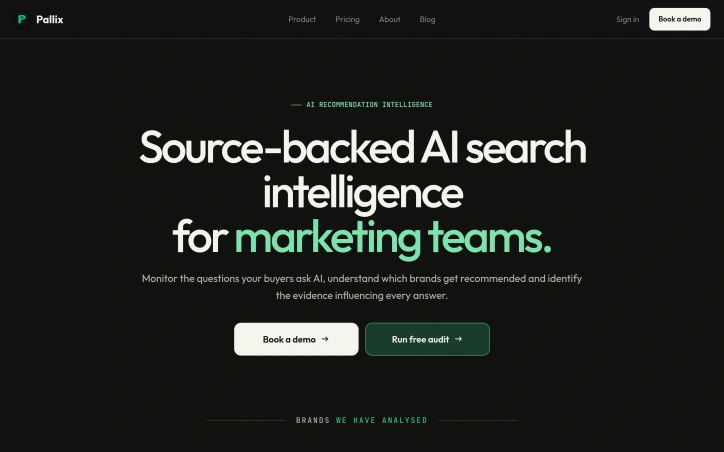
Indian e-commerce and consumer brands operate largely blind to their presence in AI-generated search results, a gap that Pallix addresses head-on. The platform monitors how brands appear across AI engines, maps the sources and communities influencing those recommendations, and surfaces the most impactful fixes to improve visibility and competitive positioning. The core insight driving Pallix's approach is radical transparency. Rather than serving up opaque visibility scores, the platform shows the exact domains, URLs, and communities that shaped each AI recommendation. When MuscleBlaze or Fire-Bolt receives a mention in an AI-generated answer, marketers see precisely where that citation came from, whether it was a Reddit thread, YouTube video, or news article. This source-level granularity transforms abstract metrics into actionable intelligence. The workflow Pallix enforces moves teams from observation to measurement in a structured cycle. After tracking visibility metrics and citation patterns, the platform identifies gaps in sourcing, competitive blind spots, and technical issues blocking AI crawlers. It then ranks these opportunities by predicted impact, effort required, and supporting evidence, converting the evidence layer into a prioritized work queue. The final step closes the loop by measuring whether visibility shifted after fixes were deployed. The platform targets marketing teams, agencies, and brands directly, positioning itself as infrastructure for managing AI search visibility much as SEO tools manage organic search. Brands including Mama Earth, The Whole Truth, and Yoga Bar have used Pallix to analyze their positioning, indicating traction among scaled Indian consumer brands. A free audit is available, and the platform offers a trial, though permanent pricing details remain undisclosed. The emphasis on transparency in both product design and business model—a corrective to the opaque tools already in the market—sets a different tone for the space. For any brand whose buyers ask questions of AI systems, Pallix translates black-box recommendations into visible, addressable problems backed by real sources and measurable outcomes.