Catalyst Healthspan Audit
Personal trainers typically sell training sessions. This startup reversed the equation by building assessment first, mak...
Launchory
We built Launchory to solve the discoverability problem for startups. Our platform offers instant approval, permanent do...
Best Keyword research tools Startups & Tools
Analyze search volume, competition, and related keywords.
Recently Listed
2 launches
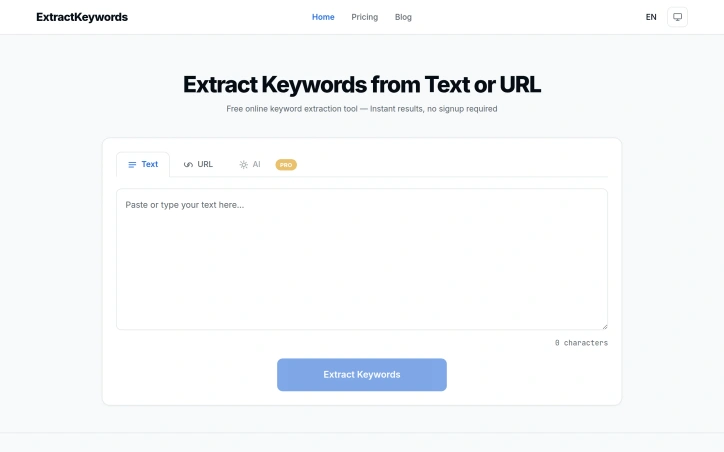
Keyword extraction is a crucial task for businesses and individuals focused on search engine optimization and content analysis, but manually sifting through text to identify key terms can be a tedious and time-consuming process. ExtractKeywords is designed to simplify this task, providing a straightforward solution for extracting keywords from text or URLs. The tool is geared towards individuals and businesses seeking to optimize their content and understand the dominant themes within their text. What stands out about ExtractKeywords is its ability to simplify the keyword extraction process without requiring users to sign up or navigate complex interfaces. The tool is designed to be user-friendly, allowing users to paste their text or enter a URL and receive instant results. The use of artificial intelligence for semantic extraction is also noteworthy, although this feature is reserved for Pro users. The tool's capabilities include word frequency analysis, stop-word filtering, and multi-word phrase detection, providing a comprehensive picture of a text's keyword profile. Users can view results sorted by frequency and density, filter by one-word, two-word, or three-word phrases, and export their findings as a CSV file or copy them to the clipboard. For URL extractions, the tool fetches the publicly accessible HTML of the webpage, respects robots.txt directives, and extracts the main text content before running the same keyword analysis used in text mode. The website does mention a Pro version with AI-powered extraction, indicating a freemium business model, but details on pricing are not provided. Overall, ExtractKeywords offers a valuable resource for those seeking to streamline their keyword extraction process and gain insights into their content.
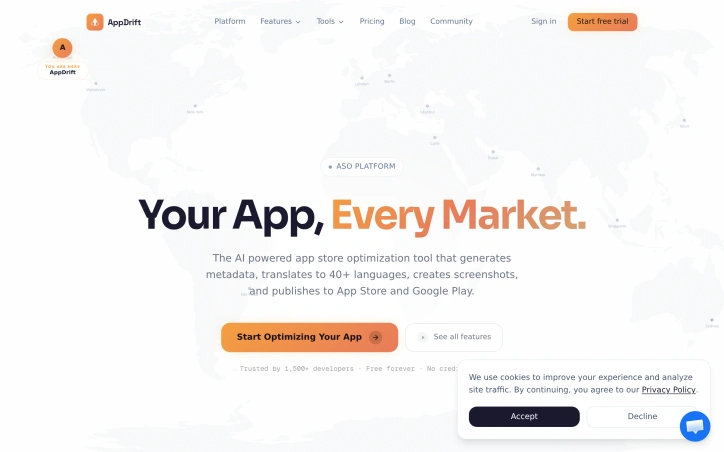
Getting an app into multiple international markets typically requires juggling translators, ASO specialists, and design tools—a workflow that can consume weeks of a small team's time or a solo developer's entire release cycle. AppDrift consolidates these steps into a single platform, automating the metadata generation, translation, and publishing process for iOS and Android simultaneously. The platform generates app store metadata—titles, subtitles, descriptions, and keywords—through AI, delivering results in under a minute with an ASO score audit attached to show optimization gaps. It then handles translation across 40+ languages and manages publication to both the App Store and Google Play in one dashboard. A screenshot generator with 50+ templates and keyword tracking with competitor analysis round out the toolkit. The offering is free to start and supported by 12,400+ connected apps. What distinguishes AppDrift is its compression of typically fragmented workflows into one interface. A solo developer or small team can move from English metadata to a global release in minutes rather than weeks. The company documents clear results: apps using the platform report significant increases in downloads and revenue alongside dramatically reduced time-to-market. These claims are grounded in actual customer usage, not theoretical projections. However, a notable limitation surfaced in real usage. One developer encountered a gap in character limit validation: translations into languages like Japanese and Arabic exceeded the App Store's subtitle field limits, yet the UI approved them with green checkmarks. The issue only emerged through manual verification before publishing. While the platform includes validation tools, running that check automatically after AI translation would catch this class of error upfront—currently, developers must actively invoke a separate checker. The team responded quickly to the feedback, a positive sign, but the gap highlights the risk of automation that still requires human oversight at critical junctures. For indie developers and scaling teams targeting international markets, AppDrift meaningfully reduces the operational friction of global deployment. The speed and one-click publishing justify the platform's foothold in the market. Solo developers or cost-conscious teams should be aware, however, that AI-generated content—especially across languages—still benefits from a human review pass before publication, and the platform's safety nets could be tighter.