uploadthefile.com
Sharing files and publishing static content has long required friction: account creation, platform navigation, or comman...

CrabTap
Small businesses have long struggled to implement loyalty programs without massive overhead. CrabTap addresses this gap...
Catalyst Healthspan Audit
Personal trainers typically sell training sessions. This startup reversed the equation by building assessment first, mak...
Best Lead generation software Startups & Tools
Find and qualify prospects; outreach automation and enrichment.
Recently Listed
6 launches
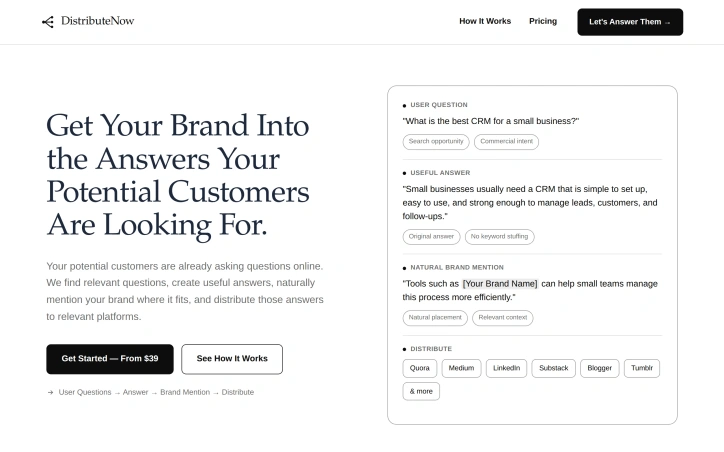
Answering customer questions before they become customers is a well-documented path to brand visibility, but the execution typically involves either hiring content teams or doing the research yourself. DistributeNow automates this workflow by identifying relevant questions potential customers ask online, writing clear answers that incorporate brand mentions naturally, and posting those answers across established platforms like Quora, Medium, and LinkedIn. The core problem DistributeNow targets is straightforward: potential customers are searching for answers, and brands are missing opportunities to appear in those answer spaces. The service works through a four-step process. First, it researches questions across different industries and evaluates which ones align with a client's product or service. Second, it creates substantive answers that directly address the question without resorting to keyword stuffing or forced mentions. Third, it integrates the brand mention only where it logically fits within the answer. Finally, it distributes the completed answer to relevant platforms. The positioning focuses on search intent and natural brand visibility rather than aggressive marketing. The founder describes the insight driving the product: customers are already asking questions; brands simply need to show up as part of the genuine answer. This reflects a real market opportunity, particularly for B2B and e-commerce companies that rely on discovery through search behavior. The platform's approach to question selection appears systematic. The company highlights examples across multiple verticals—SaaS tools facing questions about CRM selection, e-commerce brands addressing shopping criteria, accounting services tackling invoicing, and others—suggesting that the question-identification model works across different industries rather than being limited to a specific niche. Feature-wise, the service bundles research capability with content creation and distribution, addressing the full workflow. The emphasis on natural brand integration distinguishes this from more overtly promotional content syndication services. Rather than placing ads or obvious sponsored content, DistributeNow positions brands as contributors to genuine Q&A spaces. Pricing starts at $39 per month, which is accessible to small and mid-market companies. The tiered approach is not detailed in the available materials, but the entry point suggests the service is designed for businesses without massive marketing budgets. The main uncertainty is execution quality. Writing genuinely useful answers that naturally incorporate brand mentions requires skill, and the difference between helpful guidance and subtle marketing speech is significant. Whether DistributeNow maintains that balance at scale, and whether distribution to platforms like Quora and Medium actually drives meaningful lead volume, would be critical questions for potential customers to investigate independently.
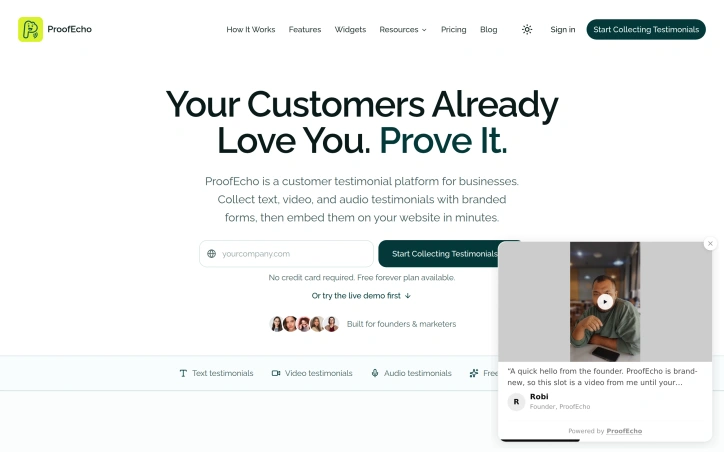
Collecting authentic customer testimonials has long been the bane of modern marketing. Businesses know peer-generated social proof converts better than any brand messaging, yet gathering and displaying testimonials falls perpetually to the bottom of the to-do list. ProofEcho tackles this friction head-on with a stripped-down testimonial platform designed for founders and marketing teams without bandwidth for traditional outreach campaigns. The core problem is real and well-articulated: glowing customer feedback languishes in inboxes and private messages, never reaching decision-making pages where it could drive conversions. ProofEcho addresses this by making the full testimonial lifecycle effortless. Users create a branded collection form in minutes, share it with customers, and receive responses in whatever format feels natural—text, video, or audio. Submissions flow into a central studio for review and curation, where teams can approve entries, organize them by product or use case, and surface patterns through AI analysis. What sets ProofEcho apart is its emphasis on speed and polish. The company claims customers move from first form to embedded widget in under five minutes, backed by pre-built display options including carousels, quote callouts, hero sections, notification toasts, and trust badges. A Wall of Love page template offers an alternative showcase format. All widgets embed with a single code snippet, eliminating technical friction. The founder's approach to authenticity also stands out. Rather than seeding the platform with fake testimonials during early stages—a temptation many new tools succumb to—ProofEcho invites real customers to become the first entries in its social proof library. On pricing, the platform offers a free forever tier with no credit card required, lowering trial barriers. This suggests a freemium model, though paid plan features remain unspecified. The business case is straightforward: convert trust into transactions by making social proof collection and display trivially easy. ProofEcho solves a recognized gap in the typical SaaS marketing stack. For teams drowning in scattered customer praise and lacking operational overhead for formal testimonial programs, it offers a pragmatic shortcut from idea to execution.

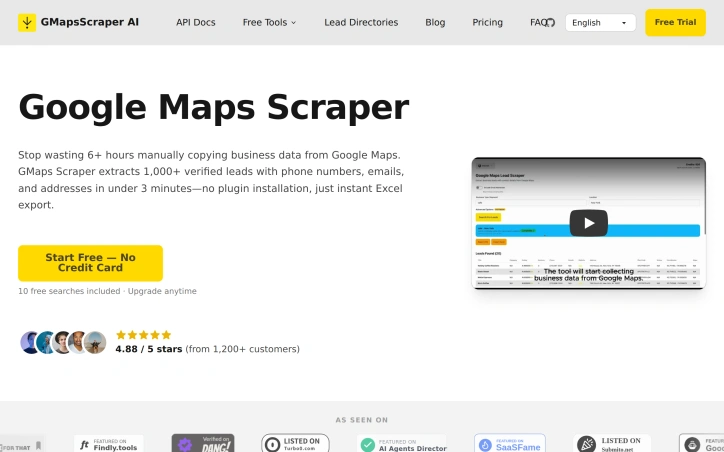
Extracting contact information from Google Maps typically involves opening dozens of business listings, manually copying phone numbers and addresses into spreadsheets, and hoping you don't lose track of which ones you've already documented. Google Maps Scraper directly addresses this friction point, targeting sales professionals, marketing agencies, and business owners who build prospect lists from local search results. The product distinguishes itself through its no-installation approach. Rather than requiring a browser plugin or software download, the tool operates entirely through a web browser, making it accessible from any device. The core appeal is speed: the tool extracts over one thousand leads in under three minutes, including phone numbers, email addresses, business websites, and ratings. For teams that traditionally spend six or more hours on this task, even a fraction of that time saved represents meaningful efficiency gains. The feature set covers the essentials for outreach workflows. Leads export directly to Excel format with minimal formatting required, and the data arrives pre-organized for immediate use in CRM systems or email campaigns. The tool integrates with Google Maps directly through the browser without requiring an API key for the basic web interface, lowering the barrier to entry. Pricing follows a freemium model. New users receive ten free searches without providing a credit card, allowing exploration before commitment. The platform offers multiple access points: the web-based tool, a free browser extension for direct extraction from Google Maps pages, a developer API for programmatic access, and AI agent skills for integration with tools like Claude and ChatGPT. This multi-channel approach accommodates different workflows, from one-off searches to embedded automation. User feedback backs the public rating of 4.88 out of 5 stars across over one thousand customer responses. The company emphasizes the verified nature of extracted phone numbers and the clean formatting of results, suggesting attention to data quality rather than raw volume. The positioning centers on time reclamation: shifting work from manual copying to strategic outreach. For teams struggling with lead research bottlenecks, particularly those operating without dedicated research staff or budget constraints on tools, the free tier serves as a low-friction entry point to evaluate whether the tool reduces their actual workload.

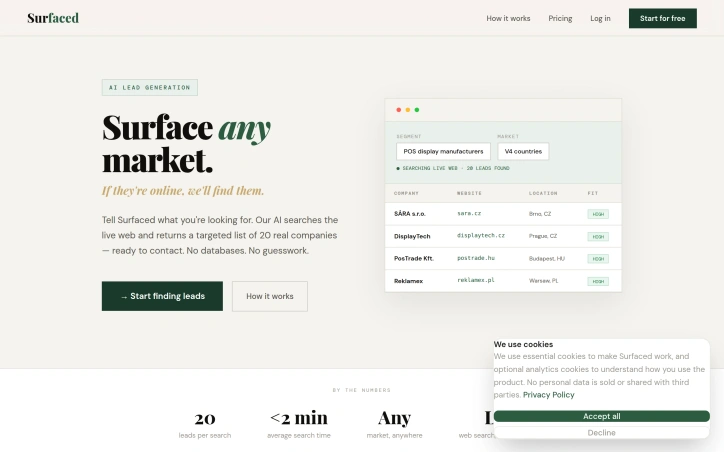
B2B lead generation is a challenging task, especially when relying on outdated databases that often yield stale or irrelevant results. Surfaced tackles this problem head-on by utilizing AI-powered live web searches to deliver targeted, up-to-date leads. This is particularly beneficial for businesses seeking to connect with newer, niche, or regional companies that may not be listed in traditional databases. What sets Surfaced apart is its ability to search the live web in real-time, rather than relying on static databases that can be months out of date. This approach ensures that the leads generated are current and relevant, giving users a significant advantage in their outreach efforts. The AI-driven search process is also refined through a series of clarifying questions, ensuring that the results closely match the user's specific needs. The platform's functionality is streamlined into a three-step process: describing the target market and industry segment, launching an AI-powered search, and receiving a structured list of leads. The resulting list includes essential company information, such as website, contact details, location, and a relevance score, which can be easily exported to a CRM or cold email sequence. Notably, Surfaced's business model includes a fair pricing structure, where unused credits are returned if a search yields no results, and a built-in mail bounce checker to ensure that only valid email addresses are suggested. Overall, Surfaced offers a robust solution for businesses seeking to identify and connect with their target audience in a more efficient and effective manner.
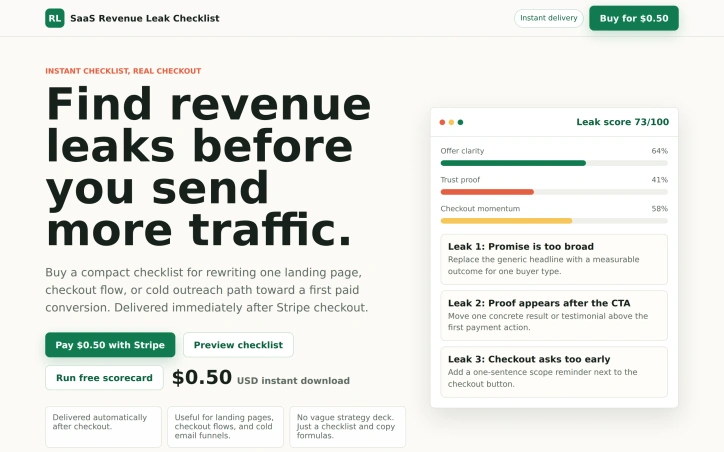
Founders and indie makers often struggle to optimize their conversion funnels, resulting in lost revenue. The Revenue Leak Scorecard is designed to help identify and fix these leaks. It is a conversion triage tool that assesses key areas such as buyer clarity, proof before checkout, and trust friction, providing a score and highlighting missing elements that hinder conversions. What stands out about this product is its straightforward and practical approach. The scorecard is free, and it provides a clear and actionable score that users can copy. For those willing to pay a minimal fee of $0.50, a comprehensive checklist is available, offering a step-by-step guide to rewriting their landing page, checkout flow, or cold outreach path. The product's key features include its ability to evaluate conversion basics, providing a score and identifying areas for improvement. The paid checklist includes copy formulas, trust checks, and paid-trigger prompts, all designed to help users tighten their conversion paths. The checklist is delivered immediately after payment via Stripe, and users can access it without providing any additional information. The pricing model is simple: the scorecard is free, and the detailed checklist costs $0.50. This low-cost upgrade offers significant value, as it provides users with a clear plan to optimize their conversion funnels. Overall, the Revenue Leak Scorecard is a valuable resource for founders and indie makers looking to maximize their revenue by identifying and fixing conversion leaks. Its practical approach, combined with its affordability, makes it an attractive solution for those seeking to improve their online sales and marketing efforts.
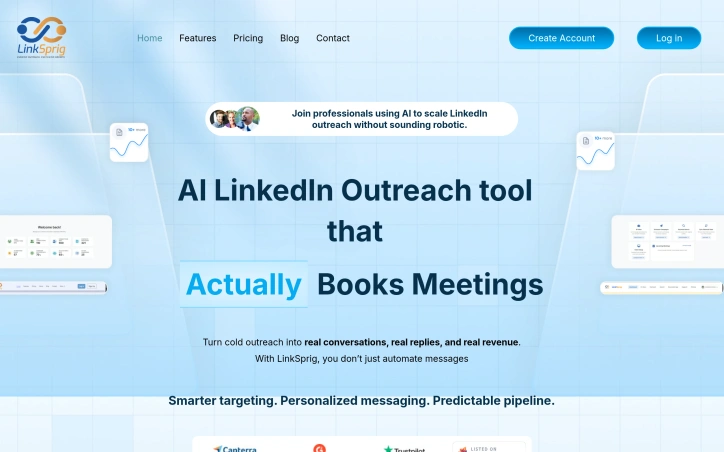
Sales teams and professionals struggling to make meaningful connections on LinkedIn can breathe a sigh of relief with the introduction of AI-powered outreach solutions. LinkSprig is one such innovative tool designed to help businesses, founders, agencies, and sales professionals simplify lead generation and grow their network efficiently. The platform is geared towards individuals tired of spending hours sending cold messages and chasing lukewarm leads, seeking a more streamlined and effective approach to LinkedIn outreach. What sets LinkSprig apart is its focus on results-driven outreach rather than sheer volume. By leveraging AI to analyze industries, roles, and interests, the platform delivers hyper-relevant leads, ensuring that users are targeting the right audience. The AI-powered personalization of messages and auto-reply assistant enable users to scale their outreach efforts without sounding robotic, making interactions feel more human-like and authentic. The platform's capabilities are geared towards making the outreach process more efficient and effective. It offers smart lead targeting, custom AI outreach messages, and an auto-reply assistant that responds to incoming messages naturally. Additionally, LinkSprig's CRM-friendly integration allows users to export leads, track responses, and monitor outreach performance seamlessly. The AI-powered analysis provides valuable insights into what works in outreach efforts, including reply rates, message performance, and conversion insights. LinkSprig is designed for founders, SDRs, and growth professionals, positioning itself as a solution that can help these individuals start real conversations, increase reply rates, and turn cold outreach into pipeline. Although the pricing details are not explicitly mentioned, the platform invites users to try it for free, giving them a chance to experience its capabilities firsthand. Overall, LinkSprig presents a compelling solution for those seeking to transform their LinkedIn outreach into a more natural and efficient business growth process.