Catalyst Healthspan Audit
Personal trainers typically sell training sessions. This startup reversed the equation by building assessment first, mak...
Launchory
We built Launchory to solve the discoverability problem for startups. Our platform offers instant approval, permanent do...
Best AI sales tools Startups & Tools
Find, research, and qualify leads; personalize messages; automate follow-ups.
Recently Listed
4 launchesResearch on emerging companies and ventures has historically required piecing together information from scattered sources—financial databases, news articles, LinkedIn, and company websites. StartupWiki consolidates this fragmented landscape into a single research directory designed for investors, competitive analysts, job seekers, and anyone needing comprehensive intelligence on deep-tech startups. The platform serves a clear market need: the difficulty of evaluating startups across emerging sectors like AI, Biotech, CleanTech, FinTech, Cybersecurity, and Quantum Computing. Rather than manually aggregating data from multiple sources, users access centralized profiles that combine multiple dimensions of startup information. This approach acknowledges that startup evaluation requires understanding both quantitative performance and qualitative context—who is founding the company, what similar competitors are raising, and how a venture positions itself in its market. What distinguishes StartupWiki is its multifaceted data integration. Beyond listing basic company information, the directory incorporates funding histories, financial metrics, competitive positioning, and team composition into single profiles. This combines practical research requirements that would otherwise demand manual data gathering across disparate platforms. The community-driven model is worth noting. Rather than relying solely on editorial teams to maintain coverage, the platform invites user contributions and validation. This structure enables faster scaling across startups and sectors compared to traditional databases, though the implications for data quality and verification aren't clarified in the available materials. The directory supports multiple browsing patterns. Users can explore by sector categories, browse a complete alphabetical listing, or engage with narrative analysis through an associated blog focused on startup insights and deep dives. This structure positions StartupWiki not merely as a reference tool but as an analysis platform, offering interpretive content alongside structured data. The platform's categorization across seven major sectors—including AI and Machine Learning, Quantum Computing, and others—reflects the current innovation landscape and investor interest in deep-tech ventures. The inclusion of financial metrics and competitive analysis signals that the product targets sophisticated users conducting formal due diligence rather than casual market browsing. For investors, corporate development teams, and market researchers, the platform addresses a genuine operational challenge in startup research. The combination of structured company data, competitive context, and team information creates a foundation for investment decisions and market positioning that would otherwise require considerable manual research effort across multiple databases and news sources. This consolidation has clear value for professionals who evaluate startups as part of their core work.


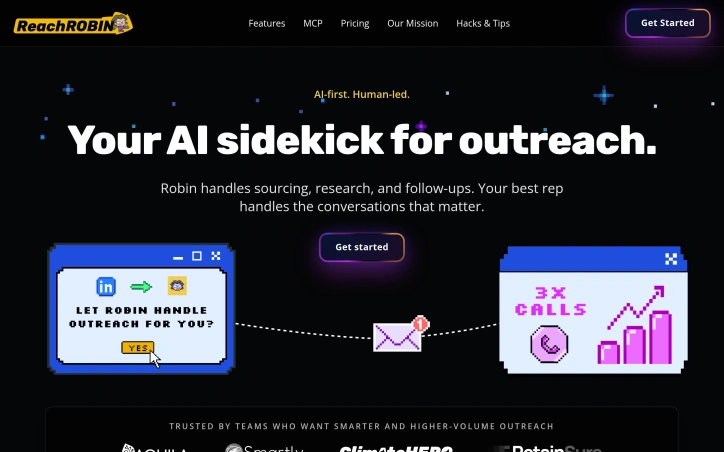
Lean sales teams often struggle with managing high-volume outreach across multiple channels, resulting in manual work, inconsistency, and lost time. Outbound sales efforts are typically fragmented across separate tools, making it challenging to maintain quality and control. ReachRobin's solution addresses this pain point by integrating LinkedIn, email, and WhatsApp outreach into a single workflow. What sets ReachRobin apart is its use of AI-powered personalization to draft messages that incorporate prospect profile data, company signals, and the user's own sales playbook. This enables sales teams to achieve genuine personalization at scale, a crucial aspect of successful outreach. The platform's rate-aware automation ensures that connection requests, messages, and follow-ups are sent in a way that keeps accounts safe, mitigating the risk of being flagged or blocked. The product's key features include automating outreach across multiple channels, tracking conversations, and measuring response rates through built-in analytics. Additionally, CRM sync capabilities allow users to seamlessly move prospects through their pipeline. By streamlining outreach and providing valuable insights, ReachRobin enables sales teams to focus on strategy rather than manual tasks. By bringing multiple outreach channels and AI-assisted personalization together, ReachRobin helps teams execute more effective outbound sales efforts with less manual effort. The platform is designed to maintain quality and control, addressing a critical need for lean sales teams. Unfortunately, the provided information does not detail ReachRobin's pricing or business model, so potential users will need to consult the company's website or sales team for more information on getting started.
Training new call center agents has historically been one of the most painful bottlenecks in customer service operations. Faced with high turnover, lengthy onboarding periods, and real damage to customer satisfaction metrics, supervisors and training managers have long needed a way to prepare agents safely before they ever touch a live call. Call Flow addresses this fundamental gap. The product is built on a founding insight grounded in eight years of hands-on call center experience. The platform creates a simulated environment where agents can practice realistic scenarios with AI-powered counterparts before facing actual customers, moving beyond script-based training alone. This addresses a critical training blind spot: most programs lack any mechanism for agents to safely fail and learn from mistakes. The founder's frustration watching talented people crumble under the pressure of their first difficult call resonates with the core pain point that the product solves. What distinguishes Call Flow is its focus on the psychological and conversational dimensions of call center work, not just product knowledge. The platform evaluates agents across empathy, clarity, objection handling, de-escalation, and compliance—dimensions that are difficult to assess in traditional training programs but critical to customer retention and reputation. This suggests the platform understands that customer service failures often stem from how something is communicated, not just what is communicated. The product also addresses the supervisor's pain in the current system. Rather than spending hours reviewing recordings after calls have already damaged relationships, managers gain visibility into agent readiness before it matters. Custom scenario building means training can be tailored to specific product lines, customer segments, or known pain points rather than relying on generic curricula. This directly bridges the gap between simulation and operational reality. The founding motivation reveals a clear market opportunity: the call center industry continues to operate training methods that lag behind other high-stakes professions. Pilots train in simulators. Surgeons practice on virtual patients. Yet the role that often determines customer lifetime value—the frontline agent—has historically remained immune to this kind of realistic, safe practice environment. Call Flow fills that void by bringing simulation-based training to an industry where the cost of learning on the job has long been accepted as inevitable.

Finding qualified leads remains a significant bottleneck in B2B sales, with teams traditionally drowning in boolean searches and manual research that consumes hours without guarantees of quality prospects. SalesOS tackles this problem by automating the entire discovery process, allowing sales teams to describe their ideal customer profile in natural language and receive ranked, enriched leads within minutes. The platform's core strength lies in its approach to qualification. Rather than overwhelming users with complex filtering options, it leverages AI to score prospects against custom ICPs and surfaces the most likely-to-convert candidates first. The claim of delivering a first lead in under two minutes reflects a genuine efficiency gain for teams accustomed to days-long prospecting cycles. The AI-driven matching reportedly achieves an 85 percent accuracy rate against ideal customer profiles, a measurable validation of its targeting capability. Beyond prospecting, SalesOS extends into the broader sales workflow. Its AI email generation feature personalizes outreach based on prospect profile data, job title, and company information, supporting the 2-4x higher reply rate claim mentioned in the marketing materials. The platform also includes lead scoring automation, smart meeting scheduling, pipeline visibility with forecasting tools, and real-time coaching for objection handling during calls. A workflow builder allows teams to construct automated follow-up sequences without requiring code, reducing friction for non-technical users. The pricing model reflects a credit-based approach layered with subscription tiers. The free plan provides dashboard access with sample data. Paid plans start at thirty-nine dollars monthly for four hundred prospects with email data, scaling to one hundred seventy-nine dollars monthly for three thousand prospects and unlimited sequences. Credits are consumed when revealing contact details—one credit per email, five per phone number—while searching and filtering remain free. This structure creates natural monetization around data access while allowing exploration without friction. The three-times faster prospecting claim, while valuable, would benefit from independent substantiation. For B2B sales teams struggling with traditional lead generation methods and seeking to accelerate their discovery process, SalesOS presents a credible alternative that combines automation with intelligence. The platform's design prioritizes speed and ease of use over customization complexity, making it most relevant for teams prioritizing velocity in lead finding over granular control.