Catalyst Healthspan Audit
Personal trainers typically sell training sessions. This startup reversed the equation by building assessment first, mak...
Launchory
We built Launchory to solve the discoverability problem for startups. Our platform offers instant approval, permanent do...
Best Social media management tools Startups & Tools
Create, schedule, publish, monitor, and analyze social content.
Recently Listed
5 launches
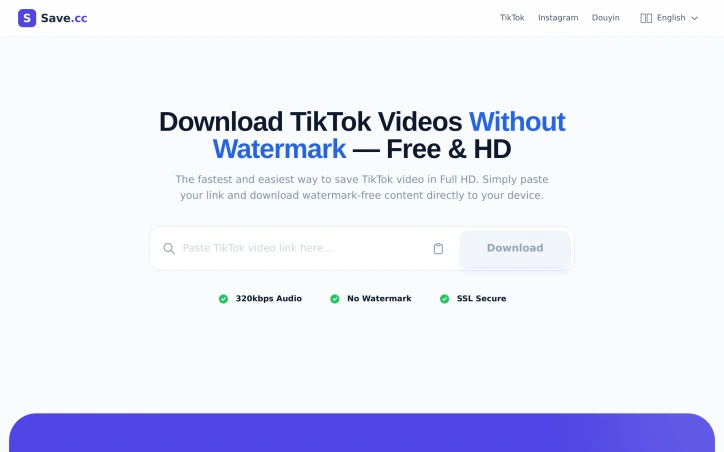
Downloading TikTok videos without watermarks or additional apps remains a common need, whether for content creators backing up their work or casual users saving clips to watch offline. Ssave.cc positions itself as the solution for this problem—a web-based downloader that handles video and audio extraction without the friction most competitors introduce. The service operates with a straightforward value proposition: no ads, no CAPTCHA verification, no app installation, and no storage of user data. Users simply paste a TikTok link into the platform and select their preferred output format—either watermark-free video or MP3 audio. The technical execution appears competent, with the tool extracting videos in HD when available and audio at 320kbps quality, supporting iOS, Android, Windows, and Mac browsers. What distinguishes Ssave from the crowded downloader category is its explicit focus on user experience simplification. The competitor set is often polluted with intrusive ads, mandatory verification screens, and paywall mechanics. Ssave advertises zero of these friction points, presenting itself as a genuinely free service with unlimited downloads and no caps on daily usage. The privacy statement clarifies that no video files or download history are retained on servers, though technical logs like IP addresses are kept for security purposes—a fairly standard posture in this space. The platform works entirely through the browser with no app required, reducing the barrier to accessing it on mobile devices. The three-step workflow (copy link, paste URL, click download) is cleanly communicated, suggesting the product prioritizes accessibility over complexity. From a business model perspective, Ssave operates as a completely free service with no subscription tier or freemium upsell mentioned. This raises implicit questions about monetization and sustainability that sit somewhat outside the scope of the user experience itself. The core value delivered here is straightforward: fast, ad-free TikTok video downloads in high quality. For users fatigued by competitor ad loads and verification screens, this positions itself as the cleaner alternative in a crowded category.

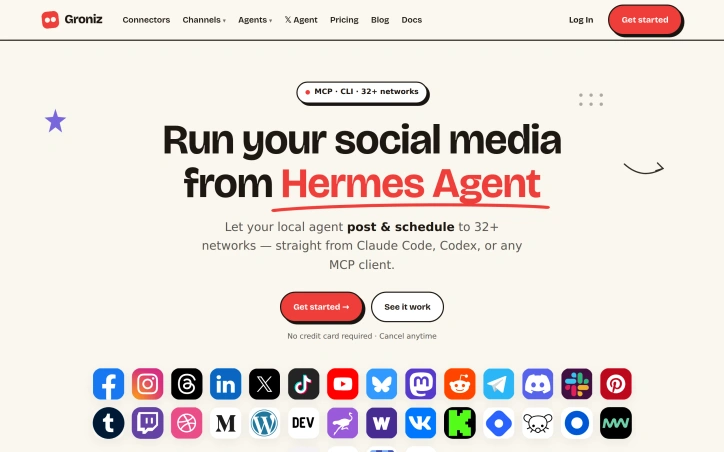
Social media management at scale has historically required juggling multiple platforms and tools. Groniz addresses this fragmentation by centralizing posting and scheduling across 32+ networks—from X and Instagram to niche platforms like Bluesky, Mastodon, and Farcaster—accessible directly from Claude Code or any MCP client. The core insight driving Groniz is that creators and agencies increasingly rely on AI agents to handle repetitive tasks. Rather than building yet another dashboard, the platform inverts the traditional model: AI agents post natively through MCP and CLI integrations, treating social distribution as a programmable task rather than a human-centric workflow. For solo creators, this means telling Claude Code to cross-post a thread in one command. For agencies managing multiple client accounts, the Codex scripting capability enables batch scheduling across an entire client roster. What distinguishes Groniz is its dual-mode architecture. The same core powers both agent-driven automation and a traditional web console—not as an afterthought, but as a full-featured social suite. The console includes drag-and-drop visual scheduling, AI-assisted caption generation tuned per platform, automatic image and video sizing for each network, and comprehensive analytics. This flexibility matters: creators who prefer clicking can adopt the same connectors their AI teammates use, creating a unified ecosystem rather than forcing teams to pick between automation and human control. The product's AI layer goes beyond scheduling. Captions are formatted platform-specifically (threads for X, carousels for Instagram), and the system handles authentication and network-specific formatting transparently. The analytics consolidate reach, engagement, and growth across networks into shareable reports. For teams, Groniz layers in workspace management, role-based permissions, approval workflows for content review, and "auto actions" that trigger engagement boosts when posts hit engagement milestones. The shared content calendar keeps collaborators synchronized. The platform supports an unusually broad network roster. Beyond the obvious players, Groniz connects to Discord, Telegram, Slack, Reddit, Pinterest, Twitch, dev.to, Nostr, and others—a depth that addresses genuine pain points for communities operating across fragmented spaces. Pricing details remain sparse in available materials, though the platform advertises no credit card required and month-to-month cancellation, suggesting a freemium or paid trial approach. The multiworkspace framing hints at tiered plans scaled to individual creators, agencies, and team use cases.
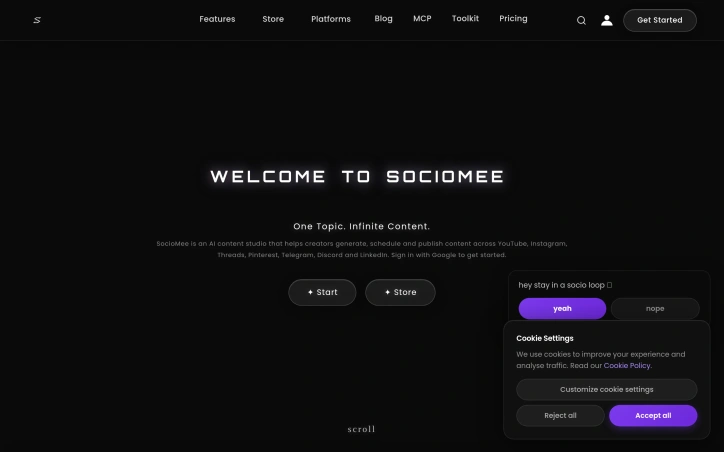
Creators managing multiple social platforms face an exhausting choice: spread attention across YouTube, Instagram, LinkedIn and others, or hire a team to handle distribution. SocioMee AI circumvents this tradeoff by automating content generation and cross-platform publishing for solo operators and small teams who need consistent presence without additional headcount. The core feature addresses the time bottleneck directly. Enter a topic and the system generates platform-specific scripts, captions, hashtags and opening hooks across up to 12 different platforms in 30 seconds. The AI adapts messaging for each platform's unique format and audience conventions rather than recycling generic content. Users get YouTube scripts, Instagram captions, LinkedIn posts and tailored content for Reddit, Threads, Pinterest, Telegram, Discord and others from a single input, powered by Google's Vertex AI. Beyond generation, the platform handles scheduling and direct publishing, eliminating the tedium of manual uploads to each account. Its multi-platform analytics dashboard consolidates performance data from YouTube, Instagram, Pinterest and Threads into one view, sparing users from constant tab-switching across services. An AI-powered viral predictor scores content before publication and identifies which elements need adjustment for maximum engagement. Smaller features reinforce the creator focus. A festival calendar alerts users about trending cultural moments a week in advance. The caption and bio writer generates copy in English, Hindi or Hinglish, acknowledging its likely appeal to South Asian creators. Hashtag and hook generators promise platform-optimized tagging and opening lines. The pricing model removes barriers to entry. A free tier includes 20 credits monthly for AI content generation, letting potential users test the core feature without commitment. Paid plans activate as needs scale, with annual pricing offering a 33 percent discount over monthly billing. With 12 platforms integrated into a single ecosystem, SocioMee positions itself as a genuine operating system for creators managing scattered audiences. Whether the AI consistently produces publication-ready content and how accurately its viral predictions correlate with real performance remain open questions, but the fundamental value is clear: dramatically reducing the time from idea to multi-platform execution.

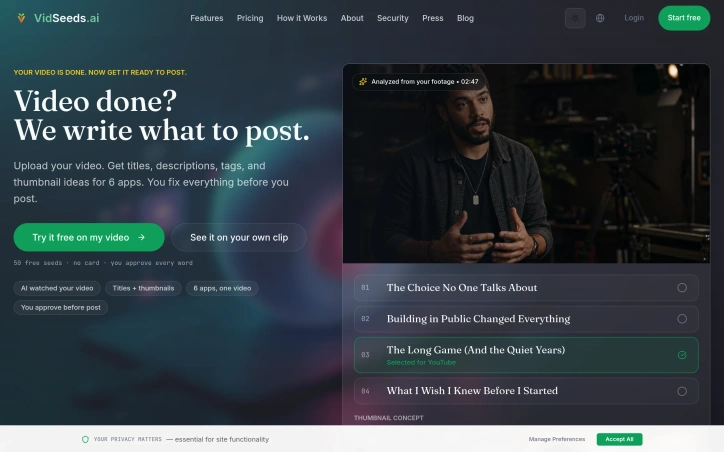
Content creators face a consistent friction point: the moment of upload. With a finished video in hand, they scramble to write titles, descriptions, tags, and thumbnails across multiple platforms—often guessing at keywords before they even hit record, or panicking with generic text that doesn't match what viewers will actually see. VidSeeds.ai tackles this by analyzing finished video footage and generating platform-specific launch copy before posting. The product works as a three-step workflow: upload a completed video, receive AI-drafted titles (five options), thumbnail concepts (three options), descriptions, and tags tailored for six platforms (YouTube, TikTok, Instagram, Facebook, LinkedIn, and X), then edit and approve before anything goes live. The approach differs from keyword-optimization tools by anchoring all suggestions to what the video actually shows—the footage, spoken words, and scenes—rather than pre-guessed terms. This timing matters: creators can refine generated content while their video is still private, before commitment. The product includes some notable constraints designed for transparency. Videos aren't used to train public AI models. The company showcases only real creator examples from those who opted in, explicitly stating it does not use fake proof or inflated view counts. Human judgment remains central; the AI suggests, but creators choose what publishes. The free tier offers 50 "seeds" without requiring a credit card, letting users test the product on their own clips. A paid model exists with a 14-day money-back guarantee, though specific pricing tiers aren't detailed in the public messaging. The product supports 85 languages, expanding its potential addressable market beyond English-speaking creators. What's genuinely distinctive here is the shift in when and how metadata gets decided. Rather than asking creators to predict their audience's search behavior, VidSeeds asks them to approve text drafted from observed reality. For creators managing multiple platforms, the time savings of getting platform-specific versions in one upload could meaningfully reduce friction at a high-stakes moment—right before going live.
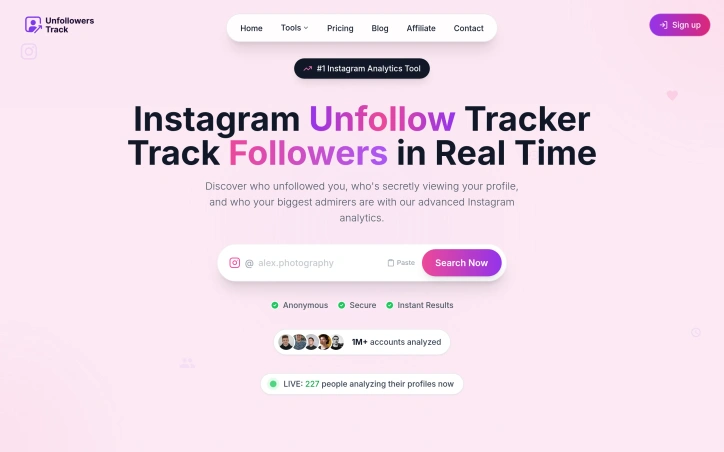
Tracking follower changes on Instagram has become a concern for creators and businesses seeking deeper insight into their audience dynamics. Unfollowers Track addresses this need by providing users with visibility into who has followed and unfollowed them on the platform, converting raw follower data into actionable intelligence about social presence and engagement patterns. The tool is designed primarily for Instagram creators and businesses that want to understand their audience composition beyond vanity metrics. Rather than checking follower counts manually, users can access detailed records of follower changes, helping them identify patterns in audience retention and growth. This appeals to anyone from emerging content creators building their initial audience to established brands monitoring long-term follower trends. What distinguishes Unfollowers Track in a crowded field of social media analytics tools is its focused approach to a specific problem. Rather than attempting to be a comprehensive social media management platform, it concentrates on the unfollow tracking capability that many Instagram users have consistently sought. The simplicity of this focus—understanding exactly who unfollows and when—removes the friction of navigating overly complex dashboards or unnecessary features. The core functionality centers on providing complete visibility into follower movements. Users gain insights into who follows and unfollows, which directly supports efforts to maintain meaningful connections with their audience. For creators concerned with audience retention, this information is valuable for adjusting content strategy or identifying moments when audience sentiment may have shifted. For businesses, it offers a window into how marketing efforts are affecting follower loyalty. The product positions itself as a solution for understanding social growth and engagement patterns, metrics that matter increasingly to Instagram users monetizing their presence or building influence. By isolating the unfollow tracker as its primary offering, the tool sidesteps the complexity of platforms offering integrated direct messaging, scheduling, or analytics across multiple social networks. The straightforward value proposition—seeing who unfollows you—taps into a genuine frustration many Instagram users experience. While Instagram itself provides follower notifications in some cases, a dedicated tracking tool offers more systematic monitoring and historical records, transforming ephemeral platform notifications into persistent, reviewable data.