Catalyst Healthspan Audit
Personal trainers typically sell training sessions. This startup reversed the equation by building assessment first, mak...
Launchory
We built Launchory to solve the discoverability problem for startups. Our platform offers instant approval, permanent do...
Best Meditation apps Startups & Tools
Mindfulness tools: guided sessions, soundscapes, journaling, coaching.
Recently Listed
2 launches
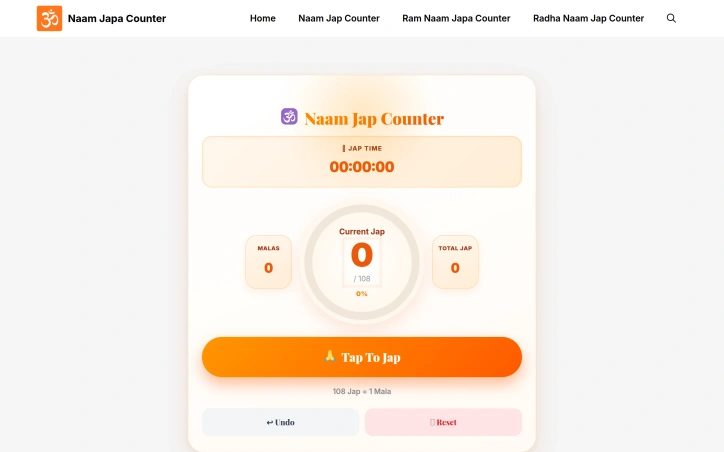
For devotees of Hindu, Vaishnav, and Krishna bhakti traditions, maintaining a consistent mantra chanting practice can be challenging due to the manual effort required to keep track of repetitions. The traditional mala beads, while beautiful and meaningful, have limitations, such as being easily misplaced or worn out, and not providing a record of progress over time. The online Naam Japa Counter addresses these challenges by providing a simple, distraction-free digital tool that allows users to track their mantra chanting and mala rounds with ease. What stands out about this product is its thoughtful design, which prioritizes the user's spiritual practice by removing the mental burden of tracking numbers. The counter is designed to be intuitive and accessible, working seamlessly on mobile, tablet, and desktop devices, and saving user progress automatically. Its features are centered around the traditional 108-count mala, providing a sense of continuity with established spiritual practices. The counter also encourages consistency by displaying daily totals and history, helping users notice their progress and stay motivated. By creating a free online counter, the founder has made a valuable resource available to devotees, enabling them to focus on their spiritual practice without the hassle of manual counting. The fact that it is free forever, with no login required, makes it an attractive solution for those seeking a straightforward and uncomplicated tool to support their mantra chanting. The absence of any pricing or login requirements suggests that the counter is genuinely intended as a service to the spiritual community, rather than a commercial venture. Overall, the Naam Japa Counter is a well-designed tool that effectively supports the spiritual practices of its users, and is a valuable resource for those seeking to deepen their devotion.

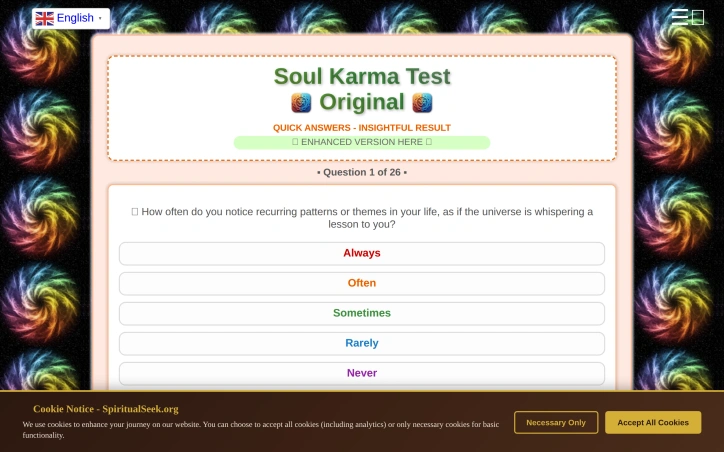
For those drawn to spiritual exploration but uncertain where to start, Soul Karma Test offers a structured entry point into understanding one's karmic patterns and life lessons. The platform addresses a genuine gap: while interest in karma and Eastern philosophy runs deep in Western culture, accessible tools for personal exploration remain scarce. The product targets spiritually curious individuals seeking actionable insight into how their behaviors, intentions, and choices shape their life trajectory. The foundation here is substance. Rather than reducing karma to vague platitudes, the platform grounds itself in actual philosophical tradition—tracing the concept from Sanskrit roots through Vedic ritual practices, the Upanishads' evolution toward moral causation, and the Buddha's refinement emphasizing intention as the core element of karmic action. This educational backbone distinguishes it from purely entertainment-focused personality quizzes. The accompanying article walks users through karma's intellectual history, establishing credibility and context before they engage with personalized assessment. The quiz itself takes the form of a multi-question test that generates a "Soul's Karmic Profile" based on responses. This structure allows users to move beyond abstract philosophy and receive tailored interpretation of their spiritual patterns. The ability to save results and restart the test suggests the platform anticipates repeat engagement and deeper exploration across sessions. A downloadable article extends value beyond the quiz alone, positioning the tool as educational rather than merely transactional. The mention of an "enhanced version" indicates a freemium model, though specifics around pricing, features, or upgrade paths remain undisclosed in available materials. This tiered approach aligns with common monetization for spiritual and self-assessment products, though transparency around costs would strengthen positioning. What works is the marriage of accessibility and rigor. Soul Karma Test makes karma tangible without oversimplifying it. Users get both the satisfying novelty of a personalized profile and genuine philosophical grounding. The platform doesn't claim to be definitively prophetic or mystical—instead, it frames itself as a framework for self-reflection rooted in centuries-old thought traditions. The primary limitation is information scarcity regarding the actual algorithm, question design philosophy, or how profiles are generated. Users may wonder whether results reflect genuine karmic assessment or serve primarily as scaffolding for reflection. Still, for someone beginning to explore these ideas, the combination of education and personalization delivers real value.