Catalyst Healthspan Audit
Personal trainers typically sell training sessions. This startup reversed the equation by building assessment first, mak...
Launchory
We built Launchory to solve the discoverability problem for startups. Our platform offers instant approval, permanent do...
Best Health & Fitness Startups & Tools
Recently Listed
25 launches
Premium
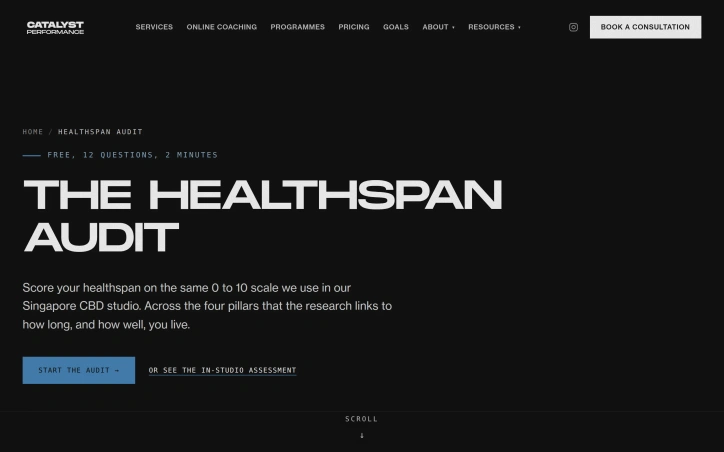
Personal trainers typically sell training sessions. This startup reversed the equation by building assessment first, making it free, and stripping away friction entirely. Catalyst Healthspan Audit addresses a straightforward problem: most people lack a structured way to understand their fitness across multiple dimensions, and those who do often face high friction barriers to entry. The product is a 12-question browser-based questionnaire that scores healthspan on a 0 to 10 scale across four pillars: body composition, cardiorespiratory fitness, stability, and strength. It completes in roughly two minutes on mobile without requiring measuring tape or account creation. Results arrive immediately as a downloadable PDF report emailed to the user, with their composite score, pillar breakdowns, identification of weakness areas, and personalized next steps. The scoring algorithm is deterministic, but a language model generates personalized narrative around the numbers, making results feel tailored rather than template-driven. Users with Apple Watch, Garmin, or Oura devices can feed in actual biometric data for greater precision, though this is entirely optional. What distinguishes this is its position at the top of a measurement funnel. The Catalyst Healthspan Audit serves as a gateway to a full 60-minute in-studio assessment at Catalyst Performance, a personal training studio in Singapore's Manulife Tower. This positioning is deliberate: founders operate the studio, so the audit genuinely reflects how they pre-screen every client before discussing training. That authenticity cuts through typical fitness marketing noise. The product extends beyond the audit itself. The team publishes eleven free calculators alongside it, each grounded in published research and built to run entirely in the browser. These cover VO2 max estimation, fitness age, grip strength benchmarks, waist-to-height ratio, and protein intake guidelines. They embed via single-line code snippets, lowering the bar for publishers to add them to websites. This approach treats measurement infrastructure as a public good rather than proprietary advantage. Pricing is absent by design: the audit is free with no sign-up friction. The business model sits in the background, functioning as a lead generator for a physical training business rather than a standalone SaaS product. For users, this eliminates risk when trying the product. For anyone building fitness or wellness software, the open calculators and transparent research citations offer a template worth studying.

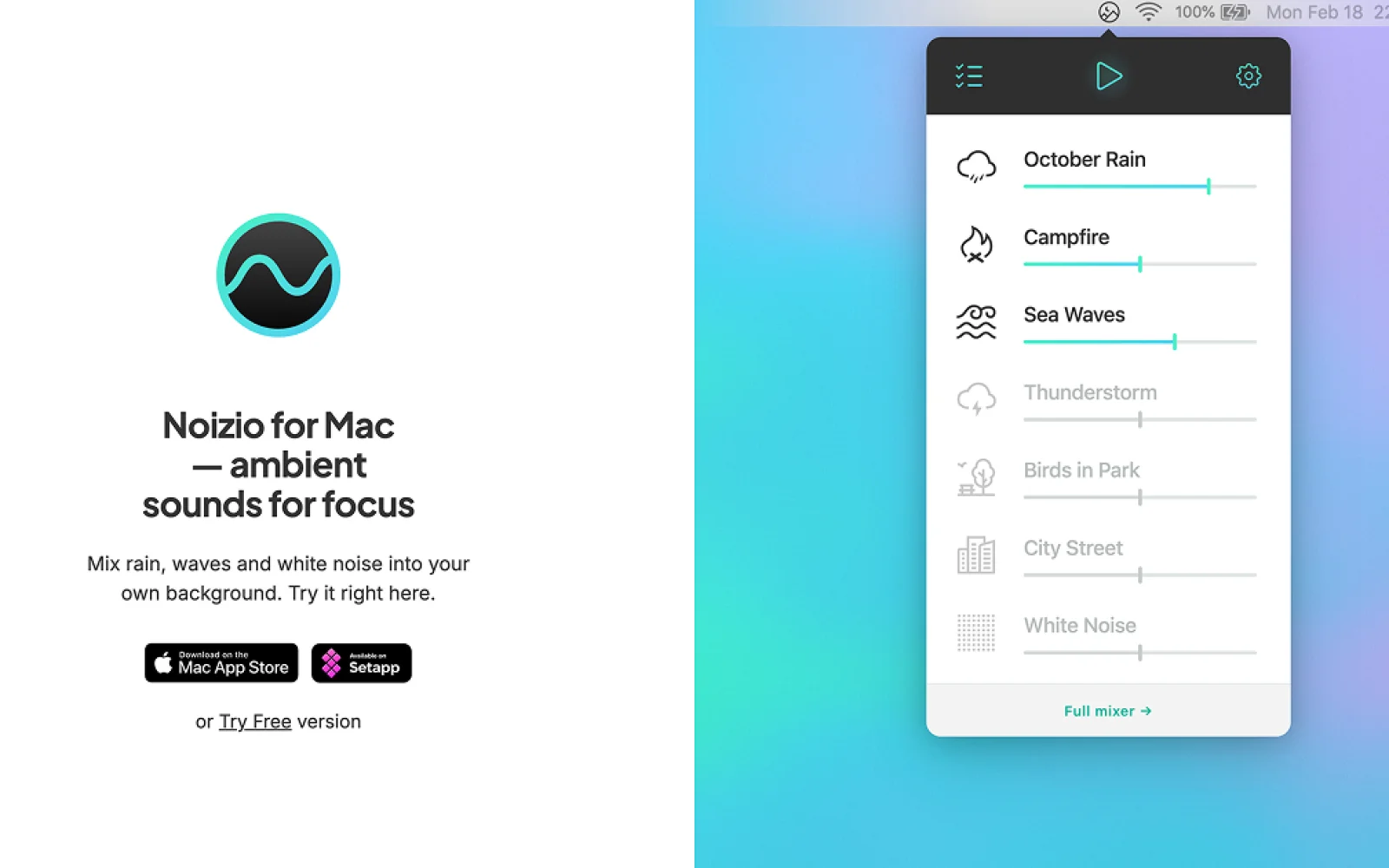
Ambient sound mixing sits at the intersection of productivity tools and wellness applications, addressing a fundamental challenge for millions: filtering out distracting environmental noise to enable focus, rest, or meditation. Noizio tackles this problem by rejecting the traditional single-track white noise approach in favor of a fully customizable sound mixer. The core innovation lies in its elegant simplicity. Rather than forcing users to choose between preset options like "white noise," "rain," or "ocean waves," Noizio enables them to blend multiple sounds together into personalized combinations. The library contains over 40 high-quality ambient recordings—everything from October rain and crackling campfire to keyboard typing, heartbeats, and natural environments like parks and subway systems—allowing users to create precisely the sonic environment they need in seconds. This flexibility serves multiple use cases: focused work, sleep onset, meditation, anxiety relief, or simple relaxation. What distinguishes Noizio from competitors is the design philosophy underlying this feature set. The founder has been refining the concept since 2014, developing across Mac, iOS, iPad, and Android while deliberately maintaining an uncomplicated interface. That restraint defines the product. Users consistently highlight how Noizio avoids the feature bloat of rival applications—the ability to layer sounds without navigating overwhelming menus or encountering subscription paywalls for basic mixing functionality. User sentiment validates this positioning. With a 4.5-star rating from 239 App Store reviews, Noizio has cultivated unusually devoted users; one reviewer noted it was the only application they'd ever bothered to rate. People report using it daily over years, suggesting strong retention and satisfaction. The value proposition extends beyond productivity: the application explicitly addresses anxiety, stress management, mindfulness, meditation, sleep improvement, and yoga—each a distinct but increasingly mainstream wellness concern. The business model remains notably restrained. Noizio operates as an independent project maintained in Ukraine, avoiding the venture-backed pressure toward forced monetization or continuous feature expansion. A free version exists, though specific pricing or premium tier details aren't publicly highlighted. For anyone seeking a lightweight tool to layer natural sounds into work or rest routines, Noizio delivers without unnecessary friction. Its persistence as an indie project over a decade old speaks to both founder commitment and the value of mastering a single discipline.

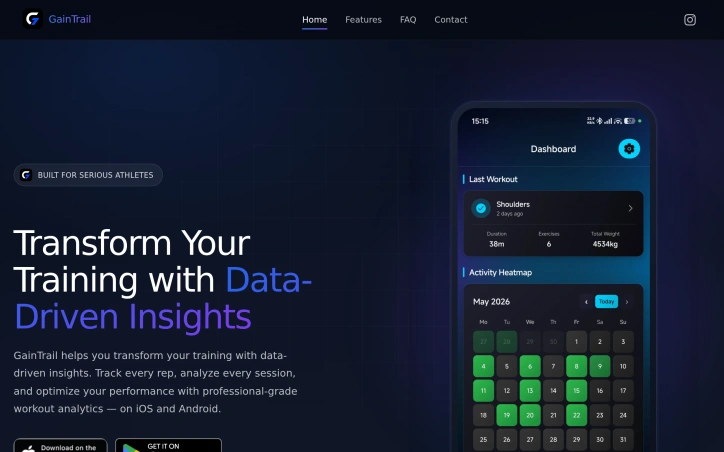
Athletes who track their workouts often face a familiar problem: fitness apps excel at logging sets and reps, but fall short in answering the questions that matter most. Why isn't progress accelerating? Which muscle groups need more attention? Does this training plan actually balance the intended stimulus? GainTrail tackles this gap by combining workout logging with performance analytics designed for athletes serious about data-driven training. The app targets strength athletes, powerlifters, and conditioning-focused trainers who follow structured programs. Whether someone is running a hypertrophy block, a powerlifting cycle, or mixed strength and conditioning work, GainTrail captures the complexity: sets, reps, weight, rest timing, and program structure. The workout builder supports five advanced block types—Standard, EMOM, Pyramid, Cluster, and Superset—allowing users to replicate real-world programming within the app. A library of over 1,000 exercises speeds setup and reduces friction between planning and execution. The standout capability is the analytics layer. After each session, GainTrail breaks down performance at the set level, tracking total volume, time under tension, and muscle activation by group. Users see weekly volume distributions across muscle groups, which exercises generate the most load, and where programming may emphasize or neglect certain patterns. These visualizations—including muscle heatmaps and interactive charts—transform raw workout data into actionable patterns. A secondary feature adds an AI layer: users can submit a training plan against stated goals (muscle growth, strength, endurance, or general fitness), and the system returns a scored review with feedback on exercise selection, muscle balance, and weekly structure. This functions as a second opinion on programming before committing weeks to training. Sync across devices means a workout logged at the gym appears instantly on other phones or tablets, removing the friction of manual entry across platforms. The app also tracks personal records and strength curves over custom time windows, surfacing trends that inform future programming decisions. GainTrail is free to download on iOS and Android, with no mention of premium tiers or paywalls in the promotional material. This positions it as an accessible entry point for athletes already thinking analytically about their training. The product is purposeful: it doesn't attempt to be a social fitness network or a general wellness tracker. It narrows focus to athletes who understand their program structure and want quantitative feedback on their execution. That specificity is its strength.

Parents managing youth baseball rosters spend far too much time reconstructing box scores from memory and crumpled scorecards. Baseball Stats Tracker solves this squarely by putting live game scoring on a smartphone, turning bleacher moments into permanent statistical records. The app targets youth baseball and softball families who track games but lack systematic infrastructure to do so. The founder, self-identified as a baseball dad, built the product to address a real gap: thousands of at-bats and notable performances vanish each season because paper scorebooks are never consulted again. The app captures every plate appearance in real time, synced across devices and accessible to coaches and relatives watching from home. What distinguishes this product is its pricing model. At 39 dollars one time with no recurring subscription, it positions itself against both free solutions and apps with monthly fees. The developer offers a free trial to score an entire game and backs the paid version with a thirty-day money-back guarantee, reducing friction for buyers uncertain whether the tool fits their situation. The feature set reflects actual use at the field. Live scoring works from a phone in the bleachers with large buttons and readable text in sunlight. The app automatically calculates batting statistics including average, on-base percentage, slugging percentage, and OPS, eliminating manual math. Spray charts display where players actually hit the ball across individual games and full seasons. Pitcher statistics track innings pitched, ERA, strikeouts, and walk counts. Splits analysis breaks performance down by opponent pitcher handedness and specific opponents, moving beyond gut feeling to data-driven observation. Supporting features include opponent roster preloading, live sync across devices, inning-by-inning box scores, and unlimited teams and seasons within the single purchase. The app also generates a shareable live link that allows grandparents and other family to follow a game in real time without attending. The product targets a specific frustration in youth baseball culture and prices itself accessibly against both paper-based alternatives and software-as-a-service competitors. By focusing on bleacher usability rather than complex analytics, the app addresses its audience directly.


Incorporating traditional wellness practices into daily life can be challenging due to the hassle and complexity associated with them. The LingcoreHealth Navel Moxibustion Wellness Device addresses this issue by reimagining an ancient practice for modern times. It is designed for individuals seeking a simple, non-invasive way to add warmth and calm to their daily routine. This wearable device stands out for its ability to deliver a gentle, controlled sensation around the navel area without smoke or hassle. The technology behind it uses radiofrequency-based warmth at a specific frequency to provide a soothing experience. Users can adjust the warming level to their preference with four selectable comfort modes. Key features of the device include its hands-free wearable design, rechargeable lithium battery, and portable nature, making it suitable for use during rest, work, or travel. It is designed to fit naturally into daily moments, such as during a desk break, post-workout cooldown, or as an evening unwind ritual. The device is also drug-free and doesn't require any consumables or topicals. The product is built to professional wellness standards while maintaining consumer-friendly simplicity. It comes with a rechargeable battery, an elastic belt, and a USB charging cable. For those interested in trying it out, an individual sample is available for $399. Businesses can also inquire about wholesale pricing, bulk orders, and private labeling options. Overall, the Navel Moxibustion Wellness Device offers a unique blend of traditional wellness concepts and modern comfort, making it an attractive option for those seeking a simple self-care ritual.


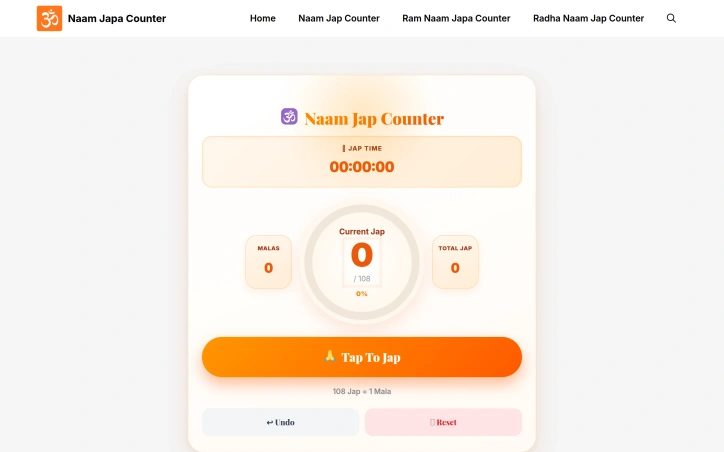
For devotees of Hindu, Vaishnav, and Krishna bhakti traditions, maintaining a consistent mantra chanting practice can be challenging due to the manual effort required to keep track of repetitions. The traditional mala beads, while beautiful and meaningful, have limitations, such as being easily misplaced or worn out, and not providing a record of progress over time. The online Naam Japa Counter addresses these challenges by providing a simple, distraction-free digital tool that allows users to track their mantra chanting and mala rounds with ease. What stands out about this product is its thoughtful design, which prioritizes the user's spiritual practice by removing the mental burden of tracking numbers. The counter is designed to be intuitive and accessible, working seamlessly on mobile, tablet, and desktop devices, and saving user progress automatically. Its features are centered around the traditional 108-count mala, providing a sense of continuity with established spiritual practices. The counter also encourages consistency by displaying daily totals and history, helping users notice their progress and stay motivated. By creating a free online counter, the founder has made a valuable resource available to devotees, enabling them to focus on their spiritual practice without the hassle of manual counting. The fact that it is free forever, with no login required, makes it an attractive solution for those seeking a straightforward and uncomplicated tool to support their mantra chanting. The absence of any pricing or login requirements suggests that the counter is genuinely intended as a service to the spiritual community, rather than a commercial venture. Overall, the Naam Japa Counter is a well-designed tool that effectively supports the spiritual practices of its users, and is a valuable resource for those seeking to deepen their devotion.

Pet owners often struggle to find quick, reliable information about their animals' health, nutrition, and care costs without wading through veterinary websites or paying for professional consultations. PetPawCalc addresses this directly by offering a collection of free calculation tools designed specifically for dog and cat owners who want straightforward answers in seconds. The platform removes traditional friction points that deter users from seeking information. There's no account creation, no email requirement, no upselling. Users select a calculator, input their pet's details, and receive an instant result. This accessibility-first approach reflects a deliberate design philosophy centered on transparency about costs and health management—areas where pet parents typically encounter confusion and scattered, unreliable information. The product differentiates itself through breadth and specificity rather than attempting to be everything. The 15-plus-calculator toolkit spans health, nutrition, reproduction, preventive care, and financial planning. The dog age calculator uses breed and size-specific formulas instead of the widely circulated but outdated 7x rule. Vaccination schedules factor in lifestyle. Heat cycle trackers map multiple estrous stages. Cost estimators break down discrete services like surgery, grooming, and dental care rather than providing vague total figures. This calculator selection suggests a founder who understands both common pet owner anxieties and legitimate knowledge gaps. Animal age conversion, nutrition calculations tied to activity level, and detailed cost forecasting genuinely help owners make informed decisions. The inclusion of pregnancy calculators and heat cycle trackers signals an attempt to serve both casual pet parents and those actively breeding, though the site doesn't explicitly differentiate these audiences or tailor messaging accordingly. The platform claims to rely on science-based formulas, and the sophistication of individual calculators lends credibility to this assertion. However, the site provides no links to underlying research or citations. That's a missed opportunity for authority, particularly around nutrition and breeding guidance, where misinformation spreads rapidly among pet owners seeking answers. The business model is transparent: completely free with no apparent ads, premium tiers, or data collection schemes. This aligns with the founder's stated commitment to accessibility, though the long-term sustainability model remains undefined on the public site. For pet owners seeking quick health and cost projections without creating another online account, PetPawCalc delivers on its promise efficiently and without friction.


Personalized health guidance typically demands friction—lengthy questionnaires, account creation, sometimes a subscription. This platform eliminates those obstacles by offering a stripped-down collection of health calculators that deliver results without mandatory signup or hidden charges. The product addresses a real gap in the market. People seeking personalized fitness data often face a choice between unreliable rules of thumb and apps that treat registration as a prerequisite. My Wellness Calc positions itself as a third path: immediate access to science-backed tools across a surprising breadth of health domains. What distinguishes the offering is its scope. Rather than a single calculator, the platform bundles over a dozen specialized tools spanning metabolic rates, cardiovascular fitness, body composition, and recovery protocols. The collection ranges from foundational measures like BMI and calorie expenditure to more sophisticated metrics such as VO2 max estimation and zone-specific heart rate training ranges. This variety attracts different user archetypes—from beginners validating their weight-management math to serious athletes fine-tuning training intensity zones. The execution reflects a deliberate philosophy around frictionless access. Each tool computes personalized results in seconds using metric or imperial inputs. The interface avoids the common trap of information overload, instead pairing calculations with explanatory context so users understand their numbers, not just receive them. For those planning fitness interventions—whether intermittent fasting windows, sleep-cycle alignment, or macro targets—the platform provides one-page clarity. Technically, the tools integrate one advertising network (Google AdSense), which supports the free model without paywalls or recurring revenue schemes. This decision trades subtle display clutter for zero financial barriers, a straightforward trade-off that aligns with the stated mission. The weaknesses are implicit in the design. Browser-based calculators live or die by accuracy; without independent validation or transparent methodology disclosure, users must trust the formulas blindly. No mobile app means the experience is tethered to desktop browsing. And while breadth is a strength, the tools lack the depth of specialized platforms—a VO2 max calculator that requires field test data cannot replace devices that measure it directly. Still, for someone seeking a quick, credible answer to a health calculation without the friction of authentication or cost, the platform delivers exactly what it promises. In a market often predicated on engagement through onboarding walls, the directness is refreshing.


For those drawn to spiritual exploration but uncertain where to start, Soul Karma Test offers a structured entry point into understanding one's karmic patterns and life lessons. The platform addresses a genuine gap: while interest in karma and Eastern philosophy runs deep in Western culture, accessible tools for personal exploration remain scarce. The product targets spiritually curious individuals seeking actionable insight into how their behaviors, intentions, and choices shape their life trajectory. The foundation here is substance. Rather than reducing karma to vague platitudes, the platform grounds itself in actual philosophical tradition—tracing the concept from Sanskrit roots through Vedic ritual practices, the Upanishads' evolution toward moral causation, and the Buddha's refinement emphasizing intention as the core element of karmic action. This educational backbone distinguishes it from purely entertainment-focused personality quizzes. The accompanying article walks users through karma's intellectual history, establishing credibility and context before they engage with personalized assessment. The quiz itself takes the form of a multi-question test that generates a "Soul's Karmic Profile" based on responses. This structure allows users to move beyond abstract philosophy and receive tailored interpretation of their spiritual patterns. The ability to save results and restart the test suggests the platform anticipates repeat engagement and deeper exploration across sessions. A downloadable article extends value beyond the quiz alone, positioning the tool as educational rather than merely transactional. The mention of an "enhanced version" indicates a freemium model, though specifics around pricing, features, or upgrade paths remain undisclosed in available materials. This tiered approach aligns with common monetization for spiritual and self-assessment products, though transparency around costs would strengthen positioning. What works is the marriage of accessibility and rigor. Soul Karma Test makes karma tangible without oversimplifying it. Users get both the satisfying novelty of a personalized profile and genuine philosophical grounding. The platform doesn't claim to be definitively prophetic or mystical—instead, it frames itself as a framework for self-reflection rooted in centuries-old thought traditions. The primary limitation is information scarcity regarding the actual algorithm, question design philosophy, or how profiles are generated. Users may wonder whether results reflect genuine karmic assessment or serve primarily as scaffolding for reflection. Still, for someone beginning to explore these ideas, the combination of education and personalization delivers real value.


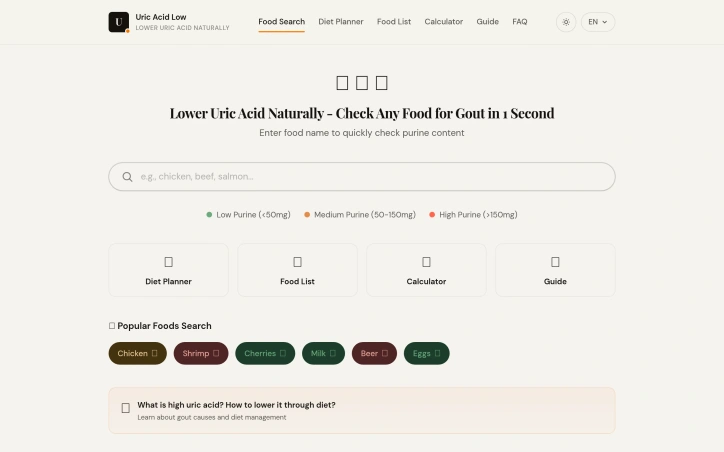
People managing gout often struggle to find practical, accessible guidance on which foods to avoid or embrace. Uric Acid Low addresses this gap by providing a free tool designed specifically for anyone looking to control their condition through dietary changes without the friction of registration. The product centers on a searchable database of over 150 foods categorized by purine content, the compound linked to elevated uric acid levels. Users can instantly check any food's classification as low, medium, or high purine, bypassing the confusion and outdated advice that typically surrounds gout management. The tool removes friction entirely: no signup required, no paywalls between users and the information they need. Beyond the core search function, the platform includes a diet planner for meal construction, a calculator for tracking purine intake, and an educational guide explaining uric acid and gout causes. A dedicated FAQ section with over 50 common questions provides quick answers to concerns that gout sufferers frequently encounter. The founder's motivation stems from real user outcomes—one user reduced their uric acid from 8.2 to 5.9 through dietary intervention, demonstrating that targeted food management can deliver measurable results. The product's accessibility sets it apart in a landscape often dominated by paywalled wellness apps or clinical referrals. By eliminating signup friction and keeping the core tool free, the platform democratizes gout management for someone diagnosed at a doctor's office who needs immediate, actionable guidance. The design philosophy prioritizes speed: searching a food takes seconds, not minutes. Commercially, Uric Acid Low operates as a free tool with affiliate income from recommended supplements like tart cherry concentrate through Amazon Associates. This model avoids direct monetization of users while still generating revenue from ancillary products, a common approach for utility-focused health tools. The main constraint lies in scope: a searchable food database and planning tools can guide dietary choices, but they cannot replace medical supervision or address all gout triggers, which can include genetics and certain medications. Still, for the segment of gout sufferers seeking diet-driven management, the tool delivers a straightforward, friction-free entry point that removes barriers to action.
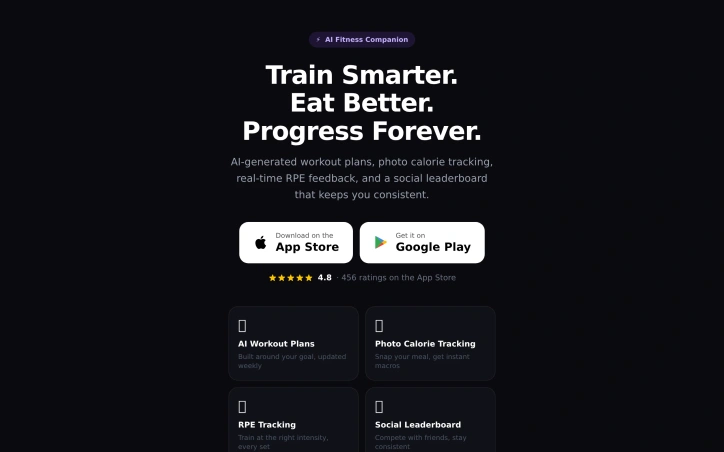
Fitness enthusiasts often struggle to maintain consistency in their workout routine and nutrition planning, hindering their progress toward their fitness goals. Soma addresses this issue by providing a comprehensive AI-powered fitness companion that helps users train smarter and eat better. What sets Soma apart is its robust integration of AI-generated workout plans that adapt to the user's progress and performance. This is complemented by a photo calorie tracking feature that simplifies nutrition logging by instantly providing macro breakdowns of meals. The app's real-time RPE feedback ensures users are training at the right intensity, while the social leaderboard fosters a competitive environment that keeps users motivated and consistent. The key features of Soma include AI-generated workout plans that are updated weekly based on the user's goals and progress, photo calorie tracking that eliminates the need for manual logging, and a social leaderboard that allows users to compete with friends. The app is designed for individuals seeking a structured and personalized approach to their fitness journey, with its features catering to the needs of both beginners and experienced athletes. With over 1,700 athletes already using the app and a rating of 4.8 from 456 reviews on the App Store, Soma has demonstrated its effectiveness and user satisfaction. The app is available for download on both iOS and Android devices, with a calorie database featuring nutrition facts and calorie counters for common foods available for free download. Overall, Soma presents a compelling solution for individuals seeking a holistic and technology-driven approach to fitness and nutrition planning.

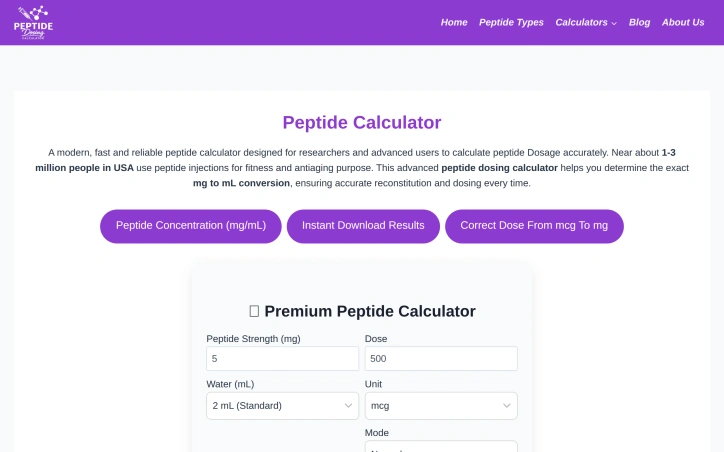
Accurate dosing is critical in peptide therapy, and most users calculating reconstitution and injection volumes are doing so with spreadsheets or manual math prone to error. Peptide Calculator addresses this gap by automating the conversion process for individuals administering peptide injections for performance enhancement, anti-aging, or research purposes. The tool tackles a straightforward but essential problem: determining precise milliliter volumes to draw when reconstituting peptide vials with bacteriostatic water. Users input their peptide strength (in milligrams), select their water volume, specify their desired dose, and the calculator returns both the concentration and the exact injection volume needed. A visual syringe graphic accompanies the results, providing an additional reference point for users preparing their injections. Several design choices distinguish this from a basic calculator. The product offers three preset water volumes (1 mL, 2 mL, and 3 mL) with clear explanations of how each affects concentration levels—1 mL for high concentration, 2 mL for standard (the recommended default), and 3 mL for lower concentrations. An "adjustable mode" feature allows further refinement, letting users increase or decrease water volume to optimize their specific requirements. The ability to download results adds a practical element, enabling users to save or print their calculations for reference during injection preparation or for record-keeping. The calculator supports multiple commonly used peptides, including Tirzepatide, Retatrutide, and Semaglutide, though the website doesn't specify whether different peptides receive specialized guidance or if the calculator treats all peptides identically. Users can input doses in either micrograms or milligrams, matching the different ways peptides are dosed in practice. The product targets researchers and advanced users, indicating a technical audience comfortable with peptide administration. The foundational information provided—brief explanations of what peptides are, their proposed benefits, and how the calculator works—reaches people new to peptide dosing, though the core tool itself remains accessible regardless of user experience level. No pricing information is disclosed on the site. The product is a web-based calculator with no subscription or licensing cost mentioned, though it carries "premium" branding.

Quitting nicotine pouches can be a challenging task, and most existing quit apps fall short in catering to the specific needs of pouch users, having been primarily designed for cigarette smokers. PouchOut addresses this gap by offering a tailored quit plan that understands the unique habits and challenges associated with nicotine pouch use. The app is designed specifically for users of popular nicotine pouch brands such as ZYN, Velo, and others, providing a structured 30-day protocol to help them overcome their addiction. What stands out about PouchOut is its comprehensive approach to quitting, which involves not just a taper plan but also urge training and a reset system. The app's 30-day protocol is divided into three phases, each designed to build awareness, disrupt habitual behavior, and ultimately give users control over their cravings. The urge training feature allows users to log their urges in seconds, track triggers, and build win streaks, providing a measurable sense of progress. The reset system is also noteworthy, as it protects users' progress and eliminates shame spirals when they slip up, instead guiding them to learn from the trigger and move forward. The app offers a range of features that support the quit journey, including a real-time cost calculator that shows users how much they are saving. By providing a structured and supportive environment, PouchOut empowers users to take back control of their lives. The testimonials from real users attest to the effectiveness of the app's approach, with some reporting significant reductions in their nicotine pouch use. With over 4,000 pouch users on their quit journey, PouchOut has established itself as a valuable resource for those looking to overcome their nicotine pouch addiction. The app is available for free download on the App Store.


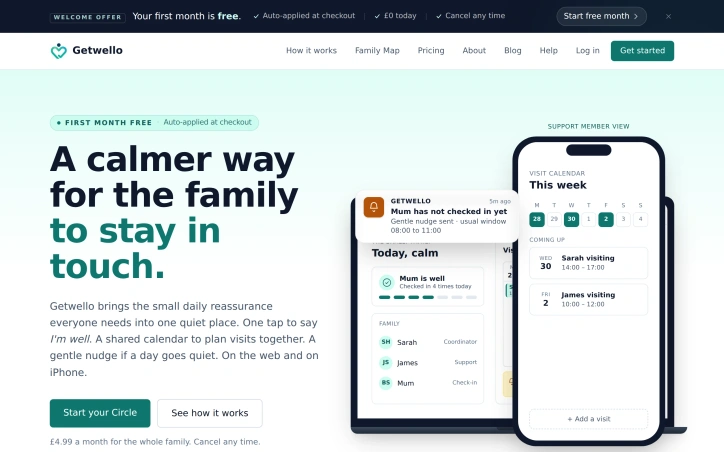
Family worry about older parents is a pervasive issue that can be both distressing and disruptive. Getwello addresses this by providing a straightforward and calming solution. The app is designed for families with older relatives who live independently, offering a simple and reassuring way to stay in touch. What stands out about Getwello is its focus on subtlety and reducing anxiety. Instead of generating a flurry of notifications or requiring constant communication, the app facilitates a gentle and periodic check-in. The "I'm well" button allows the older relative to quickly notify their family that they are okay, without needing to engage in lengthy conversations or respond to multiple messages. The app's key features include a shared calendar for planning visits, gentle nudges if a day passes without a check-in, and an optional "Family Map" add-on that provides location information and alerts for low phone battery or arrival at home. These features work together to provide a sense of reassurance and connection without being intrusive or overwhelming. Getwello is available on iPhone, with Android support forthcoming, and is priced at £4.99 per month for the whole family, with the first month free and the option to cancel at any time. Overall, Getwello offers a thoughtful and practical solution for families seeking to stay connected with their older relatives while respecting their independence. By streamlining communication and reducing the need for frequent checks, Getwello helps to create a calmer and more reassuring experience for all parties involved.

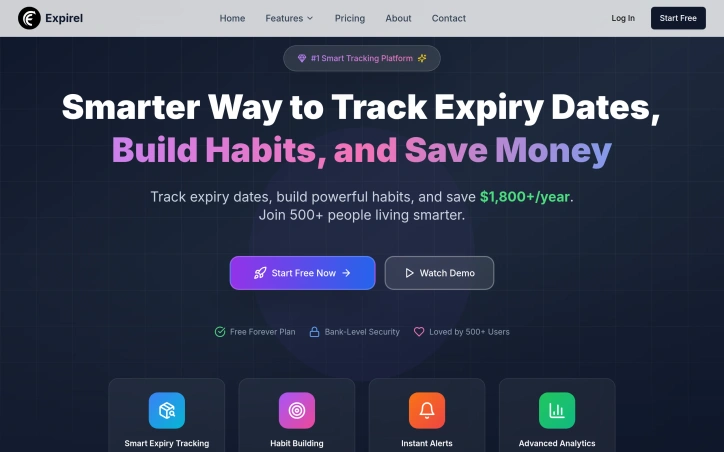
Tracking expiry dates and building habits can be a daunting task, but a smart platform is simplifying this process for individuals. Expirel is designed for anyone looking to reduce waste, stay consistent, and save money. At its core, the platform addresses the issue of keeping track of various expiry dates, whether for food, medicines, documents, or subscriptions, and helps users develop lasting habits. What stands out about Expirel is its comprehensive approach to tracking and reminders. It allows users to add items quickly, set reminders according to their preferences, and receive notifications via email or WhatsApp. The platform's ability to integrate habit tracking alongside expiry date monitoring is particularly noteworthy, providing a holistic view of one's progress and consistency. The platform boasts several key features, including a smart barcode scanner for automatic product information and expiry date detection, multi-channel alerts to ensure users never miss an important date, and a habit streak system with gamification elements to foster motivation. Advanced analytics also enable users to visualize their progress and track the financial benefits of using the platform. Users can start with Expirel for free, and the platform explicitly mentions a "Free Forever Plan." The emphasis on bank-level security and the mention of features like team collaboration suggest that the platform is also considering the needs of power users and potentially businesses, although the details of its business model beyond the free plan are not extensively elaborated. By simplifying the process of tracking expiry dates and building habits, Expirel helps its users save an average of $1,800 annually and reduce waste significantly.

Dermatology has an access problem. A routine mole check that should take minutes can require weeks of waiting and hundreds in consultation fees. ScanSkinAI tackles this by putting AI skin analysis in your pocket—uploading a photo to get instant condition screening, with optional expert review afterward. The core product works straightforwardly: snap a clear image of a skin concern, and the platform's AI returns results in 30 seconds, identifying potential issues across 80+ conditions including melanoma, eczema, psoriasis, and acne. If you want deeper assurance, a dermatologist review costs from $19.99 and typically arrives within 8-48 hours. Beyond initial scans, the platform offers ongoing tracking and care recommendations to help users monitor changes over time. What distinguishes ScanSkinAI from amateur apps is its regulatory posture and clinical validation. It's registered as a Class I medical device under UKCA standards and holds ISO 27001 (security) and ISO 13485 (medical device quality) certifications. The company validates its AI across all six Fitzpatrick skin types—a crucial requirement for ensuring accuracy doesn't vary by ethnicity. The claimed 96.48% accuracy, while high, comes from their own validation testing rather than independent peer review, so some caution is warranted, but the rigor of device registration and international certifications suggests real clinical work behind it. The user base—50,000+ reported users with a 4.9/5 rating—indicates genuine adoption beyond early adopters. More interesting is the business model: rather than relying purely on individual consumer scanning, ScanSkinAI operates B2B2C through insurers, corporate wellness platforms, and healthcare brokers like Aon and Lockton. This approach scales access through employee and policyholder benefits in 7+ countries. That's where the real value proposition shines—not for consumers paying out-of-pocket, but for organizations looking to democratize preventive screening. The app is most useful for people with recurring skin conditions, those concerned about melanoma changes, busy professionals who need fast preliminary assessment, and parents checking unexplained rashes. It doesn't replace dermatology but meaningfully shortens the path to expert care—eliminating the weeks of uncertainty most people experience before an appointment.


Doctor visits speed past faster than most minds can process, leaving patients, parents, and adult children who coordinate care stuck with fuzzy memories and half-remembered instructions. AI Doctor Notes attacks that gap by turning the conversation into a tangible, shareable record while nudging every participant to prepare beforehand. The app keeps the entire lifecycle in one place: users jot down symptoms, medications, and questions before leaving home, record the live discussion during the appointment, then receive an auto-generated set of questions and a concise next-steps summary once the visit ends. A built-in sharing layer lets a child’s caregiver, an aging parent’s helper, or any member of a care circle see only the important excerpts without forcing anyone to retype disjointed recollections. What quickly catches attention is the deliberate focus on psychological friction. Instead of broad “clinical” features, the product hangs its value on mental bandwidth—reducing the pre-visit scramble, the mid-visit nodding amnesia, and the post-visit parking-lot panic. Recording and transcription already exist in other tools, yet tying them to an explicit prep module and a ready-to-email recap separates this from generic note apps. The App Store rating sits at a perfect five stars after a handful of public reviews, and the company makes the download itself free; beyond that it has not yet laid out any paid tier or monetization scheme. Early adopters are therefore getting all current capabilities without subscription gates. For anyone who has ever left a consultation wondering what was actually decided, AI Doctor Notes delivers a structured memory when memory fails most.


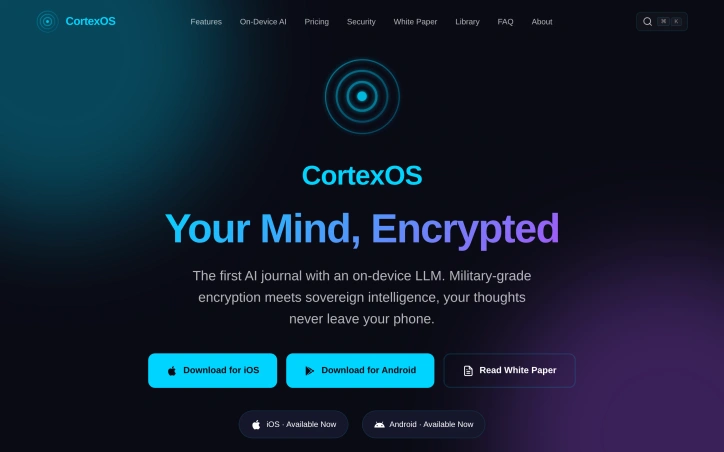
Privacy-sensitive journaling stops feeling like an oxymoron once CortexOS is in your pocket. The app speaks squarely to anyone whose diary carries real emotional weight—mental-health trackers, therapy students, individuals under legal or personal threat—yet winces at uploading raw thoughts to external servers. Its blunt thesis is that the only trustworthy steward of your psyche is the phone already in your hand. CortexOS encrypts every entry with AES-256-GCM and locks the key behind a six-word recovery phrase generated locally during installation. Because the phrase produces keys through Argon2id on-device, the developer cannot reproduce it even when served a warrant or data request. The same isolation philosophy powers an impressive technical feat: Meta’s Llama 3.2 language model—either 1 B or 3 B parameters—runs entirely within the app, slicing prompts and producing summaries without a single packet crossing the network. That means reflection, weekly chapter analysis, and 20-point emotion classification happen on silicon you control, not in some distant GPU farm. A Whisper-based speech engine follows the same rule: speak into the microphone and the transcription never leaves the handset, supporting 99 languages and demanding zero cloud credits. The intelligence glows brighter because it feeds solely on your corpus. Each entry contributes to a living psychological profile; the AI highlights persistent cognitive distortions, charts mood against daily variables, and can export a clinician-ready PDF report stripped of any raw text. A still-optional encrypted cloud vault syncs ciphertext blobs that even the company’s servers treat as opaque, preserving offline-first peace of mind whenever you prefer it. Crucially, the company never dangles paywalls over the core promise: the full on-device LLM and zero-knowledge encryption ship to every user on day one. Revenue talk is absent from the pitch, making the product feel less like a trial and more like a manifesto delivered in code. If journals are the R&D lab of the self, CortexOS finally treats that research as classified material—and keeps the clearance level where it belongs.

Emotion tracking has long suffered from competing impulses: the clinical efficiency of mood logging strips the practice of meaning, while open-ended journaling can feel like shouting into the void. VibeLoop attempts to thread this needle by treating daily emotional reflection as a ritual rather than a data collection exercise. The product's core interaction is deliberately minimal. Users record a single emotion per day—their "vibe"—refining it and adding a brief note before the distinctive part begins. Rather than leaving the reflection there, the app responds with observations from a group of AI personalities. These aren't uniform analyses; instead, they represent different perspectives, from poetic reframing to analytical dissection to unflinching honesty. This multiplicity works because a single AI voice risks becoming either a bland mirror or an unwelcome therapist. Multiple voices approximate conversation, each bringing a distinct lens to the same emotional moment. Where most mood trackers dead-end at daily entry, VibeLoop builds upward. The app surfaces patterns through calendar views and weekly summaries that transform discrete emotional snapshots into narrative. This framing is deliberate: summaries "turn your moods into a story" rather than into a chart. That narrative orientation reveals what the product actually values—pattern recognition and meaning-making, not optimization or self-improvement. The positioning reflects this clarity. VibeLoop explicitly distances itself from productivity-obsessed wellness apps. There's no claim that tracking mood improves performance or that patterns enable "better choices." Instead, the value proposition is direct: understanding yourself matters. For users fatigued by apps that treat emotions as inputs to be managed, this directness refreshes. The one-entry-per-day constraint is worth questioning. For some users, emotional life moves faster; for others, daily reflection already feels like journaling, just reframed. But the constraint likely serves the product's identity by resisting the obsessive data collection that makes many tracking apps feel extractive. It keeps the ritual focused. VibeLoop targets a specific user: someone who journaled once, found it meaningful but incomplete, and wants the space between reflection and response. Whether AI companions authentically fill that gap is the product's real test. But its resistance to the self-improvement framing that dominates wellness is itself valuable—it proves you can build in this space without abandoning honesty.


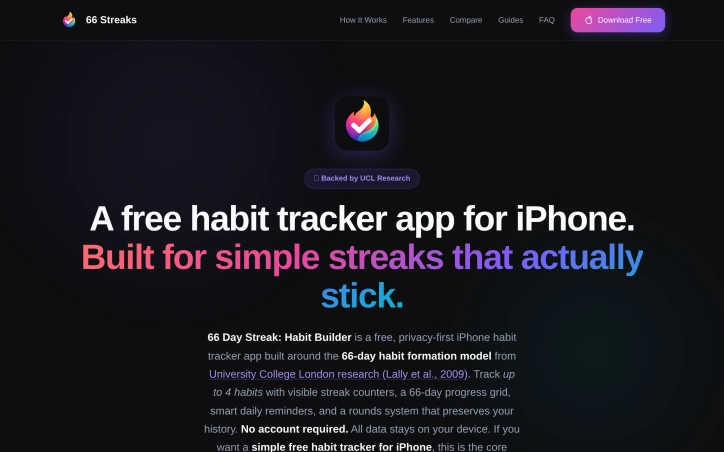
Habit tracking has become unnecessarily complex. Most popular apps bury their core function—simple daily logging—beneath feature-heavy dashboards that overwhelm rather than motivate. 66 Streaks corrects this by stripping away the noise and building around a single, research-supported principle: it takes 66 days, not 21, for a behavior to become automatic. The app's foundation rests on a 2009 study from University College London by Dr. Phillippa Lally and colleagues, published in the European Journal of Social Psychology. Their work tracked 96 participants and found that habit formation averaged 66 days, with a range between 18 and 254 days. This contradicts the widely repeated "21-day rule," often misattributed to Maxwell Maltz's 1960 book, which lacks scientific backing. Follow-up research from King's College London reinforced that real behavioral change requires consistent repetition far beyond three weeks. By anchoring the entire product around this precise timeframe, 66 Streaks gives users a legitimate finish line rather than an arbitrary target. The feature set reflects this philosophy of restraint. Users can track up to four habits simultaneously through a combination of visible streak counters, a 66-day progress grid, and daily reminders. The app includes a rounds system to preserve history across multiple habit cycles. Critically, it operates entirely offline—no account creation, no login requirement, and all data remains on the user's device. This privacy-first approach eliminates friction at the point of entry and addresses legitimate concerns about data handling. The product is positioned as free on the Apple App Store with no subscription component. This pricing structure removes another barrier to adoption while betting that simplicity itself becomes the retention mechanism. 66 Streaks targets people fatigued by overengineered productivity tools who want a focused, daily check-in system backed by actual behavioral science. The execution suggests the founders understood what makes habit trackers fail in practice: complexity and endless targets. By solving for those specific pain points rather than competing on feature count, the app addresses a genuine gap in the market where most competitors prioritize comprehensiveness over usability.