Catalyst Healthspan Audit
Personal trainers typically sell training sessions. This startup reversed the equation by building assessment first, mak...
Launchory
We built Launchory to solve the discoverability problem for startups. Our platform offers instant approval, permanent do...
Best Medical Startups & Tools
Tools that guide care and provide practical health support.
Recently Listed
5 launches
Incorporating traditional wellness practices into daily life can be challenging due to the hassle and complexity associated with them. The LingcoreHealth Navel Moxibustion Wellness Device addresses this issue by reimagining an ancient practice for modern times. It is designed for individuals seeking a simple, non-invasive way to add warmth and calm to their daily routine. This wearable device stands out for its ability to deliver a gentle, controlled sensation around the navel area without smoke or hassle. The technology behind it uses radiofrequency-based warmth at a specific frequency to provide a soothing experience. Users can adjust the warming level to their preference with four selectable comfort modes. Key features of the device include its hands-free wearable design, rechargeable lithium battery, and portable nature, making it suitable for use during rest, work, or travel. It is designed to fit naturally into daily moments, such as during a desk break, post-workout cooldown, or as an evening unwind ritual. The device is also drug-free and doesn't require any consumables or topicals. The product is built to professional wellness standards while maintaining consumer-friendly simplicity. It comes with a rechargeable battery, an elastic belt, and a USB charging cable. For those interested in trying it out, an individual sample is available for $399. Businesses can also inquire about wholesale pricing, bulk orders, and private labeling options. Overall, the Navel Moxibustion Wellness Device offers a unique blend of traditional wellness concepts and modern comfort, making it an attractive option for those seeking a simple self-care ritual.


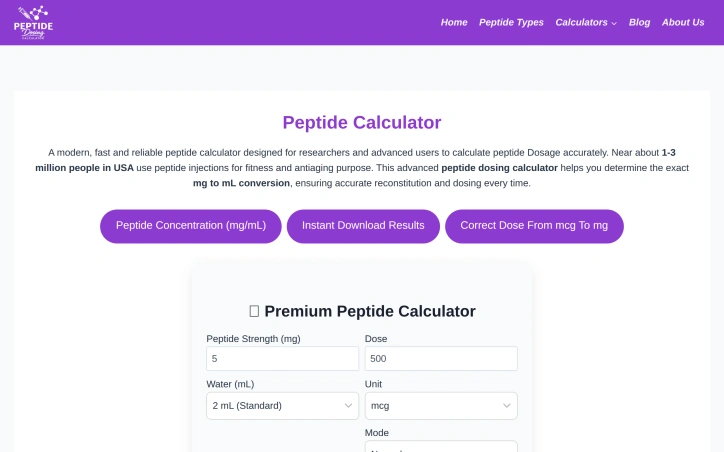
Accurate dosing is critical in peptide therapy, and most users calculating reconstitution and injection volumes are doing so with spreadsheets or manual math prone to error. Peptide Calculator addresses this gap by automating the conversion process for individuals administering peptide injections for performance enhancement, anti-aging, or research purposes. The tool tackles a straightforward but essential problem: determining precise milliliter volumes to draw when reconstituting peptide vials with bacteriostatic water. Users input their peptide strength (in milligrams), select their water volume, specify their desired dose, and the calculator returns both the concentration and the exact injection volume needed. A visual syringe graphic accompanies the results, providing an additional reference point for users preparing their injections. Several design choices distinguish this from a basic calculator. The product offers three preset water volumes (1 mL, 2 mL, and 3 mL) with clear explanations of how each affects concentration levels—1 mL for high concentration, 2 mL for standard (the recommended default), and 3 mL for lower concentrations. An "adjustable mode" feature allows further refinement, letting users increase or decrease water volume to optimize their specific requirements. The ability to download results adds a practical element, enabling users to save or print their calculations for reference during injection preparation or for record-keeping. The calculator supports multiple commonly used peptides, including Tirzepatide, Retatrutide, and Semaglutide, though the website doesn't specify whether different peptides receive specialized guidance or if the calculator treats all peptides identically. Users can input doses in either micrograms or milligrams, matching the different ways peptides are dosed in practice. The product targets researchers and advanced users, indicating a technical audience comfortable with peptide administration. The foundational information provided—brief explanations of what peptides are, their proposed benefits, and how the calculator works—reaches people new to peptide dosing, though the core tool itself remains accessible regardless of user experience level. No pricing information is disclosed on the site. The product is a web-based calculator with no subscription or licensing cost mentioned, though it carries "premium" branding.

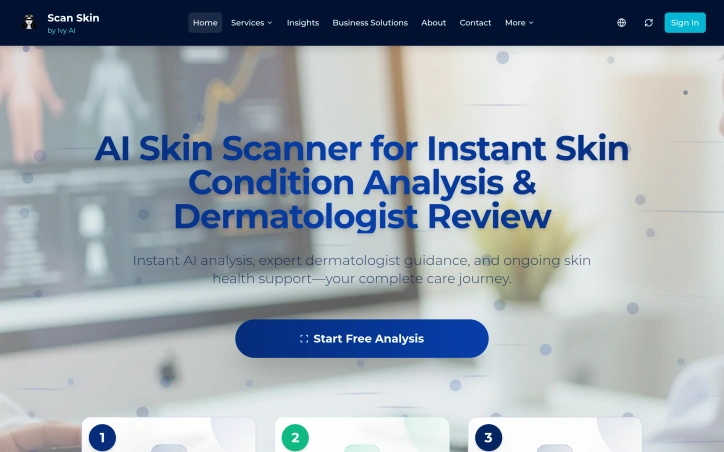
Dermatology has an access problem. A routine mole check that should take minutes can require weeks of waiting and hundreds in consultation fees. ScanSkinAI tackles this by putting AI skin analysis in your pocket—uploading a photo to get instant condition screening, with optional expert review afterward. The core product works straightforwardly: snap a clear image of a skin concern, and the platform's AI returns results in 30 seconds, identifying potential issues across 80+ conditions including melanoma, eczema, psoriasis, and acne. If you want deeper assurance, a dermatologist review costs from $19.99 and typically arrives within 8-48 hours. Beyond initial scans, the platform offers ongoing tracking and care recommendations to help users monitor changes over time. What distinguishes ScanSkinAI from amateur apps is its regulatory posture and clinical validation. It's registered as a Class I medical device under UKCA standards and holds ISO 27001 (security) and ISO 13485 (medical device quality) certifications. The company validates its AI across all six Fitzpatrick skin types—a crucial requirement for ensuring accuracy doesn't vary by ethnicity. The claimed 96.48% accuracy, while high, comes from their own validation testing rather than independent peer review, so some caution is warranted, but the rigor of device registration and international certifications suggests real clinical work behind it. The user base—50,000+ reported users with a 4.9/5 rating—indicates genuine adoption beyond early adopters. More interesting is the business model: rather than relying purely on individual consumer scanning, ScanSkinAI operates B2B2C through insurers, corporate wellness platforms, and healthcare brokers like Aon and Lockton. This approach scales access through employee and policyholder benefits in 7+ countries. That's where the real value proposition shines—not for consumers paying out-of-pocket, but for organizations looking to democratize preventive screening. The app is most useful for people with recurring skin conditions, those concerned about melanoma changes, busy professionals who need fast preliminary assessment, and parents checking unexplained rashes. It doesn't replace dermatology but meaningfully shortens the path to expert care—eliminating the weeks of uncertainty most people experience before an appointment.

Doctor visits speed past faster than most minds can process, leaving patients, parents, and adult children who coordinate care stuck with fuzzy memories and half-remembered instructions. AI Doctor Notes attacks that gap by turning the conversation into a tangible, shareable record while nudging every participant to prepare beforehand. The app keeps the entire lifecycle in one place: users jot down symptoms, medications, and questions before leaving home, record the live discussion during the appointment, then receive an auto-generated set of questions and a concise next-steps summary once the visit ends. A built-in sharing layer lets a child’s caregiver, an aging parent’s helper, or any member of a care circle see only the important excerpts without forcing anyone to retype disjointed recollections. What quickly catches attention is the deliberate focus on psychological friction. Instead of broad “clinical” features, the product hangs its value on mental bandwidth—reducing the pre-visit scramble, the mid-visit nodding amnesia, and the post-visit parking-lot panic. Recording and transcription already exist in other tools, yet tying them to an explicit prep module and a ready-to-email recap separates this from generic note apps. The App Store rating sits at a perfect five stars after a handful of public reviews, and the company makes the download itself free; beyond that it has not yet laid out any paid tier or monetization scheme. Early adopters are therefore getting all current capabilities without subscription gates. For anyone who has ever left a consultation wondering what was actually decided, AI Doctor Notes delivers a structured memory when memory fails most.


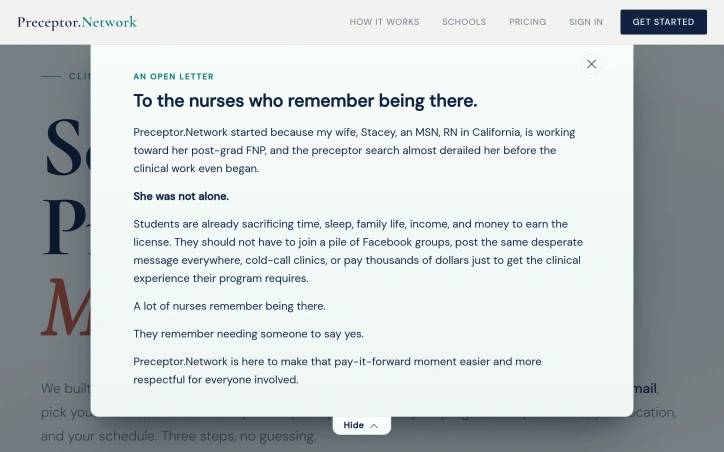
Clinical placement matching represents one of healthcare education's persistent friction points, and Preceptor.Network proposes a direct solution to an unnecessarily manual problem. The platform targets students pursuing advanced nursing and physician assistant credentials—FNP, PMHNP, PA, DNP, and similar programs—who traditionally navigate preceptor recruitment through spreadsheets, department lists, and personal networking. Faculty coordinators simultaneously shoulder the burden of troubleshooting mismatched placements that fail to meet program requirements. The company's core insight is straightforward: institutional requirements can be codified into matching logic. Rather than treating preceptor directories as glorified listings, Preceptor.Network integrates directly with each school's clinical rules—specialty requirements, minimum hours, accepted credentials—and weights candidate preceptors against those parameters. The matching engine also factors in geographic availability and student location, producing ranked results sorted by fit score rather than undifferentiated lists. The onboarding flow underscores this automation philosophy. A student provides their school email address; the system recognizes the domain and retrieves their program enrollment automatically. This eliminates form filling and roster uploads. After selecting their course rotation, they receive preceptor recommendations ordered by relevance to their specific requirements. The three-step design feels deliberately friction-minimized, a direct counterpoint to the opaque, coordinator-dependent processes it displaces. For schools, the value proposition centers on reducing placement fulfillment burden at scale. Once program requirements are configured, the system handles cohorts ranging from twenty to thousands of students without adding administrative overhead. The platform claims to improve through repeated use—each completed match trains recommendations for future cycles. Pricing for students is direct: ten dollars per confirmed match with no subscription component. The school and preceptor business models remain less explicit, though the architecture suggests a two-sided marketplace where schools configure requirements and preceptors receive filtered requests ordered by relevance. What's notably absent is data on matching accuracy, program coverage breadth, or current adoption rates. For a product solving a coordination problem in a relatively niche market, these specifics would strengthen confidence in its claims. The email-domain auto-detection is genuinely useful, but the true value depends entirely on whether the matching algorithm actually reduces friction or simply reorders the guesswork it promises to eliminate. That gap between concept and execution remains the critical unknown.