
VibeLoop: AI Mood Journal
- No match
Machine translation — the English original is authoritative.
The Story
Most mood trackers feel like logging data. Most journals feel like writing into a void.
VibeLoop is different.
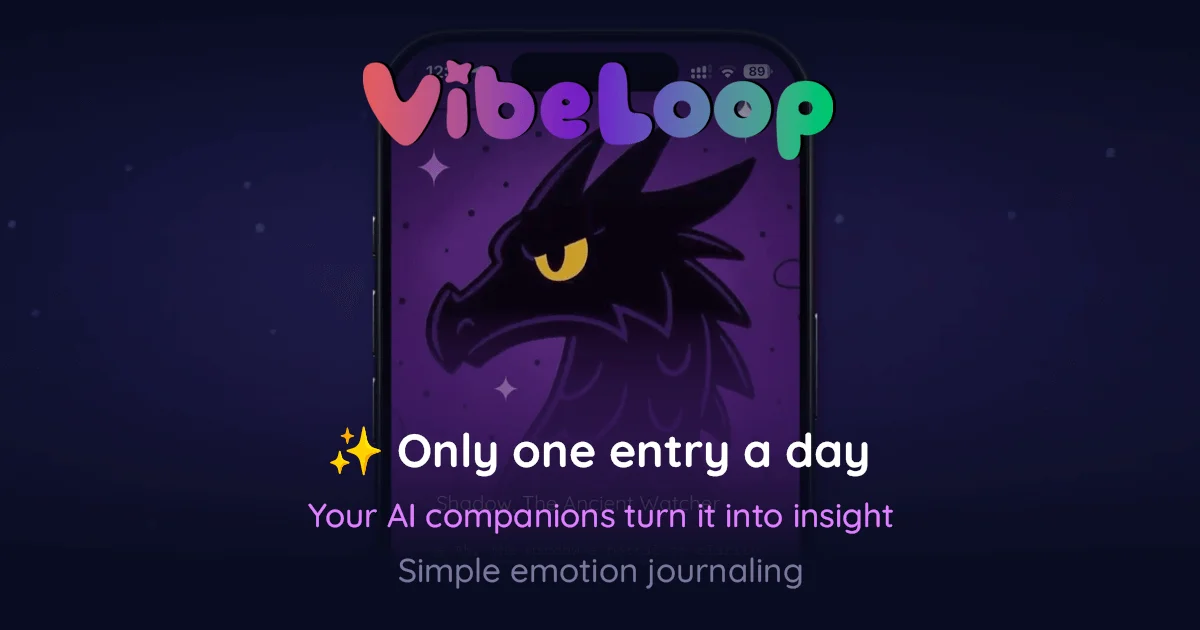
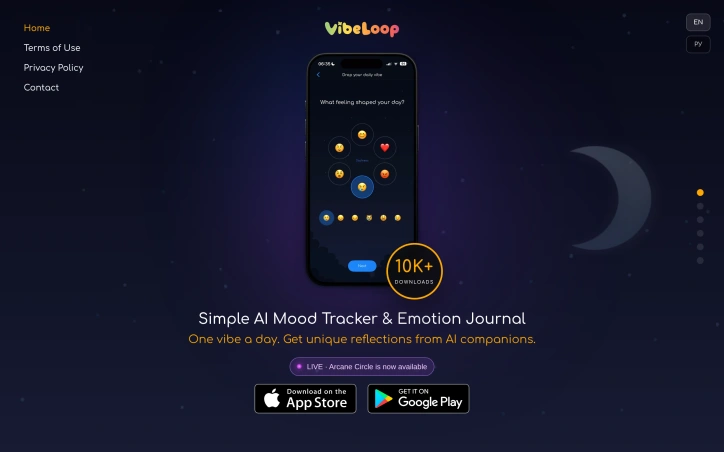
You record one emotion per day, your "vibe". A simple moment, not a stream of entries.
You choose an emotion, refine it, add a short note, and then something unusual happens.
The app responds.
A small council of AI personalities reflects on your emotion, each in a different voice. Some are poetic, some analytical, some brutally honest.
Over time your emotions form patterns. You see them in a calendar and in weekly summaries that turn your moods into a story.
This is not about productivity or optimization. It is about understanding.
More ritual than tracker.
AI Overview
AI-generatedEmotion tracking has long suffered from competing impulses: the clinical efficiency of mood logging strips the practice of meaning, while open-ended journaling can feel like shouting into the void. VibeLoop attempts to thread this needle by treating daily emotional reflection as a ritual rather than a data collection exercise.
The product's core interaction is deliberately minimal. Users record a single emotion per day—their "vibe"—refining it and adding a brief note before the distinctive part begins. Rather than leaving the reflection there, the app responds with observations from a group of AI personalities. These aren't uniform analyses; instead, they represent different perspectives, from poetic reframing to analytical dissection to unflinching honesty. This multiplicity works because a single AI voice risks becoming either a bland mirror or an unwelcome therapist. Multiple voices approximate conversation, each bringing a distinct lens to the same emotional moment.
Where most mood trackers dead-end at daily entry, VibeLoop builds upward. The app surfaces patterns through calendar views and weekly summaries that transform discrete emotional snapshots into narrative. This framing is deliberate: summaries "turn your moods into a story" rather than into a chart. That narrative orientation reveals what the product actually values—pattern recognition and meaning-making, not optimization or self-improvement.
The positioning reflects this clarity. VibeLoop explicitly distances itself from productivity-obsessed wellness apps. There's no claim that tracking mood improves performance or that patterns enable "better choices." Instead, the value proposition is direct: understanding yourself matters. For users fatigued by apps that treat emotions as inputs to be managed, this directness refreshes.
The one-entry-per-day constraint is worth questioning. For some users, emotional life moves faster; for others, daily reflection already feels like journaling, just reframed. But the constraint likely serves the product's identity by resisting the obsessive data collection that makes many tracking apps feel extractive. It keeps the ritual focused.
VibeLoop targets a specific user: someone who journaled once, found it meaningful but incomplete, and wants the space between reflection and response. Whether AI companions authentically fill that gap is the product's real test. But its resistance to the self-improvement framing that dominates wellness is itself valuable—it proves you can build in this space without abandoning honesty.
Founder Diary
DevlogThe maker hasn't posted a diary entry yet.
Key Features
Daily Emotion Logging
Users record a single emotion per day called their vibe with refinement and brief notes
Multi-Perspective AI Feedback
Multiple AI personalities provide distinct perspectives including poetic reframing, analytical dissection, and unflinching honesty
Pattern Recognition
Calendar views and weekly summaries transform emotional snapshots into narrative insights revealing patterns and meaning
Minimalist Design
Deliberately minimal core interaction focused on daily ritual rather than data collection
Narrative Framing
Summaries present moods as stories rather than charts or optimization metrics
Use Cases
-
1
Journaling Enthusiasts
For people who found journaling meaningful but incomplete and want reflection paired with AI response
-
2
Wellness-Fatigued Users
For those exhausted by productivity-obsessed apps that treat emotions as inputs to optimize
-
3
Self-Understanding Seekers
For people who value understanding themselves without pressure for behavioral improvement or performance gains
FAQ
How often do I log my mood? ▾
Is this a productivity or self-improvement app? ▾
What makes the AI different from other mood apps? ▾
Tech Stack & Tags
Discussion
No comments yet — be the first!
Join the conversation — sign up to comment.
Sign up freeCommunity Support
Boost this project on Sell With boost
Meet the Founder

"Creative Technologist With Obsessive Tendencies I build apps, experiments and open-source curiositi..."
More in Mental Health
ND Hive
We built ND Hive because ADHD and neurodivergent...

SetHabits
We built SetHabits because habit apps were makin...

CortexOS - Private AI Journal
I built CortexOS because every journal app I tri...

Uric Acid Low
I built this free tool to help gout sufferers ea...

PouchOut
I built PouchOut to help nicotine pouch users qu...