#mindfulness Startups & Tools
Discover the best mindfulness startups, tools, and products on SellWithBoost.
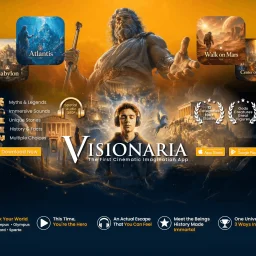
Meditation apps typically ask users to sit in silence and focus on breathing. Visionaria inverts this formula by replacing quiet contemplation with immersive first-person journeys through ancient cities and mythological scenes. The app uses spatial 3D audio—narration, music, and sound design that surrounds the listener—to place users inside historical locations like Sparta, Troy, and Babylon while they close their eyes and imagine. Rather than traditional meditation, Visionaria packages mindfulness as a daily cinematic experience. The product targets two audiences. First are wellness seekers who find conventional meditation tedious but crave daily calm and stress relief. The second are history and mythology enthusiasts who want to learn ancient stories through immersive narrative rather than textbooks. The target context is clear from the founder's framing: this reaches people for whom imagination, not silence, unlocks meditation's benefits. Several features distinguish Visionaria from other audio apps. Each story runs five to twenty minutes, designed for a single daily session that builds habit through streaks and medal-based rewards. The spatial audio technology is the core differentiator—properly applied through headphones, it creates the sensation of environmental sound moving around the listener. Stories are set in real historical places with genuine mythology woven into first-person narration. The app includes a prophecy oracle feature that delivers daily guidance, plus timer controls and iOS widgets to encourage morning and evening use. Gamification appears throughout: users collect medals, map progress across five ancient cities, unlock gifts, and maintain daily streaks. These mechanics add engagement without requiring interaction mid-story. After pressing play, users put the phone down and listen. The business model emphasizes accessibility. Visionaria is free to download with at least one episode per city available without cost, lowering friction for new users. A Premium tier removes ads and unlocks offline listening, though pricing is not disclosed on the public website. What remains unclear is how well the spatial audio translates across different headphone types and listening environments, and whether the mythological content satisfies actual history interest or serves merely as thematic flavor. User reviews suggest visceral responses to the immersion, but whether this remains novel beyond the first month requires extended engagement. Visionaria addresses a real problem for meditation-skeptics, but its long-term retention depends on whether cinematic immersion sustains the calm-building habit its mechanics promise.

Privacy-sensitive journaling stops feeling like an oxymoron once CortexOS is in your pocket. The app speaks squarely to anyone whose diary carries real emotional weight—mental-health trackers, therapy students, individuals under legal or personal threat—yet winces at uploading raw thoughts to external servers. Its blunt thesis is that the only trustworthy steward of your psyche is the phone already in your hand. CortexOS encrypts every entry with AES-256-GCM and locks the key behind a six-word recovery phrase generated locally during installation. Because the phrase produces keys through Argon2id on-device, the developer cannot reproduce it even when served a warrant or data request. The same isolation philosophy powers an impressive technical feat: Meta’s Llama 3.2 language model—either 1 B or 3 B parameters—runs entirely within the app, slicing prompts and producing summaries without a single packet crossing the network. That means reflection, weekly chapter analysis, and 20-point emotion classification happen on silicon you control, not in some distant GPU farm. A Whisper-based speech engine follows the same rule: speak into the microphone and the transcription never leaves the handset, supporting 99 languages and demanding zero cloud credits. The intelligence glows brighter because it feeds solely on your corpus. Each entry contributes to a living psychological profile; the AI highlights persistent cognitive distortions, charts mood against daily variables, and can export a clinician-ready PDF report stripped of any raw text. A still-optional encrypted cloud vault syncs ciphertext blobs that even the company’s servers treat as opaque, preserving offline-first peace of mind whenever you prefer it. Crucially, the company never dangles paywalls over the core promise: the full on-device LLM and zero-knowledge encryption ship to every user on day one. Revenue talk is absent from the pitch, making the product feel less like a trial and more like a manifesto delivered in code. If journals are the R&D lab of the self, CortexOS finally treats that research as classified material—and keeps the clearance level where it belongs.

Emotion tracking has long suffered from competing impulses: the clinical efficiency of mood logging strips the practice of meaning, while open-ended journaling can feel like shouting into the void. VibeLoop attempts to thread this needle by treating daily emotional reflection as a ritual rather than a data collection exercise. The product's core interaction is deliberately minimal. Users record a single emotion per day—their "vibe"—refining it and adding a brief note before the distinctive part begins. Rather than leaving the reflection there, the app responds with observations from a group of AI personalities. These aren't uniform analyses; instead, they represent different perspectives, from poetic reframing to analytical dissection to unflinching honesty. This multiplicity works because a single AI voice risks becoming either a bland mirror or an unwelcome therapist. Multiple voices approximate conversation, each bringing a distinct lens to the same emotional moment. Where most mood trackers dead-end at daily entry, VibeLoop builds upward. The app surfaces patterns through calendar views and weekly summaries that transform discrete emotional snapshots into narrative. This framing is deliberate: summaries "turn your moods into a story" rather than into a chart. That narrative orientation reveals what the product actually values—pattern recognition and meaning-making, not optimization or self-improvement. The positioning reflects this clarity. VibeLoop explicitly distances itself from productivity-obsessed wellness apps. There's no claim that tracking mood improves performance or that patterns enable "better choices." Instead, the value proposition is direct: understanding yourself matters. For users fatigued by apps that treat emotions as inputs to be managed, this directness refreshes. The one-entry-per-day constraint is worth questioning. For some users, emotional life moves faster; for others, daily reflection already feels like journaling, just reframed. But the constraint likely serves the product's identity by resisting the obsessive data collection that makes many tracking apps feel extractive. It keeps the ritual focused. VibeLoop targets a specific user: someone who journaled once, found it meaningful but incomplete, and wants the space between reflection and response. Whether AI companions authentically fill that gap is the product's real test. But its resistance to the self-improvement framing that dominates wellness is itself valuable—it proves you can build in this space without abandoning honesty.