Catalyst Healthspan Audit
Personal trainers typically sell training sessions. This startup reversed the equation by building assessment first, mak...
Launchory
We built Launchory to solve the discoverability problem for startups. Our platform offers instant approval, permanent do...
Best Mental Health Startups & Tools
Tools supporting emotional health, stress reduction, and daily wellbeing.
Recently Listed
6 launches
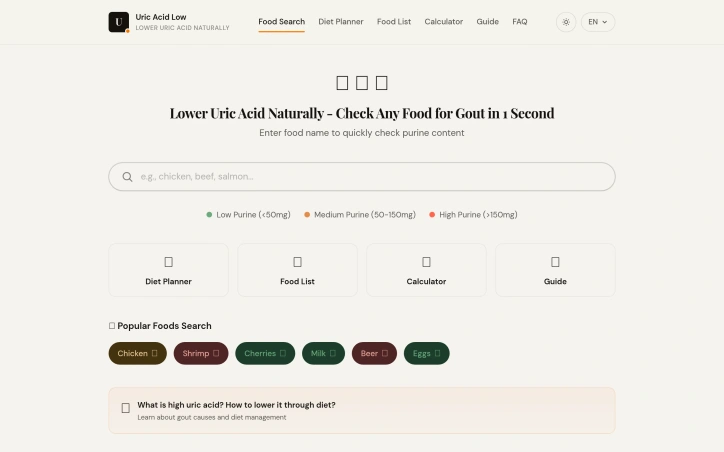
People managing gout often struggle to find practical, accessible guidance on which foods to avoid or embrace. Uric Acid Low addresses this gap by providing a free tool designed specifically for anyone looking to control their condition through dietary changes without the friction of registration. The product centers on a searchable database of over 150 foods categorized by purine content, the compound linked to elevated uric acid levels. Users can instantly check any food's classification as low, medium, or high purine, bypassing the confusion and outdated advice that typically surrounds gout management. The tool removes friction entirely: no signup required, no paywalls between users and the information they need. Beyond the core search function, the platform includes a diet planner for meal construction, a calculator for tracking purine intake, and an educational guide explaining uric acid and gout causes. A dedicated FAQ section with over 50 common questions provides quick answers to concerns that gout sufferers frequently encounter. The founder's motivation stems from real user outcomes—one user reduced their uric acid from 8.2 to 5.9 through dietary intervention, demonstrating that targeted food management can deliver measurable results. The product's accessibility sets it apart in a landscape often dominated by paywalled wellness apps or clinical referrals. By eliminating signup friction and keeping the core tool free, the platform democratizes gout management for someone diagnosed at a doctor's office who needs immediate, actionable guidance. The design philosophy prioritizes speed: searching a food takes seconds, not minutes. Commercially, Uric Acid Low operates as a free tool with affiliate income from recommended supplements like tart cherry concentrate through Amazon Associates. This model avoids direct monetization of users while still generating revenue from ancillary products, a common approach for utility-focused health tools. The main constraint lies in scope: a searchable food database and planning tools can guide dietary choices, but they cannot replace medical supervision or address all gout triggers, which can include genetics and certain medications. Still, for the segment of gout sufferers seeking diet-driven management, the tool delivers a straightforward, friction-free entry point that removes barriers to action.

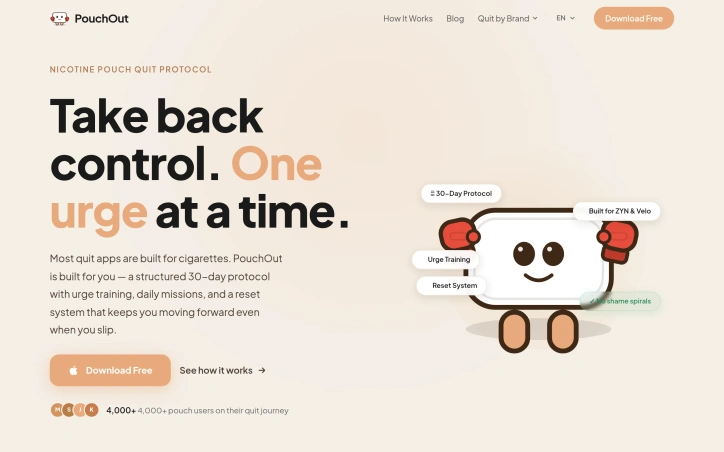
Quitting nicotine pouches can be a challenging task, and most existing quit apps fall short in catering to the specific needs of pouch users, having been primarily designed for cigarette smokers. PouchOut addresses this gap by offering a tailored quit plan that understands the unique habits and challenges associated with nicotine pouch use. The app is designed specifically for users of popular nicotine pouch brands such as ZYN, Velo, and others, providing a structured 30-day protocol to help them overcome their addiction. What stands out about PouchOut is its comprehensive approach to quitting, which involves not just a taper plan but also urge training and a reset system. The app's 30-day protocol is divided into three phases, each designed to build awareness, disrupt habitual behavior, and ultimately give users control over their cravings. The urge training feature allows users to log their urges in seconds, track triggers, and build win streaks, providing a measurable sense of progress. The reset system is also noteworthy, as it protects users' progress and eliminates shame spirals when they slip up, instead guiding them to learn from the trigger and move forward. The app offers a range of features that support the quit journey, including a real-time cost calculator that shows users how much they are saving. By providing a structured and supportive environment, PouchOut empowers users to take back control of their lives. The testimonials from real users attest to the effectiveness of the app's approach, with some reporting significant reductions in their nicotine pouch use. With over 4,000 pouch users on their quit journey, PouchOut has established itself as a valuable resource for those looking to overcome their nicotine pouch addiction. The app is available for free download on the App Store.

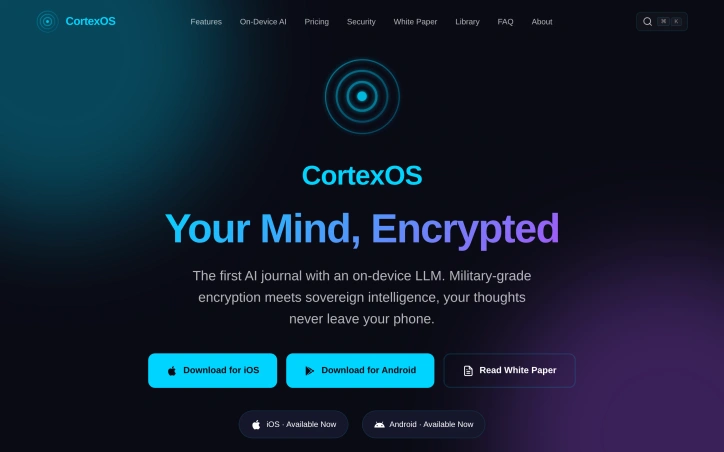
Privacy-sensitive journaling stops feeling like an oxymoron once CortexOS is in your pocket. The app speaks squarely to anyone whose diary carries real emotional weight—mental-health trackers, therapy students, individuals under legal or personal threat—yet winces at uploading raw thoughts to external servers. Its blunt thesis is that the only trustworthy steward of your psyche is the phone already in your hand. CortexOS encrypts every entry with AES-256-GCM and locks the key behind a six-word recovery phrase generated locally during installation. Because the phrase produces keys through Argon2id on-device, the developer cannot reproduce it even when served a warrant or data request. The same isolation philosophy powers an impressive technical feat: Meta’s Llama 3.2 language model—either 1 B or 3 B parameters—runs entirely within the app, slicing prompts and producing summaries without a single packet crossing the network. That means reflection, weekly chapter analysis, and 20-point emotion classification happen on silicon you control, not in some distant GPU farm. A Whisper-based speech engine follows the same rule: speak into the microphone and the transcription never leaves the handset, supporting 99 languages and demanding zero cloud credits. The intelligence glows brighter because it feeds solely on your corpus. Each entry contributes to a living psychological profile; the AI highlights persistent cognitive distortions, charts mood against daily variables, and can export a clinician-ready PDF report stripped of any raw text. A still-optional encrypted cloud vault syncs ciphertext blobs that even the company’s servers treat as opaque, preserving offline-first peace of mind whenever you prefer it. Crucially, the company never dangles paywalls over the core promise: the full on-device LLM and zero-knowledge encryption ship to every user on day one. Revenue talk is absent from the pitch, making the product feel less like a trial and more like a manifesto delivered in code. If journals are the R&D lab of the self, CortexOS finally treats that research as classified material—and keeps the clearance level where it belongs.

Emotion tracking has long suffered from competing impulses: the clinical efficiency of mood logging strips the practice of meaning, while open-ended journaling can feel like shouting into the void. VibeLoop attempts to thread this needle by treating daily emotional reflection as a ritual rather than a data collection exercise. The product's core interaction is deliberately minimal. Users record a single emotion per day—their "vibe"—refining it and adding a brief note before the distinctive part begins. Rather than leaving the reflection there, the app responds with observations from a group of AI personalities. These aren't uniform analyses; instead, they represent different perspectives, from poetic reframing to analytical dissection to unflinching honesty. This multiplicity works because a single AI voice risks becoming either a bland mirror or an unwelcome therapist. Multiple voices approximate conversation, each bringing a distinct lens to the same emotional moment. Where most mood trackers dead-end at daily entry, VibeLoop builds upward. The app surfaces patterns through calendar views and weekly summaries that transform discrete emotional snapshots into narrative. This framing is deliberate: summaries "turn your moods into a story" rather than into a chart. That narrative orientation reveals what the product actually values—pattern recognition and meaning-making, not optimization or self-improvement. The positioning reflects this clarity. VibeLoop explicitly distances itself from productivity-obsessed wellness apps. There's no claim that tracking mood improves performance or that patterns enable "better choices." Instead, the value proposition is direct: understanding yourself matters. For users fatigued by apps that treat emotions as inputs to be managed, this directness refreshes. The one-entry-per-day constraint is worth questioning. For some users, emotional life moves faster; for others, daily reflection already feels like journaling, just reframed. But the constraint likely serves the product's identity by resisting the obsessive data collection that makes many tracking apps feel extractive. It keeps the ritual focused. VibeLoop targets a specific user: someone who journaled once, found it meaningful but incomplete, and wants the space between reflection and response. Whether AI companions authentically fill that gap is the product's real test. But its resistance to the self-improvement framing that dominates wellness is itself valuable—it proves you can build in this space without abandoning honesty.

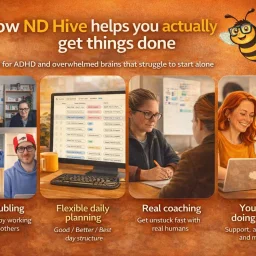
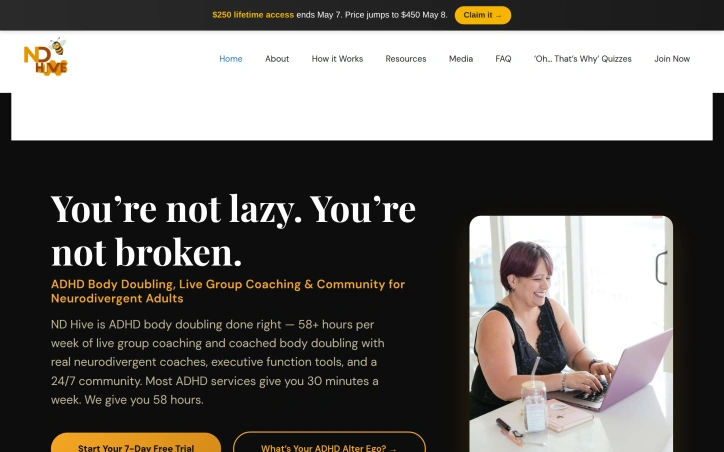
Burnout and task paralysis plague millions of adults with ADHD and autism spectrum traits, yet most productivity solutions ignore the neurodivergent brain entirely. ND Hive addresses this gap by centering on a deceptively simple mechanism: body doubling—the measurable boost in focus and task completion that comes from working alongside others in real time. The platform operates as a daily coworking community with live sessions led by human coaches. Members join drop-in sessions, pick a task to complete, and work through it with accountability from both coaches and fellow participants. No complex app tutorials, no 47-step setup process. The simplicity is intentional. ADHD and autism often coexist with executive dysfunction that makes navigating byzantine software interfaces itself a barrier to use. What distinguishes ND Hive is its explicit design for neurodivergent needs rather than neurotypical defaults. The accompanying "Hub" provides structured tools—capacity planners, task breakdowns, emotion check-ins, and a completion tracker—built around how divergent brains actually operate. Sessions accommodate 58 hours per week of access, but participation is fluid. Members can attend one session or many, with no penalty for inconsistency. The company makes a specific empirical claim worth noting: its own data shows meaningful behavioral shifts by day three for most users, with larger transformations reported by day seven. Testimonials from the site reflect this pattern. A therapist reported reduced burnout within 72 hours. A college student moved from feeling paralyzed by workload to managing coursework effectively. A working parent progressed from chronic task avoidance to career advancement. These aren't outlier claims—body doubling is an established phenomenon in ADHD literature, and the company leverages it directly. The target audience is clear: working professionals, students, parents, and founders who recognize their difficulty isn't laziness or broken executive function, but rather isolation and lack of accountability structures suited to their neurology. For this cohort, the friction of traditional goal-setting apps or generic coworking spaces is real. ND Hive eliminates that friction by removing onboarding complexity and designing every interaction around neurodivergent cognition. The model includes a seven-day free trial, suggesting a subscription foundation, though specific pricing isn't disclosed in the available materials.

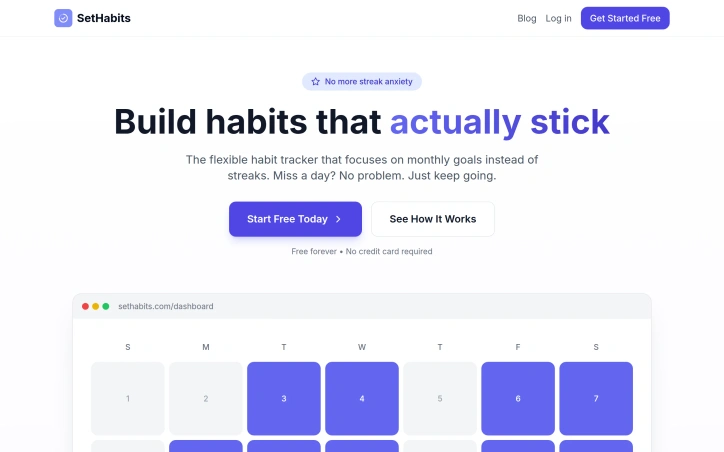
Modern habit-tracking apps have created an unexpected problem: the anxiety of maintaining perfect daily streaks. A new entrant in the productivity space takes direct aim at this phenomenon by replacing the all-or-nothing streak model with a more forgiving monthly framework. The product is designed for people who want to build genuine habits but get discouraged when life inevitably gets in the way—missing a day shouldn't derail months of progress. SetHabits positions itself explicitly around psychological sustainability rather than gamification. Where traditional trackers emphasize consecutive-day chains, this tool sets monthly targets (like completing a habit 20 out of 30 days) and visualizes progress through a clean calendar interface. The approach reflects a fundamental understanding of behavior change: consistency matters more than perfectionism, and shame typically undermines long-term progress rather than motivating it. The product philosophy centers on aggressive simplicity. Habits can be added and logged in seconds, and the interface resists the feature bloat that plagues most productivity software. Users see their monthly progress at a glance through visual calendar data without navigating graphs or reports. The free tier supports up to five habits alongside monthly calendar views, basic statistics, and daily reminders. A weekly habit-tips email is included across all plans. The business model employs a straightforward freemium structure. The Premium tier costs $3.99 monthly or $29.99 annually and adds unlimited habits, AI-powered insights, weekly summary emails, detailed statistics, and custom habit colors. A lifetime access option at $59.99 exists with supply intentionally capped at 100 licenses—a transparent scarcity strategy targeting early adopters. The pricing is genuinely accessible for individual users while providing credible upgrade incentives. What distinguishes this product most sharply is its counter-cultural positioning. Rather than amplifying the perfectionism baked into most habit software, it explicitly rejects streak anxiety in favor of a more realistic, sustainable approach. The execution matches the philosophy: minimal interface, limited features, and transparent pricing all signal that the team grasps what struggling habit-builders actually need. For people burned out on guilt-driven productivity tools, this represents a genuinely different value proposition grounded in behavioral realism rather than motivational hype.