Catalyst Healthspan Audit
Personal trainers typically sell training sessions. This startup reversed the equation by building assessment first, mak...
Launchory
We built Launchory to solve the discoverability problem for startups. Our platform offers instant approval, permanent do...
Best Activity tracking Startups & Tools
Track workouts, habits, sleep, and time to reveal patterns.
Recently Listed
4 launches
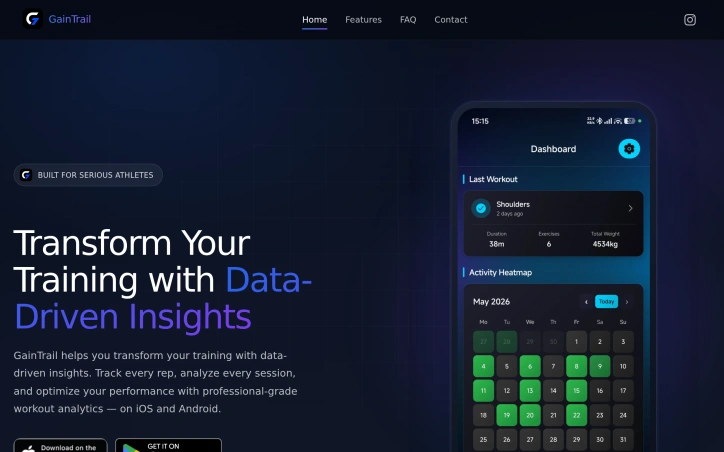
Athletes who track their workouts often face a familiar problem: fitness apps excel at logging sets and reps, but fall short in answering the questions that matter most. Why isn't progress accelerating? Which muscle groups need more attention? Does this training plan actually balance the intended stimulus? GainTrail tackles this gap by combining workout logging with performance analytics designed for athletes serious about data-driven training. The app targets strength athletes, powerlifters, and conditioning-focused trainers who follow structured programs. Whether someone is running a hypertrophy block, a powerlifting cycle, or mixed strength and conditioning work, GainTrail captures the complexity: sets, reps, weight, rest timing, and program structure. The workout builder supports five advanced block types—Standard, EMOM, Pyramid, Cluster, and Superset—allowing users to replicate real-world programming within the app. A library of over 1,000 exercises speeds setup and reduces friction between planning and execution. The standout capability is the analytics layer. After each session, GainTrail breaks down performance at the set level, tracking total volume, time under tension, and muscle activation by group. Users see weekly volume distributions across muscle groups, which exercises generate the most load, and where programming may emphasize or neglect certain patterns. These visualizations—including muscle heatmaps and interactive charts—transform raw workout data into actionable patterns. A secondary feature adds an AI layer: users can submit a training plan against stated goals (muscle growth, strength, endurance, or general fitness), and the system returns a scored review with feedback on exercise selection, muscle balance, and weekly structure. This functions as a second opinion on programming before committing weeks to training. Sync across devices means a workout logged at the gym appears instantly on other phones or tablets, removing the friction of manual entry across platforms. The app also tracks personal records and strength curves over custom time windows, surfacing trends that inform future programming decisions. GainTrail is free to download on iOS and Android, with no mention of premium tiers or paywalls in the promotional material. This positions it as an accessible entry point for athletes already thinking analytically about their training. The product is purposeful: it doesn't attempt to be a social fitness network or a general wellness tracker. It narrows focus to athletes who understand their program structure and want quantitative feedback on their execution. That specificity is its strength.

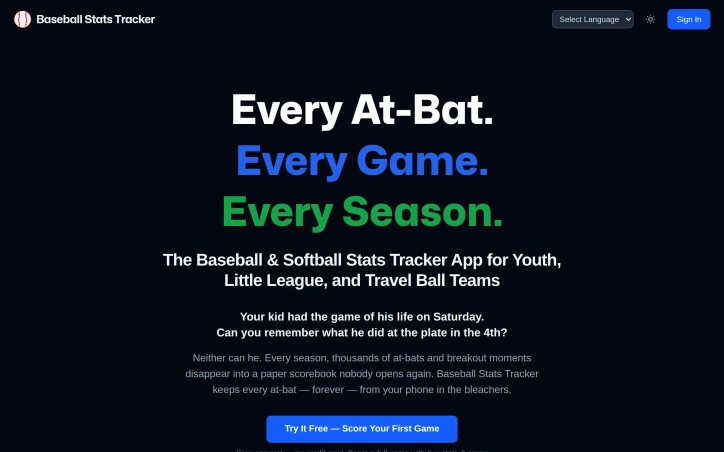
Parents managing youth baseball rosters spend far too much time reconstructing box scores from memory and crumpled scorecards. Baseball Stats Tracker solves this squarely by putting live game scoring on a smartphone, turning bleacher moments into permanent statistical records. The app targets youth baseball and softball families who track games but lack systematic infrastructure to do so. The founder, self-identified as a baseball dad, built the product to address a real gap: thousands of at-bats and notable performances vanish each season because paper scorebooks are never consulted again. The app captures every plate appearance in real time, synced across devices and accessible to coaches and relatives watching from home. What distinguishes this product is its pricing model. At 39 dollars one time with no recurring subscription, it positions itself against both free solutions and apps with monthly fees. The developer offers a free trial to score an entire game and backs the paid version with a thirty-day money-back guarantee, reducing friction for buyers uncertain whether the tool fits their situation. The feature set reflects actual use at the field. Live scoring works from a phone in the bleachers with large buttons and readable text in sunlight. The app automatically calculates batting statistics including average, on-base percentage, slugging percentage, and OPS, eliminating manual math. Spray charts display where players actually hit the ball across individual games and full seasons. Pitcher statistics track innings pitched, ERA, strikeouts, and walk counts. Splits analysis breaks performance down by opponent pitcher handedness and specific opponents, moving beyond gut feeling to data-driven observation. Supporting features include opponent roster preloading, live sync across devices, inning-by-inning box scores, and unlimited teams and seasons within the single purchase. The app also generates a shareable live link that allows grandparents and other family to follow a game in real time without attending. The product targets a specific frustration in youth baseball culture and prices itself accessibly against both paper-based alternatives and software-as-a-service competitors. By focusing on bleacher usability rather than complex analytics, the app addresses its audience directly.

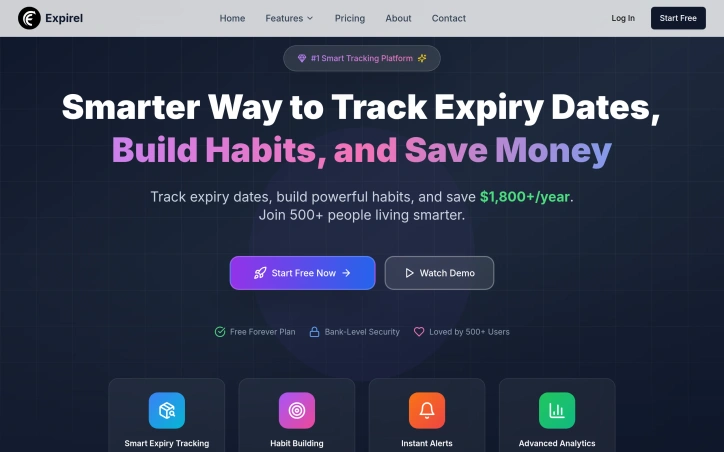
Tracking expiry dates and building habits can be a daunting task, but a smart platform is simplifying this process for individuals. Expirel is designed for anyone looking to reduce waste, stay consistent, and save money. At its core, the platform addresses the issue of keeping track of various expiry dates, whether for food, medicines, documents, or subscriptions, and helps users develop lasting habits. What stands out about Expirel is its comprehensive approach to tracking and reminders. It allows users to add items quickly, set reminders according to their preferences, and receive notifications via email or WhatsApp. The platform's ability to integrate habit tracking alongside expiry date monitoring is particularly noteworthy, providing a holistic view of one's progress and consistency. The platform boasts several key features, including a smart barcode scanner for automatic product information and expiry date detection, multi-channel alerts to ensure users never miss an important date, and a habit streak system with gamification elements to foster motivation. Advanced analytics also enable users to visualize their progress and track the financial benefits of using the platform. Users can start with Expirel for free, and the platform explicitly mentions a "Free Forever Plan." The emphasis on bank-level security and the mention of features like team collaboration suggest that the platform is also considering the needs of power users and potentially businesses, although the details of its business model beyond the free plan are not extensively elaborated. By simplifying the process of tracking expiry dates and building habits, Expirel helps its users save an average of $1,800 annually and reduce waste significantly.

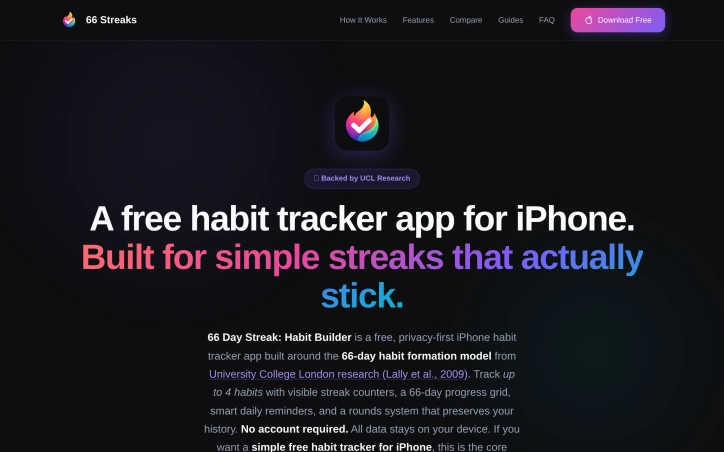
Habit tracking has become unnecessarily complex. Most popular apps bury their core function—simple daily logging—beneath feature-heavy dashboards that overwhelm rather than motivate. 66 Streaks corrects this by stripping away the noise and building around a single, research-supported principle: it takes 66 days, not 21, for a behavior to become automatic. The app's foundation rests on a 2009 study from University College London by Dr. Phillippa Lally and colleagues, published in the European Journal of Social Psychology. Their work tracked 96 participants and found that habit formation averaged 66 days, with a range between 18 and 254 days. This contradicts the widely repeated "21-day rule," often misattributed to Maxwell Maltz's 1960 book, which lacks scientific backing. Follow-up research from King's College London reinforced that real behavioral change requires consistent repetition far beyond three weeks. By anchoring the entire product around this precise timeframe, 66 Streaks gives users a legitimate finish line rather than an arbitrary target. The feature set reflects this philosophy of restraint. Users can track up to four habits simultaneously through a combination of visible streak counters, a 66-day progress grid, and daily reminders. The app includes a rounds system to preserve history across multiple habit cycles. Critically, it operates entirely offline—no account creation, no login requirement, and all data remains on the user's device. This privacy-first approach eliminates friction at the point of entry and addresses legitimate concerns about data handling. The product is positioned as free on the Apple App Store with no subscription component. This pricing structure removes another barrier to adoption while betting that simplicity itself becomes the retention mechanism. 66 Streaks targets people fatigued by overengineered productivity tools who want a focused, daily check-in system backed by actual behavioral science. The execution suggests the founders understood what makes habit trackers fail in practice: complexity and endless targets. By solving for those specific pain points rather than competing on feature count, the app addresses a genuine gap in the market where most competitors prioritize comprehensiveness over usability.