Catalyst Healthspan Audit
Personal trainers typically sell training sessions. This startup reversed the equation by building assessment first, mak...
Launchory
We built Launchory to solve the discoverability problem for startups. Our platform offers instant approval, permanent do...
Best Workout platforms Startups & Tools
Plan, track, or coach training across strength, cardio, and classes.
Recently Listed
4 launches
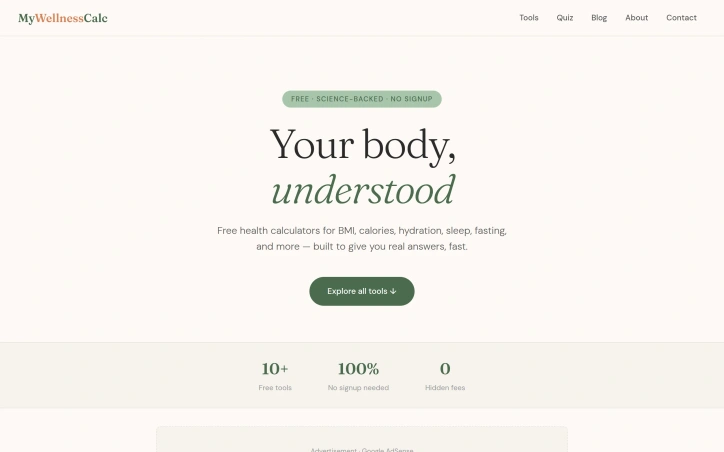
Personalized health guidance typically demands friction—lengthy questionnaires, account creation, sometimes a subscription. This platform eliminates those obstacles by offering a stripped-down collection of health calculators that deliver results without mandatory signup or hidden charges. The product addresses a real gap in the market. People seeking personalized fitness data often face a choice between unreliable rules of thumb and apps that treat registration as a prerequisite. My Wellness Calc positions itself as a third path: immediate access to science-backed tools across a surprising breadth of health domains. What distinguishes the offering is its scope. Rather than a single calculator, the platform bundles over a dozen specialized tools spanning metabolic rates, cardiovascular fitness, body composition, and recovery protocols. The collection ranges from foundational measures like BMI and calorie expenditure to more sophisticated metrics such as VO2 max estimation and zone-specific heart rate training ranges. This variety attracts different user archetypes—from beginners validating their weight-management math to serious athletes fine-tuning training intensity zones. The execution reflects a deliberate philosophy around frictionless access. Each tool computes personalized results in seconds using metric or imperial inputs. The interface avoids the common trap of information overload, instead pairing calculations with explanatory context so users understand their numbers, not just receive them. For those planning fitness interventions—whether intermittent fasting windows, sleep-cycle alignment, or macro targets—the platform provides one-page clarity. Technically, the tools integrate one advertising network (Google AdSense), which supports the free model without paywalls or recurring revenue schemes. This decision trades subtle display clutter for zero financial barriers, a straightforward trade-off that aligns with the stated mission. The weaknesses are implicit in the design. Browser-based calculators live or die by accuracy; without independent validation or transparent methodology disclosure, users must trust the formulas blindly. No mobile app means the experience is tethered to desktop browsing. And while breadth is a strength, the tools lack the depth of specialized platforms—a VO2 max calculator that requires field test data cannot replace devices that measure it directly. Still, for someone seeking a quick, credible answer to a health calculation without the friction of authentication or cost, the platform delivers exactly what it promises. In a market often predicated on engagement through onboarding walls, the directness is refreshing.
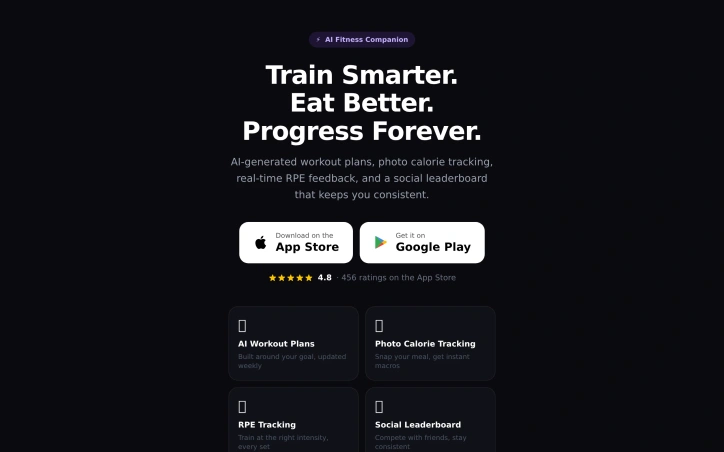
Fitness enthusiasts often struggle to maintain consistency in their workout routine and nutrition planning, hindering their progress toward their fitness goals. Soma addresses this issue by providing a comprehensive AI-powered fitness companion that helps users train smarter and eat better. What sets Soma apart is its robust integration of AI-generated workout plans that adapt to the user's progress and performance. This is complemented by a photo calorie tracking feature that simplifies nutrition logging by instantly providing macro breakdowns of meals. The app's real-time RPE feedback ensures users are training at the right intensity, while the social leaderboard fosters a competitive environment that keeps users motivated and consistent. The key features of Soma include AI-generated workout plans that are updated weekly based on the user's goals and progress, photo calorie tracking that eliminates the need for manual logging, and a social leaderboard that allows users to compete with friends. The app is designed for individuals seeking a structured and personalized approach to their fitness journey, with its features catering to the needs of both beginners and experienced athletes. With over 1,700 athletes already using the app and a rating of 4.8 from 456 reviews on the App Store, Soma has demonstrated its effectiveness and user satisfaction. The app is available for download on both iOS and Android devices, with a calorie database featuring nutrition facts and calorie counters for common foods available for free download. Overall, Soma presents a compelling solution for individuals seeking a holistic and technology-driven approach to fitness and nutrition planning.
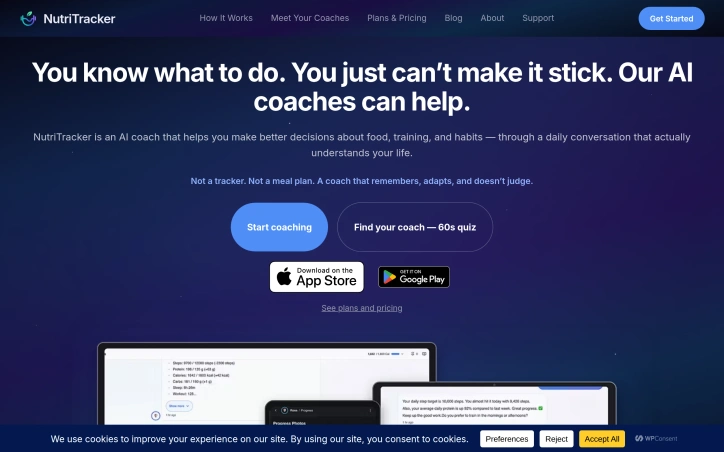
Consistency in fitness and nutrition is notoriously difficult. Most people know what they should do—eat better, exercise regularly, build sustainable habits—but fail at the execution. Willpower crumbles by midweek, life circumstances disrupt plans, and one slip-up becomes a total restart. NutriTracker positions itself as a solution to this endemic problem, offering an AI coach designed to help users navigate the gap between intention and practice. The product targets people who have already tried conventional approaches—fitness trackers, calorie counters, spreadsheets, even personal trainers—without achieving lasting change. The pitch is straightforward: rather than logging meals and hitting numerical targets, users engage in ongoing conversations with a customizable AI coach that learns their individual constraints and helps them recover from inevitable lapses instead of abandoning efforts altogether. What distinguishes NutriTracker from traditional fitness apps is its emphasis on adaptability and psychological resilience. The core insight is that most coaching fails when life interferes, so the system is designed to recognize disruptions and help users salvage a week rather than write it off entirely. The app integrates with health data platforms like Apple Health and MyFitnessPal, allowing the coach to reference actual activity, sleep, and nutrition data when offering advice tailored to the user's real circumstances rather than generic recommendations. The product also emphasizes user control and safety boundaries. The coach operates within explicit guardrails: it won't attempt diagnosis, prescribe treatments, or assume medical authority. Users can pause the coach's memory, delete shared information, and customize communication style and frequency. Data is encrypted and the company is GDPR compliant, catering to privacy-conscious users. A testimonial on the site claims one user found the app more effective than previous attempts at habit change, though such anecdotal evidence is inherently limited. The main limitation of the available information is opacity around pricing and business model. The site mentions pricing tiers exist but provides no details on cost, free trial availability, or subscription structure—crucial factors for potential customers evaluating whether the product is accessible to them. This gap makes it difficult to assess whether NutriTracker is positioned as a premium coaching alternative or a mass-market app.

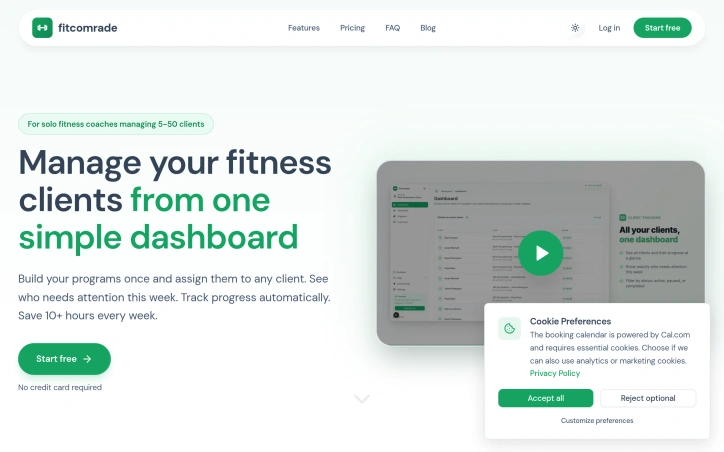
Solo fitness coaches juggling multiple client programs face a familiar administrative burden: rebuilding the same workout templates for different clients, tracking progress across a scattered client base, and managing the friction of app downloads and password resets. FitComrade targets this pain point directly, positioning itself as a lightweight coaching management platform for trainers managing between five and fifty clients. The product centers on three core functions. Its program builder lets coaches create templates once and deploy them to multiple clients without duplication. A dashboard consolidates client tracking into a single view, categorizing clients by their current status to highlight who needs attention. The client-sharing feature removes adoption friction by generating shareable links that load directly in any web browser—no app installation or account setup required. What distinguishes FitComrade in a crowded market is its pricing approach. Unlike competitors Trainerize and TrueCoach, which charge per-client fees that compound as a coach's roster grows, FitComrade decouples its pricing from client count. The free tier supports one active client indefinitely with unlimited program templates and core tracking features. The paid tier costs thirty dollars monthly, discounted to one dollar for the first month, and unlocks multiple active clients, shareable program links, and additional content categories including yoga and nutrition. This structure removes one obstacle to growth—coaches can expand their client base without proportional increases to software costs. The platform emphasizes simplicity in its design language, claiming that coaches without technical expertise can navigate it intuitively. The program builder takes a visual, day-based approach rather than forcing users into complex data entry. Support for workouts, meals, yoga, and habits suggests flexibility across different coaching disciplines. Whether FitComrade delivers on its claim to restore ten or more hours weekly depends on how substantially it streamlines a coach's actual workflow. The emphasis on template reuse and consolidated tracking addresses real friction points. The platform targets smaller coaching operations; coaches managing fifty clients across multiple disciplines or those needing advanced automation will exhaust its capabilities. For solo trainers in the five-to-fifty-client range seeking to reduce administrative overhead without substantial software costs, the value proposition is clear.