Catalyst Healthspan Audit
Personal trainers typically sell training sessions. This startup reversed the equation by building assessment first, mak...
Launchory
We built Launchory to solve the discoverability problem for startups. Our platform offers instant approval, permanent do...
Best No-Code App Builder Startups & Tools
Drag-and-drop builders for rapid app prototyping.
Recently Listed
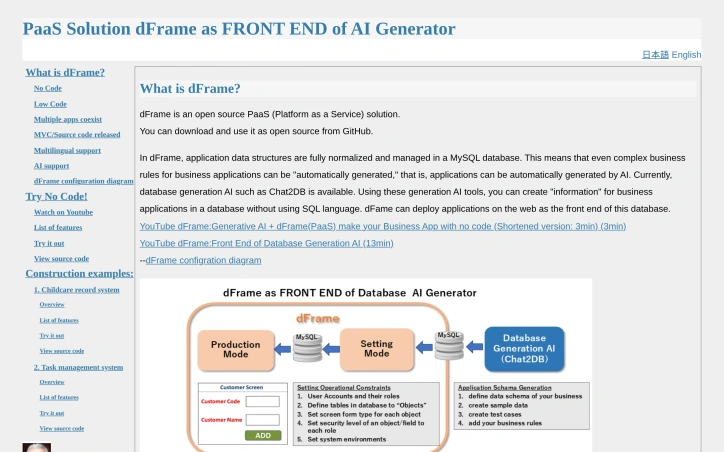
2 launchesOpen-source platforms that eliminate the need for custom programming have gained traction in recent years, but most still require at least some technical knowledge. dFrame tackles a specific problem: automating the creation of business applications directly from normalized database schemas, without requiring developers to write frontend code. The platform targets organizations that want to deploy operational applications quickly, particularly those working alongside AI database generation tools like Chat2DB. Rather than starting from scratch, users can leverage AI to generate database structures, then have dFrame automatically produce the web interface layer. This workflow removes two major friction points: SQL expertise and frontend development. What distinguishes dFrame from generic no-code platforms is its architectural approach. Applications generated through dFrame run against fully normalized MySQL databases, with each application stored in its own database schema. This encapsulation creates clear boundaries between applications, improving maintainability and making it feasible to host multiple applications on a single instance. For teams that need custom logic beyond basic data operations, the platform offers a low-code path through MySQL procedures, views, functions, and triggers, avoiding the need to rewrite entire application layers. The feature set covers typical business application needs: data entry, searching, editing, and list views with pagination. Export capabilities include PDF and CSV formats. The workflow follows a natural progression—users define objects and fields in a settings mode, then switch to an application mode for actual data operations. Existing database schemas can be imported directly, eliminating setup friction for teams migrating from legacy systems. The platform is available as open source through GitHub, removing licensing barriers to adoption. No explicit pricing model appears in available materials, suggesting this is positioned as a community-driven project rather than a commercial offering. The documentation positions dFrame primarily around AI integration and no-code workflows, though the practical limitations of purely no-code systems deserve consideration. The platform works best for applications with standard CRUD operations and normalized data structures. More specialized requirements would require stepping into the low-code layer, which increases complexity accordingly. dFrame positions itself as infrastructure for a specific workflow: leveraging AI to generate database structures, then exposing them through automatically generated web interfaces. Organizations with this exact need have a working solution. Those building more complex applications or requiring deep customization would need to evaluate whether the low-code extensions or hand-coding alternatives better serve their timeline and capability constraints.
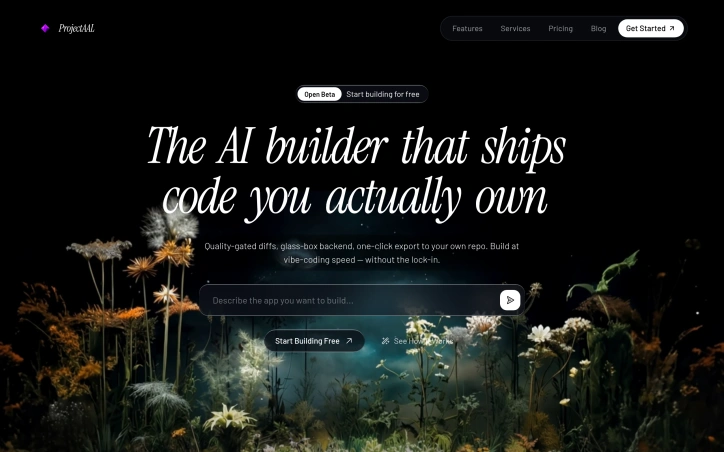
Slow web app development has long been a constraint for engineering teams, with developers spending weeks building boilerplate and handling infrastructure configuration before they can focus on features that actually matter. ProjectAAL addresses this bottleneck head-on with an AI-powered code generation platform that produces production-ready applications instantly. The platform's core value proposition centers on accelerating the development workflow through smart multi-model routing. Rather than treating AI code generation as a one-size-fits-all solution, the architecture leverages multiple AI models for different code generation tasks. This thoughtful approach distinguishes ProjectAAL from simpler generative solutions that often sacrifice code quality for speed. Developers building web applications stand to benefit most directly, particularly those working in fast-paced environments where rapid prototyping or MVP delivery carries business importance. The platform's ability to generate deployable code eliminates the traditionally tedious setup phase, allowing engineering teams to shift focus toward business logic and user experience faster than conventional development workflows permit. The claimed 90% reduction in development time directly addresses a real pain point in software development. The practical impact will vary depending on project scope, complexity, and how much custom logic sits outside the generation framework. The explicit emphasis on maintaining code quality alongside speed sets ProjectAAL apart from template-based solutions that produce working but architecturally questionable output. What remains less clear from the available information is how the product handles edge cases, proprietary business logic, or projects that diverge significantly from common architectural patterns. The multi-model routing indicates sophistication in handling diverse scenarios, though the specifics of when and how developers extend or customize generated code beyond the initial generation phase deserve more explanation. For development teams frustrated by the friction of setup and boilerplate, ProjectAAL offers a compelling alternative to traditional development frameworks. The product's simultaneous emphasis on speed and code quality suggests maturity beyond simple proof-of-concept, though real-world outcomes will ultimately depend on the application domains where teams deploy it.