Catalyst Healthspan Audit
Personal trainers typically sell training sessions. This startup reversed the equation by building assessment first, mak...
Launchory
We built Launchory to solve the discoverability problem for startups. Our platform offers instant approval, permanent do...
Best Online learning Startups & Tools
Interactive courses and workspaces for skill-building.
Recently Listed
14 launches
Measuring soft skills within organizations remains a persistent challenge, typically relying on cumbersome self-assessments and surveys that drain time and rarely capture authentic behavioral patterns. Helix targets both individual professionals seeking personal development and organizations trying to understand and improve team capabilities through data-backed insights rather than subjective evaluation. What sets this offering apart is its passive measurement approach. Rather than requiring employees to complete questionnaires, Helix joins video meetings on Microsoft Teams, Zoom, and Google Meet to analyze behavioral signals in real time. Using a combination of OpenAI's capabilities and a proprietary scoring engine, the tool identifies patterns in soft skills—communication, collaboration, leadership, and others from a set of nine core competencies—then delivers personalized insights within minutes of a call ending. The product's feature set addresses a gap in existing talent development workflows. Weekly summaries aggregate trends over time, visual dashboards let individuals track their own progress, and a built-in AI coaching tool recommends targeted learning resources based on identified growth areas. For HR and L&D leaders, a company-wide dashboard surfaces skills gaps across teams and measures the return on learning investments, providing strategic visibility into organizational capability. The non-intrusive design stands out as particularly valuable. By operating silently within existing communication tools rather than asking employees to adopt new platforms or complete additional surveys, Helix reduces friction that typically limits engagement with development initiatives. The inclusion of actual meeting transcript snippets alongside recommendations adds specificity that generic coaching often lacks. One consideration worth noting: the product's effectiveness depends on the accuracy of its behavioral analysis engine. The marketing materials emphasize that the 3Q Engine weighs quantitative signals, qualitative patterns, and sentiment analysis, yet independent validation of these scoring mechanisms remains unavailable from the information provided. For organizations serious about moving beyond vanity metrics in talent development and individuals looking for objective feedback on professional growth, Helix presents a compelling shift toward behavioral measurement over self-reported assessment.


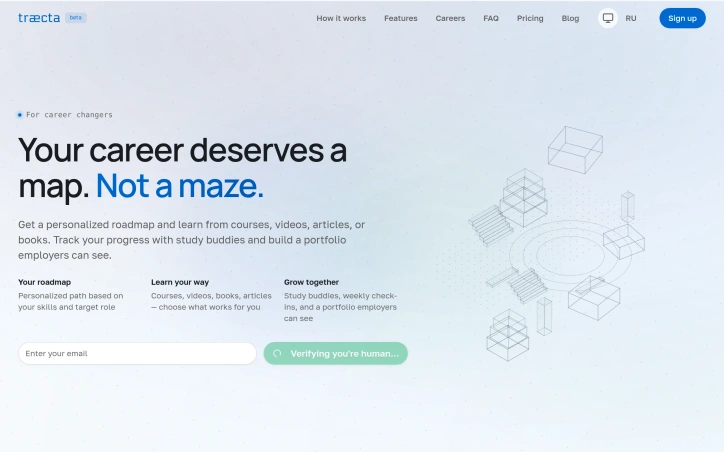
Career changers typically encounter a universal problem: most learning platforms treat all students the same, forcing them through content they've already mastered while ignoring their existing foundation. Traecta addresses this friction by building personalized learning roadmaps designed specifically for professionals transitioning between industries. The platform targets career switchers moving from roles like design to frontend development, accounting to data analysis, or teaching to technical writing. Rather than presenting exhaustive course libraries, Traecta constructs adaptive learning paths that skip redundant material and focus exclusively on skill gaps. This respect for prior experience cuts through the cognitive overload that plagues traditional online learning. What distinguishes Traecta centers on its three-stage framework. Users spend two minutes answering questions about their current skills and target role, receive an instant personalized roadmap, then track progress through concrete milestones. The platform emphasizes practical work—learners complete projects, upload portfolios, and build demonstrable proof of competency that employers can evaluate directly. This portfolio-first approach directly challenges the certificate-heavy model dominating the industry. The platform incorporates several features that reinforce this philosophy. Users select from multiple learning formats—courses, videos, books, articles—rather than following a prescribed sequence. This flexibility acknowledges that different professionals absorb knowledge differently. A skill profile maps abilities across multiple dimensions, giving learners visibility into exactly where they stand and what to prioritize next. Community elements add another layer. Study buddies and weekly check-ins connect learners pursuing the same career transitions, replacing the isolation of self-directed online education with peer accountability and feedback. This acknowledges an often-overlooked factor: career changes succeed more reliably when accompanied by social reinforcement. The underlying proposition cuts against convenience and completeness, two temptations in digital education. Traecta deliberately excludes irrelevant material and emphasizes depth over breadth, betting that professionals changing careers want precision over choice paralysis. Whether this translates to measurable results—faster transitions, higher retention, better employment outcomes—remains to be demonstrated in practice. But the fundamental insight driving the product resonates: career development, especially across industries, demands customization, not commodification.
Choosing the right professor shapes the entire college experience, yet students typically make this decision with incomplete information. Rate My Professor addresses this knowledge gap by aggregating candid assessments from actual students to help learners identify instructors whose teaching styles and classroom dynamics align with their needs. The platform targets undergraduate and graduate students navigating course selection. By collecting anonymous peer reviews without requiring an account, it lowers barriers to both contributing and accessing honest feedback. Students understand institutional incentives to remain quiet, so anonymity becomes the prerequisite for truth-telling. Their evaluations accumulate toward shaping others' decisions. What distinguishes Rate My Professor is its multi-faceted rating system. Rather than collapsing professor quality into a single score, the platform captures nuanced dimensions: teaching quality, course difficulty, personality, treatment of students, subject mastery, and research guidance capacity. This granularity acknowledges that great teaching takes different forms and matters differently across disciplines and learning preferences. A student seeking rigorous methodology critiques values a professor differently than one prioritizing accessible mentorship. The submission process emphasizes verification without friction. Respondents complete a simple verification check to prove familiarity with the professor, blocking spam while preserving anonymity. The form guides constructive feedback and explicitly discourages personal information sharing, encouraging substantive critique over character attacks. Rate My Professor operates across multiple countries and represents thousands of universities worldwide. The platform reports fifty thousand professors rated globally, over five hundred thousand reviews collected, and influence on more than one million course decisions. This breadth suggests network effects: the more students contribute, the more valuable the resource becomes for future enrollees. The product's restraint is notable. It sticks to its core function—professor reviews—without feature creep toward social networking, grade distribution, or tangential additions. This focus strengthens its utility as a decision-making tool rather than a time sink. The absence of a paywall or account requirement removes friction during registration periods when students most need this information. Rate My Professor fills a genuine void in course planning by systematizing peer knowledge and making it accessible, shifting professor selection from guesswork to informed choice.


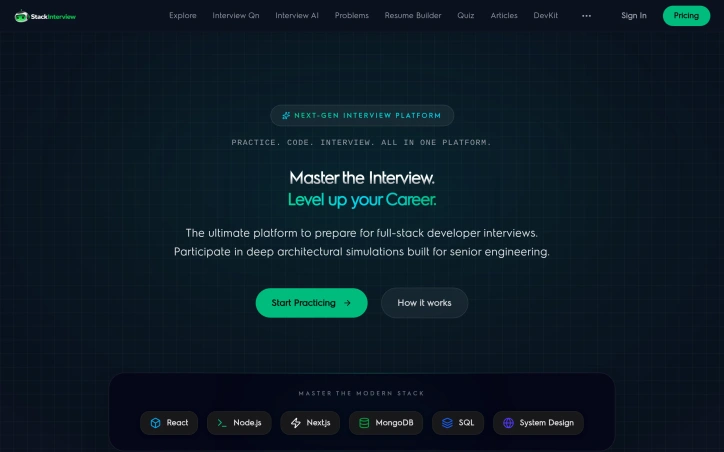
Preparing for technical interviews typically forces candidates into exhausting fragmentation: hunting for relevant questions across scattered blog posts, switching to separate coding platforms for DSA practice, and hoping they can communicate their thinking clearly during the actual interview. Stack Interview consolidates this workflow into a unified, free platform targeting developers aiming for senior-level roles. The platform tackles three specific pain points head-on. Its question bank of 1,000+ scenarios focuses on modern stack technologies—React, Node.js, Next.js, MongoDB, SQL, and system design—rather than generic definitions. These are architected around realistic problems candidates encounter in interviews at top companies. The second pillar, 215+ data structures and algorithms problems, comes with live code execution directly in the browser, eliminating the friction of local setup. Rather than leaving communication to chance, the platform includes an AI-driven mock interview feature that accepts voice input, scores responses across technical depth and communication clarity, and tailors questions to a candidate's selected target company. What distinguishes Stack Interview from existing interview prep resources is its scope consolidation. Most platforms optimize for one dimension—question banks, coding environments, or interview simulation. By integrating all three with supporting analytics like weakness tracking and company-specific readiness scoring, the tool reduces context switching and cognitive load during preparation. The business model reflects an unusual commitment to accessibility: everything is available for free with no paywall. The founder, a solo developer, built this after struggling with the exact inefficiencies the platform now solves. That origin story carries weight because the product solves real friction rather than imagined problems. The platform does target a specific audience. Candidates preparing for mid-to-senior roles in full-stack development will find the most value; those pursuing other specialties or junior-level positions may find the content overscoped. The voice-based AI interview feature, while innovative, lacks published data on performance across different accents, speech patterns, or technical communication styles. For developers serious about cracking interviews at competitive companies and tired of juggling multiple preparation tools, Stack Interview represents a meaningful consolidation. Its free-forever model removes friction to trying it, and its focus on architectural thinking over trivia aligns with how serious companies actually interview senior engineers.
For serious Christians seeking a deeper understanding of the Bible without the complexity of seminary-level study, a new web app offers a comprehensive and user-friendly solution. Formation Bible Study addresses the need for a Bible study experience that is both in-depth and accessible, providing a platform where users can engage with scripture in a meaningful way. What stands out about Formation Bible Study is its commitment to creating a safe and judgment-free environment where users can explore the Bible. The app is built around the classical inductive method, a centuries-old approach used by serious scholars, but presents it in a straightforward and faithful manner. This approach involves three steps: observing the text, interpreting its meaning through access to over 2,400 years of orthodox scholarship, and applying the insights gained to one's life. The app's features are geared towards facilitating a rich and interactive study experience. Users can access a distraction-free Bible reading environment, utilize a scholarly research tool to ask complex theological questions, and participate in synchronous study groups to share insights and prayers. Additionally, the app offers curated reading plans, inductive markup tools, and progress tracking, all designed to support a deepening understanding of scripture. Notably, Formation Bible Study offers a free tier with substantial features, including access to the BSB translation and basic highlighting, as well as one study group. For those seeking more, the Standard and Plus Academic plans are available for $7 and $12 per month, respectively, offering additional features such as unlimited groups, advanced research tools, and original language lexicons. The transparent pricing model supports the app's mission of facilitating independent biblical research. Overall, Formation Bible Study is a robust and inviting platform for Christians to engage with the Bible in a meaningful and community-driven way.

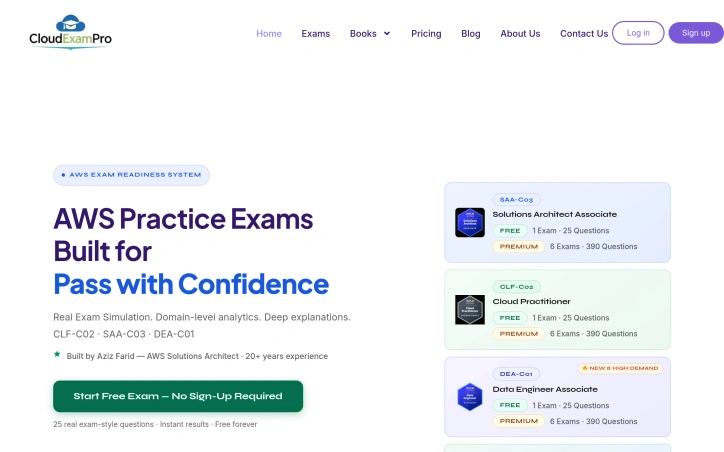
Aspiring AWS certification holders often struggle to find high-quality, affordable practice exams that accurately reflect the actual test experience. CloudExamPro addresses this need by providing realistic exam-style practice tests and study resources tailored to AWS certification candidates. The platform is specifically designed for individuals seeking to pass AWS certifications, including the Cloud Practitioner, Solutions Architect Associate, and Data Engineer Associate exams. What stands out about CloudExamPro is its focus on delivering a genuine exam simulation experience, complete with real exam-style questions and detailed explanations to help learners understand their mistakes. The platform's creator, an AWS Solutions Architect with over 20 years of experience, brings valuable expertise to the table. The site's emphasis on domain-level analytics allows users to identify knowledge gaps and target their studying effectively. Key features of CloudExamPro include its free tier, which offers 25 questions per certification without requiring a credit card, and its premium packages, which provide six months of access to multiple full exams and priority support for $29 per certification. The platform's questions are updated weekly to ensure they remain relevant and accurate, with a verified 98% pass rate among its users. Overall, CloudExamPro is a valuable resource for AWS certification candidates seeking to gain confidence and pass their exams on the first attempt. By offering a focused, affordable, and effective study solution, CloudExamPro helps learners achieve their certification goals.

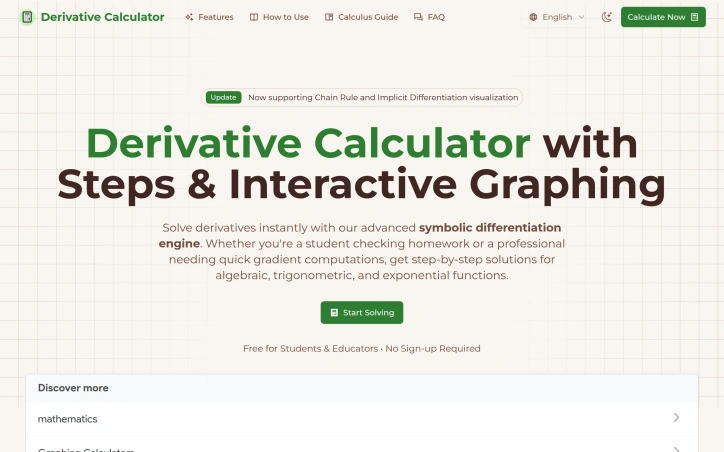
Calculus students and professionals often struggle with complex differentiation problems, tediously working through manual calculations prone to errors. Derivative Calculator addresses this pain point by providing a comprehensive online tool that not only solves derivatives instantly but also explains the step-by-step process behind the calculations. The platform is geared towards students checking their homework, educators looking for a reliable teaching aid, and professionals needing quick gradient computations. What stands out about Derivative Calculator is its commitment to transparency and learning. Unlike other online calculators that provide a final answer without context, this tool reveals the intermediate steps involved in the differentiation process, reinforcing users' understanding of calculus concepts. The incorporation of interactive graphs allows users to visualize the function and its derivative simultaneously, providing a geometric intuition that's essential to mastering calculus. The calculator's capabilities are impressive, supporting a wide range of functions, including algebraic, trigonometric, and exponential functions. It also handles complex rules like the Chain Rule, Product Rule, and Quotient Rule, labeling each applied rule to help users map the solution back to their textbook theories. Notably, Derivative Calculator is free for students and educators, with no sign-up required. This accessibility, combined with its robust feature set, makes it an attractive resource for those looking to accelerate their study workflow or verify manual calculations. Overall, Derivative Calculator is a valuable tool for anyone working with calculus, providing a reliable and instructive companion for academic and professional pursuits.

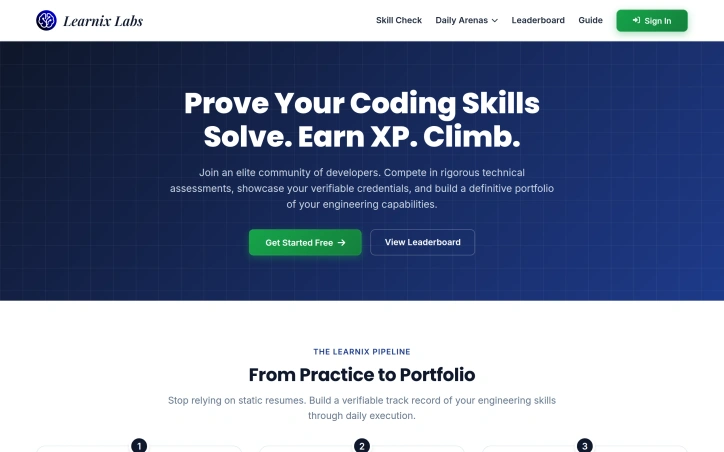
Developers entering the job market face a credibility gap: their resumes rarely demonstrate actual coding ability under pressure. Learnix Labs addresses this by offering a platform where engineers earn verifiable credentials through daily coding challenges and timed assessments, building portfolios backed by measurable performance data rather than claims alone. The platform organizes its offering around four core challenge types. Skill Check assessments target language-specific competency across Python, JavaScript, Java, React, and others—developers scoring 80% or higher receive verified credentials. A daily bug challenge requires reading source code and identifying logic errors, completing patches under anti-cheat supervision. A daily Linux task focuses on backend infrastructure and terminal command execution. A fourth arena covers data structures and algorithms, emphasizing optimization under time pressure. What distinguishes Learnix Labs from traditional coding practice sites is its emphasis on creating employment-ready proof of ability. The platform generates XP for completed challenges and tracks consistency through daily heatmaps, feeding data into a global leaderboard that aggregates performance metrics in real time. This persistent tracking creates both accountability and social proof—developers can point to live performance data when interviewing rather than referencing static achievements. The proctored environment mirrors real interview conditions, adding legitimacy to earned credentials. Testimonials from an ambassador program suggest the platform has cultivated community engagement and networking opportunities beyond pure technical assessment. The range of challenge types indicates an attempt to validate diverse engineering specializations rather than algorithmic skill alone. The platform offers free access, though specific pricing for premium features isn't detailed. The ambassador cohort program suggests a potential growth vector through community advocates. Learnix Labs fills a practical need: traditional portfolios struggle to prove technical competency in verifiable ways. For developers serious about standing out to employers, or those wanting to benchmark themselves against a global peer group, the combination of daily challenges, verified credentials, and transparent leaderboard competition creates concrete incentives to improve. The proctored assessment model positions earned credentials as meaningfully harder to game than self-reported practice, addressing a real pain point in how engineering talent gets evaluated and discovered.

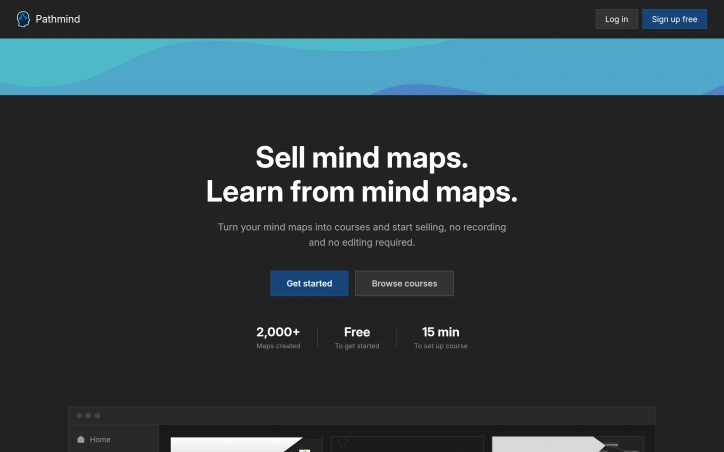
Visual learning is gaining traction in education, yet many educators lack the technical infrastructure to monetize their expertise. Pathmind addresses this gap by allowing creators to convert mind maps directly into sellable courses without requiring video production, editing expertise, or complex course-building knowledge. The platform targets course creators, educators, and subject matter experts who want to package and distribute knowledge through a visual-first format rather than traditional lectures or text-heavy materials. The core innovation lies in its simplicity: creators map out topics as interactive nodes, enrich them with text, videos, images, and documents, then publish the entire structure as a course. Learners navigate these mind maps as interactive learning paths, creating an engaging alternative to linear course formats. This approach eliminates the high friction points that prevent many experts from becoming educators—no recording sessions, no post-production editing, no platform complexity. The setup process takes approximately fifteen minutes, a deliberately low barrier designed to encourage adoption among non-technical users. Pathmind's node-based system extends beyond basic mind mapping. The platform includes an interactive scripting layer that allows creators to add conditional logic and dynamic functionality to their maps, enabling more sophisticated course design than static diagrams alone. This technical depth is concealed beneath an accessible interface, allowing both non-technical content creators and those seeking advanced customization to work within the same tool. The business model reflects a creator-friendly philosophy. The platform operates free of charge, supporting both free course distribution and paid offerings. Creators retain full control over pricing and access, with the revenue model supporting recurring income as new learners discover and purchase courses. This removes financial barriers to entry for emerging educators while enabling established instructors to reach audiences without expensive course development platforms. The founder's evolution from browser-based productivity extension to education-focused platform indicates iterative customer discovery and willingness to pivot toward market demand. The transition to Pathmind Courses in July 2025 suggests stronger market validation in online education than in general productivity tools. Pathmind faces competition from established players like MindMeister and Miro, which offer broader collaboration features, though neither emphasizes course monetization. The platform's focus on educational content packaging distinguishes it, though may limit adoption among users seeking general-purpose diagramming tools. The interactive node system with scripting capabilities provides genuine product depth, yet market education will be crucial—users must understand how this visual approach meaningfully differs from and improves upon traditional course platforms.

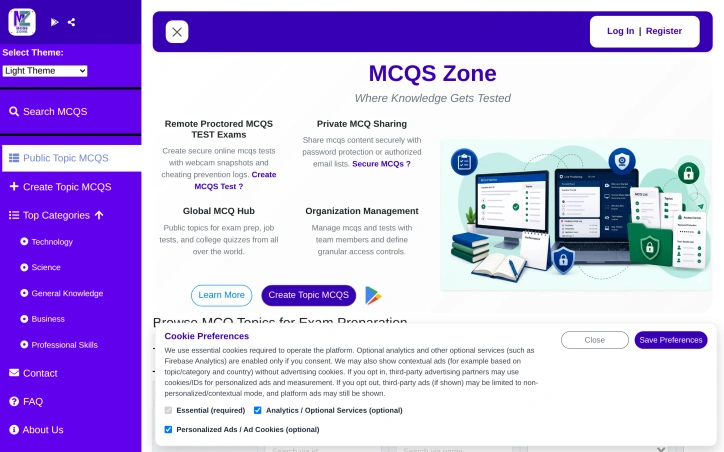
Online assessment platforms have long been fragmented: proctoring tools come with exorbitant licensing costs, practice materials exist across multiple disconnected sites, and creating tests demands technical proficiency from educators who should focus on teaching. MCQsZone addresses all three problems by consolidating secure testing, centralized study resources, and intuitive assessment creation into a single free offering. The platform emerged from a founder's frustration watching educational institutions struggle during the pandemic's shift to remote learning. With a background in both computer science and education, the creator recognized that institutions needed trust in online exam integrity while students needed accessible, quality study materials. Rather than accept the prevailing market assumption that robust assessments require expensive tooling, MCQsZone built enterprise-grade capabilities without the enterprise price tag. Security stands out as a core differentiator. The platform integrates webcam snapshots, screen monitoring, and detailed activity logging to detect and document suspicious behavior during tests. This moves beyond simple detection into audit-ready documentation that institutions can trust, addressing a critical pain point for remote assessment. For student preparation, MCQsZone hosts a free question library organized by topic, complete with detailed explanations. This directly addresses the reality that students preparing for exams typically waste time cobbling together materials from multiple sources. Centralizing this content under one roof, at no cost, removes a genuine friction point. The teacher-facing side prioritizes accessibility. Rather than demanding technical expertise, the platform allows educators to build question banks, import existing questions from Excel spreadsheets, and administer timed assessments through an intuitive interface. This simplification matters considerably for teachers who lack IT support or want to focus on content rather than software configuration. The business model is unusually direct: MCQsZone operates entirely free for all users. The founder's stated conviction that educational technology should democratize rather than gatekeep access drives this choice. Whether a single student preparing for board exams, a teacher conducting formative assessments, or an organization running certification programs, all users access identical capabilities at zero cost. The platform is available both as a web application and as a mobile app through the Google Play Store, extending reach beyond desktop users. For an ecosystem fragmented by cost barriers and technical complexity, a free, centralized alternative with serious security features represents a genuine response to real institutional and student needs.

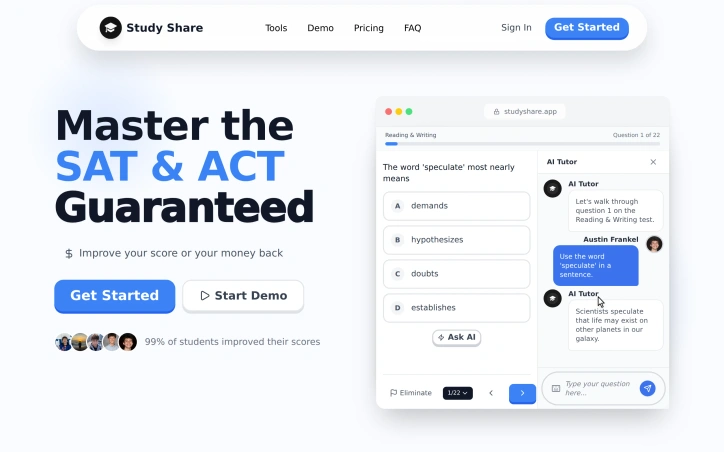
Standardized test preparation has traditionally demanded either expensive one-on-one tutoring or a patchwork of free and paid resources that students must assemble themselves. Study Share positions itself as a middle ground—a comprehensive platform that consolidates test prep into a single interface while keeping costs lower than private instruction. The platform centers on AI-powered guidance alongside realistic practice testing. The company emphasizes its Bluebook-style test interface, matching the actual exam format students will encounter, and backs this approach with a money-back guarantee if students don't improve their scores. This confidence in outcomes is notable, though the site cites a 99% improvement rate without qualifying what "improvement" means or how that figure was measured. Study Share covers multiple exam tracks. Beyond the SAT, the platform supports ACT and PSAT preparation, allowing students to keep all their test prep work consolidated rather than juggling separate tools. The feature set includes full-length practice tests, flashcards, detailed analytics, a review system for missed questions, and an integrated AI tutor that offers hints and explanations during study sessions. This breadth suggests an attempt to eliminate context-switching between different platforms—a genuine friction point in self-study workflows. The company differentiates itself from existing alternatives by positioning against Khan Academy's free-first model and Quizlet's flashcard focus. Study Share argues its strength lies in combining practice tests, AI tutoring, and analytics into a unified workflow designed for structured self-study rather than pure content consumption or flashcard drilling. On business model, the platform publishes pricing publicly so families can see plan options before committing, and allows cancellation at any time. This transparency around cost and commitment is more consumer-friendly than many competitors in the test prep space. The platform targets self-motivated students who want structured guidance without the scheduling limitations of tutoring. For students already comfortable with independent study but frustrated by disjointed tools, Study Share's integrated approach addresses a real gap. The money-back guarantee and emphasis on measurable score improvement signal the company believes in its product's efficacy, though prospective users should verify improvement claims against independent data.

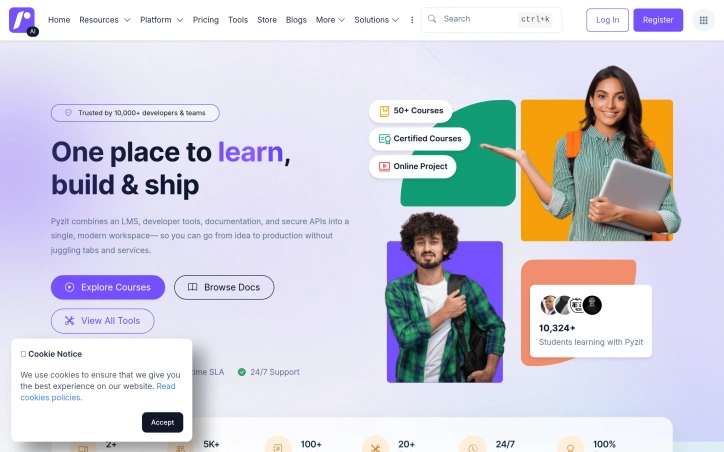
Consolidating developer workflows into a single workspace remains a persistent challenge in modern software development. Pyzit addresses this fragmentation by bundling online courses, developer utilities, API access, and documentation into one integrated platform, targeting developers, students, and technical teams who spend too much time context-switching between tools and learning resources. The platform's core value proposition centers on eliminating context-switching friction. Rather than sourcing courses from one provider, utility tools from another, and documentation from yet another, developers can access a curated collection of 50-plus courses, 20-plus tools, and educational resources all within the same environment. The company operates with an explicit focus on privacy-aware design and fast execution, principles reflected in its security certifications and stated 99.9% uptime commitment. What distinguishes Pyzit among its competitors is the breadth of its feature set. The DevKit component alone comprises over 25 utilities spanning formatters, validators, encoders, and converters—the kinds of small utilities developers typically gather from scattered online sources. Beyond this, Pyzit offers specialized services like Temp Mail Detector for blocking disposable email addresses during user signup, an enterprise-grade encryption service, a code editor for testing HTML, CSS, and JavaScript snippets, and Sendit, a bulk email marketing platform with performance analytics. The company also integrates file conversion, invoice generation, and meta tag generation tools, though some of these feel more like ancillary features than core offerings. The platform has attracted over 10,000 developers and teams, with approximately 10,000 students actively using the learning resources. The company claims SOC 2 compliance and maintains 24/7 support, addressing enterprise-level trust concerns. However, the website provides limited transparency on the business model. While courses are mentioned as part of the offering, no explicit pricing is stated for individual tools, courses, or enterprise plans. The platform appears to operate a freemium model given references to free access, but the distinction between free and paid tiers remains unclear from the available information. This ambiguity could signal either a generously accessible platform or insufficient clarity about monetization strategy. Pyzit's strength lies in offering developers a genuine alternative to the fragmented tool landscape, but potential customers would benefit from clearer pricing and tier definitions before committing to the platform.

For language learners who've grown tired of tedious grammar exercises and unrealistic conversation scenarios, a refreshing alternative has emerged in LangLime. This self-guided learning platform aims to break free from the traditional mold of language education by focusing on reading and writing skills through authentic, translated snippets. What sets LangLime apart is its straightforward approach to language acquisition. By targeting reading and writing proficiency over speaking and listening, it addresses a critical gap in existing language learning tools. This unique focus allows learners to build a strong foundation in written communication, essential for academic, professional, or personal pursuits abroad. Key features of LangLime include the use of realistic snippets to facilitate contextual learning. While the website doesn't go into further detail about its methodology or content library, it's clear that the platform is designed to provide learners with relevant, applicable language skills. Pricing and business model information are not explicitly mentioned on the website, leaving room for speculation about LangLime's revenue streams and monetization strategies. However, based on the founder's statement, it appears that the platform may operate on a subscription-based model or offer pay-per-use options, allowing learners to access content without committing to a long-term contract. Overall, LangLime presents an intriguing alternative to traditional language learning tools. By targeting a specific skill set and adopting a self-guided approach, it has the potential to resonate with learners seeking a more practical and effective way to acquire language proficiency.

Learners of Japanese language and culture have long faced a significant obstacle: mastering the complex Kanji characters that form such a crucial part of the language. Ziyo aims to simplify this process by providing an online dictionary and search engine specifically tailored for Kanji. What stands out about Ziyo is its simplicity, as promised by its founder. Rather than overwhelming users with features or trying to be an all-encompassing resource, it focuses on one core task: efficiently searching for Kanji information. This streamlined approach makes it easy for learners to quickly look up English meanings, Kana readings, Chinese characters, Pinyin pronunciation guides, Hangeul, and Romaji equivalents. The product's key features include a versatile search engine that can accept user input in various formats, including English descriptions of Kanji or even rough sketches. This flexibility makes it an attractive option for learners who may not yet be familiar with the nuances of Japanese writing systems. Additionally, the fact that Ziyo specifically targets Kanji means users won't have to sift through irrelevant information, saving time and effort. The pricing and business model details are unclear from the provided content, so it's impossible to comment on this aspect further. Overall, Ziyo appears well-suited for its target audience: learners of Japanese language who struggle with understanding and remembering Kanji. By providing a simple yet powerful tool, it has the potential to significantly improve their studies.