@fuck.it
Email privacy has become an afterthought at mainstream providers, which treat inboxes as data sources to be mined for ad...
Categories
Best Startup incorporation Startups & Tools
Form companies and manage legal/compliance/banking/bookkeeping ops.
Recently Listed
2 launches
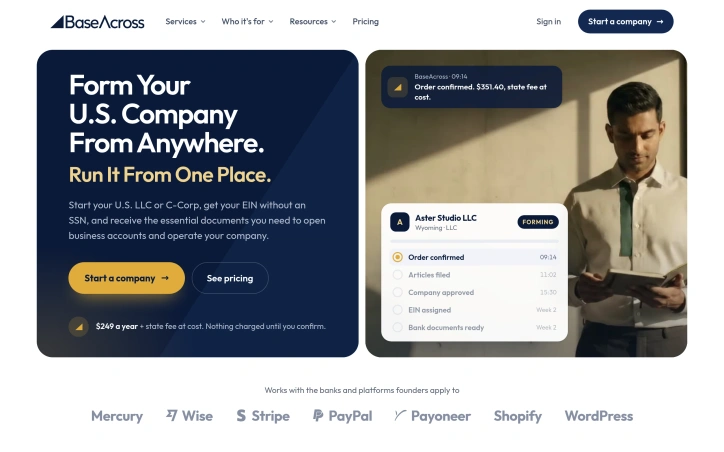
Forming a US company as a foreign entrepreneur has historically been a friction-filled process. BaseAcross eliminates that friction by handling corporate formation and ongoing compliance entirely for non-resident founders who lack a US Social Security Number or physical address. The product targets a specific and underserved market: international founders who want to establish legitimacy, open US bank accounts, and accept payments via Stripe without navigating Byzantine bureaucracy or hiring expensive lawyers. The solution encompasses the entire lifecycle—from LLC or C-Corp incorporation in Wyoming or Delaware through annual compliance filings, compliance deadline tracking, and essential documentation for banking applications. What distinguishes BaseAcross is the comprehensiveness of its integrated offering. Beyond formation, the platform handles EIN assignment without requiring an SSN, a critical advantage for non-resident founders. It generates the specific documents that US banks demand, maintains compliance calendars with cost estimates surfaced well in advance, and connects users to startup credit programs from Google Cloud, AWS, and Microsoft. The platform also extends into adjacent needs: it provisions a US business phone number, sets up professional email and business domains, provides bookkeeping with automated transaction categorization, and offers managed WordPress or Shopify hosting. The user experience is designed for transparency. The timeline is explicit: same-day filing after confirmation, EIN assignment within one to two weeks, and bank-ready documents shortly after. Users see the full order and cost before paying, with the platform handling communication with state filing agencies throughout. Pricing is straightforward: $249 annually plus state fees at cost. The example shown—$351.40 total for Wyoming incorporation—reflects actual filing costs passed through without markup. Certain features like the US phone number and domain are free for the first three months, then included in the ongoing "Operate" plan. Annual compliance obligations like state reports carry transparent pricing shown in advance. The platform integrates deeply with financial infrastructure founders actually use: Mercury, Stripe, PayPal, Shopify, and others are embedded throughout the product. This reflects BaseAcross's understanding of what founders need downstream and builds the company formation experience around those requirements. For non-resident founders, particularly those bootstrapping or early-stage, BaseAcross removes a genuine barrier to incorporating in the US and accessing US financial rails without that incorporation requiring a US presence or identity number.
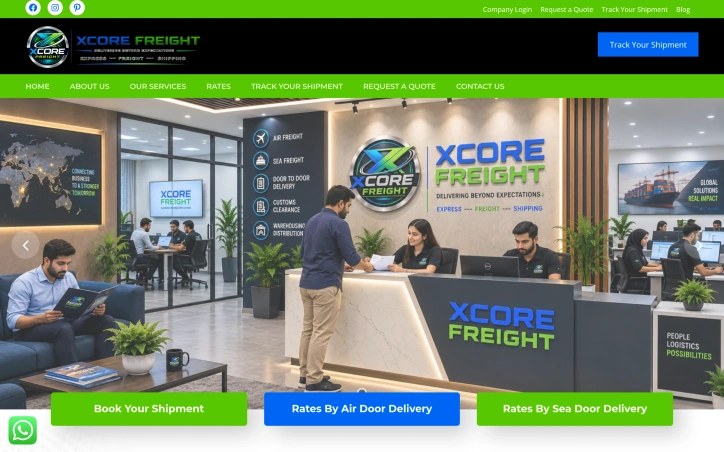
International freight forwarding from Pakistan traditionally has relied on a fragmented network of agents with varying service standards. XCORE Freight addresses this gap by offering consolidated logistics infrastructure that caters to both individual shippers and commercial operations moving goods from Pakistan to major English-speaking destinations. The company targets a specific but significant market: the Pakistani diaspora spread across the UK, USA, Canada, and Australia, alongside Pakistani businesses requiring reliable international cargo transport. The company's core value proposition rests on operational consistency backed by 18 years in the logistics sector. Where many freight forwarders fragment responsibilities across multiple vendors, XCORE coordinates the entire shipment lifecycle—pickup, documentation, transportation, and final-mile delivery—under one operational umbrella. This end-to-end model removes coordination friction that typically lengthens transit times and complicates tracking for customers. XCORE's service portfolio spans the transportation methods essential for different cargo profiles. Air freight handles time-sensitive shipments, while ocean freight through FCL and LCL options accommodates larger, less time-critical loads. The company explicitly manages customs coordination internally, a critical pain point that many smaller forwarders delegate to third parties, creating delays and miscommunication. Door-to-door delivery options extend beyond traditional port-to-port arrangements, appealing to customers without established infrastructure at destination points. The cargo types handled signal pragmatic positioning: commercial merchandise, household goods, and personal effects. This breadth reflects understanding of the diaspora use case—many shipments are relocations or family parcels rather than industrial supply chain operations. The willingness to handle mixed cargo (business goods alongside personal items in a single shipment) differentiates from carriers that enforce separation by category. Geographically, the company's network reaches beyond the primary diaspora destinations into Europe, Africa, and the Middle East, suggesting infrastructure or partnerships that enable more than point-to-point routing. A notable gap in XCORE's public positioning is transparent pricing. The website mentions rate options but provides no actual rate cards or pricing methodology. This opacity reflects industry norms for forwarders targeting enterprise clients who expect custom quotes rather than published rates, though it may frustrate smaller shippers seeking competitive benchmarking. The company's marketing consistently emphasizes trust and reliability—language that signals the business serves cost-conscious shippers for whom service failure carries significant personal or business consequences. This positioning trades on reputation as a defensible moat in a crowded logistics market where price competition alone proves insufficient.