Best Web3 Startups & Tools

Recently Listed

7 launches

Sort
CryptoBolt

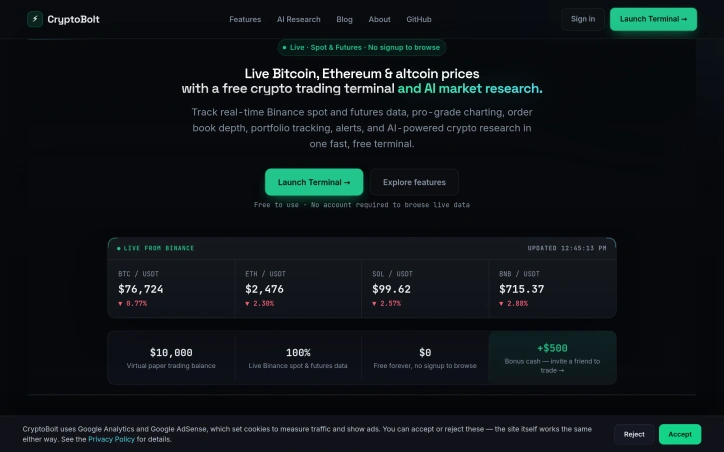
For crypto traders juggling multiple browser tabs to monitor prices, charts, order flow, and news, CryptoBolt consolidates the entire research and trading workflow into a single browser-based terminal. The platform eliminates the friction of account creation and subscription paywalls that gate core features in competing terminals, instead offering a free, feature-rich alternative that loads live data immediately upon access. The product's standout advantage is its zero-friction entry point. Users can begin monitoring live Bitcoin, Ethereum, or any spot or futures pair through Binance data without signup, login, or credit card. This removes the barrier-to-entry that plagues traditional trading terminals, making it accessible to traders learning the craft and those who want to conduct quick research before executing decisions. Core charting capabilities rival paid platforms, delivering candlestick streams with indicators including RSI, MACD, Bollinger Bands, exponential and simple moving averages, and VWAP—all without plugin installation or paywall. Beyond technical analysis, the order flow visibility shows actual depth and trade prints rather than just the last traded price, giving traders a view into where volume and limit orders actually sit. The AI research desk distinguishes CryptoBolt from indicator-only signal systems. Rather than relying solely on technical overlays, the research function grounds analysis in live news, funding rates, and Fear and Greed sentiment data. This approach contextualizes moves without falling into the hallucination traps common in unconstrained AI price prediction tools. Additional features include portfolio tracking across spot and leveraged futures positions, price alerts that notify without requiring constant screen monitoring, and a paper trading account to simulate positions using live prices before deploying capital. For users who want cross-device synchronization of watchlists and trades, account creation remains optional but available. The business model departs from the standard subscription formula. CryptoBolt remains free for all core features. The AI research desk requires a Groq API key—users provide their own—eliminating vendor lock-in and subscription costs. The platform is open source on GitHub, offering transparency into data handling and execution logic that proprietary terminals cannot match. This approach directly challenges the paid terminal market's gatekeeping model by delivering professional-grade tools without friction, though traders requiring advanced features unique to premium terminals may still find those options necessary.

Crypto-tools
C
CryptoBolt

For crypto traders juggling multiple browser tabs to monitor prices, charts, order flow, and news, CryptoBolt consolidates the entire research and trading workflow into a single browser-based terminal. The platform eliminates the friction of account creation and subscription paywalls that gate core features in competing terminals, instead offering a free, feature-rich alternative that loads live data immediately upon access. The product's standout advantage is its zero-friction entry point. Users can begin monitoring live Bitcoin, Ethereum, or any spot or futures pair through Binance data without signup, login, or credit card. This removes the barrier-to-entry that plagues traditional trading terminals, making it accessible to traders learning the craft and those who want to conduct quick research before executing decisions. Core charting capabilities rival paid platforms, delivering candlestick streams with indicators including RSI, MACD, Bollinger Bands, exponential and simple moving averages, and VWAP—all without plugin installation or paywall. Beyond technical analysis, the order flow visibility shows actual depth and trade prints rather than just the last traded price, giving traders a view into where volume and limit orders actually sit. The AI research desk distinguishes CryptoBolt from indicator-only signal systems. Rather than relying solely on technical overlays, the research function grounds analysis in live news, funding rates, and Fear and Greed sentiment data. This approach contextualizes moves without falling into the hallucination traps common in unconstrained AI price prediction tools. Additional features include portfolio tracking across spot and leveraged futures positions, price alerts that notify without requiring constant screen monitoring, and a paper trading account to simulate positions using live prices before deploying capital. For users who want cross-device synchronization of watchlists and trades, account creation remains optional but available. The business model departs from the standard subscription formula. CryptoBolt remains free for all core features. The AI research desk requires a Groq API key—users provide their own—eliminating vendor lock-in and subscription costs. The platform is open source on GitHub, offering transparency into data handling and execution logic that proprietary terminals cannot match. This approach directly challenges the paid terminal market's gatekeeping model by delivering professional-grade tools without friction, though traders requiring advanced features unique to premium terminals may still find those options necessary.

CryptoBolt preview

Key features

  • No-Signup Access: Begin monitoring live Bitcoin, Ethereum, and any spot or futures pair through Binance data immediately without account creation, login, or credit card
  • Technical Charting: Candlestick streams with indicators including RSI, MACD, Bollinger Bands, exponential and simple moving averages, and VWAP
See full listing
ChainHint

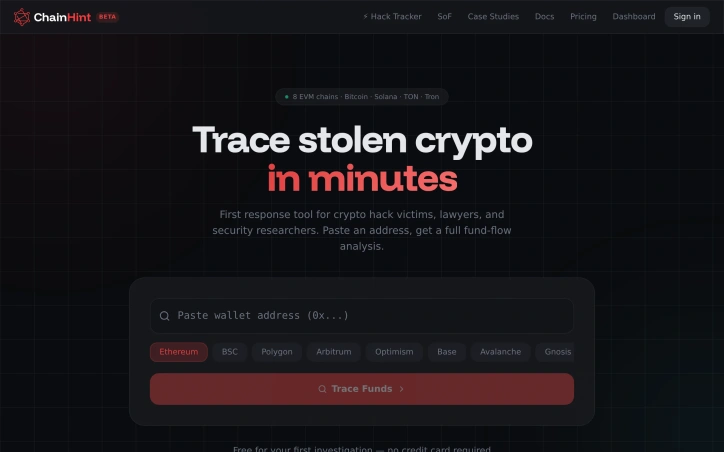
Access to professional-grade blockchain investigation tools has remained locked behind a paywall reserved for government agencies and enterprise compliance departments. ChainHint breaks that gatekeeping by offering forensics and fund tracing capabilities at prices independent investigators and mid-sized exchanges can actually afford. The platform targets a clear market gap: when major cryptocurrency exchanges suffer breaches, stolen assets leave traceable on-chain footprints. The challenge has always been that specialized tools to follow those trails demand subscriptions exceeding $30,000 annually, effectively pricing out smaller organizations. ChainHint addresses this through tiered pricing starting at $79 monthly for individual investigators and scaling to $499 for agency-grade operations, with a free tier for basic access. The core functionality focuses on tracing funds across fragmented blockchain networks. The platform supports multi-hop tracking across six EVM-compatible chains (Ethereum, BSC, Polygon, Arbitrum, Optimism, Avalanche) plus Bitcoin, allowing investigators to follow assets as they hop between networks. Integration with Chainalysis enables real-time screening against OFAC sanctions lists, while pattern recognition detects mixing service usage and Tornado Cash interactions. What differentiates ChainHint is its depth of address intelligence. The platform maintains a database of over 86,000 labeled addresses representing known cryptocurrency exchanges, decentralized protocols, bridges, and identified exploiters. This foundation enables entity resolution—mapping transactions back to known actors rather than stopping at wallet addresses. The addition of AI-generated incident reports incorporating MITRE ATT&CK threat frameworks suggests the product aims to bridge technical analysis and formal security documentation. Operational features include continuous wallet monitoring with alert mechanisms, the ability to share investigations with external stakeholders through read-only access, and PDF export capabilities for formal reporting. The founder's description points to real-world validation through testing against documented breaches including the Bybit exploit, establishing that the product functions against actual attack scenarios rather than theoretical cases. The positioning is notably specific: rather than competing with Chainalysis or Elliptic on features or attempting to serve enterprise compliance teams, ChainHint occupies a middle tier where boutique security firms, academic researchers, and smaller exchanges can access investigation tools previously unavailable at accessible price points. That strategic positioning, combined with demonstrated functionality on known cases, suggests a product designed around practical constraints in the cryptocurrency security market rather than aspirational feature lists.

Crypto-tools
K
Kir

Access to professional-grade blockchain investigation tools has remained locked behind a paywall reserved for government agencies and enterprise compliance departments. ChainHint breaks that gatekeeping by offering forensics and fund tracing capabilities at prices independent investigators and mid-sized exchanges can actually afford. The platform targets a clear market gap: when major cryptocurrency exchanges suffer breaches, stolen assets leave traceable on-chain footprints. The challenge has always been that specialized tools to follow those trails demand subscriptions exceeding $30,000 annually, effectively pricing out smaller organizations. ChainHint addresses this through tiered pricing starting at $79 monthly for individual investigators and scaling to $499 for agency-grade operations, with a free tier for basic access. The core functionality focuses on tracing funds across fragmented blockchain networks. The platform supports multi-hop tracking across six EVM-compatible chains (Ethereum, BSC, Polygon, Arbitrum, Optimism, Avalanche) plus Bitcoin, allowing investigators to follow assets as they hop between networks. Integration with Chainalysis enables real-time screening against OFAC sanctions lists, while pattern recognition detects mixing service usage and Tornado Cash interactions. What differentiates ChainHint is its depth of address intelligence. The platform maintains a database of over 86,000 labeled addresses representing known cryptocurrency exchanges, decentralized protocols, bridges, and identified exploiters. This foundation enables entity resolution—mapping transactions back to known actors rather than stopping at wallet addresses. The addition of AI-generated incident reports incorporating MITRE ATT&CK threat frameworks suggests the product aims to bridge technical analysis and formal security documentation. Operational features include continuous wallet monitoring with alert mechanisms, the ability to share investigations with external stakeholders through read-only access, and PDF export capabilities for formal reporting. The founder's description points to real-world validation through testing against documented breaches including the Bybit exploit, establishing that the product functions against actual attack scenarios rather than theoretical cases. The positioning is notably specific: rather than competing with Chainalysis or Elliptic on features or attempting to serve enterprise compliance teams, ChainHint occupies a middle tier where boutique security firms, academic researchers, and smaller exchanges can access investigation tools previously unavailable at accessible price points. That strategic positioning, combined with demonstrated functionality on known cases, suggests a product designed around practical constraints in the cryptocurrency security market rather than aspirational feature lists.

ChainHint preview

Key features

  • Multi-Chain Fund Tracing: Tracks cryptocurrency across Ethereum, BSC, Polygon, Arbitrum, Optimism, Avalanche, and Bitcoin networks.
  • OFAC Sanctions Screening: Real-time integration with Chainalysis for sanctions list compliance checking.
See full listing
Alarm Crypto

For cryptocurrency traders who need to stay on top of market movements without constantly monitoring the markets, Alarm Crypto offers a timely solution. The app is designed to alert users with a loud, audible alarm when the price of a cryptocurrency crosses a user-defined threshold, ensuring they never miss a critical market moment. This functionality is particularly useful for traders who need to react quickly to price changes, even when they are not actively watching the market. What stands out about Alarm Crypto is its ability to provide real-time price alerts with extremely low latency, thanks to its direct WebSocket connections from major exchanges like Binance, Coinbase, and Kraken. The app's alarm is not just a silent notification that can be easily ignored; it's a loud, native Android alarm that will sound even when the device is locked or the app is closed. This feature is a significant upgrade over more traditional notification systems that might not grab a user's attention when it counts. The app's capabilities extend beyond simple price alerts. Users can choose from 2,472 monitored tokens and set alerts based on various conditions, including price thresholds, percentage changes over 24 hours, and sentiment analysis via the Fear & Greed Index. Additionally, the app provides a market overview with top gainers and losers, Bitcoin dominance, market capitalization, and 24-hour volume, all accessible on the home screen. A widget feature allows users to keep an eye on Bitcoin prices and the Altcoin Season Index directly from their home screen. Users can try Alarm Crypto with a 7-day free trial, after which the pricing details come into effect, though the exact cost is not specified. Overall, Alarm Crypto is a robust tool for serious cryptocurrency traders who need reliable, customizable, and attention-grabbing market alerts to stay ahead in a fast-moving market.


Crypto-tools
A
Alarm Crypto

For cryptocurrency traders who need to stay on top of market movements without constantly monitoring the markets, Alarm Crypto offers a timely solution. The app is designed to alert users with a loud, audible alarm when the price of a cryptocurrency crosses a user-defined threshold, ensuring they never miss a critical market moment. This functionality is particularly useful for traders who need to react quickly to price changes, even when they are not actively watching the market. What stands out about Alarm Crypto is its ability to provide real-time price alerts with extremely low latency, thanks to its direct WebSocket connections from major exchanges like Binance, Coinbase, and Kraken. The app's alarm is not just a silent notification that can be easily ignored; it's a loud, native Android alarm that will sound even when the device is locked or the app is closed. This feature is a significant upgrade over more traditional notification systems that might not grab a user's attention when it counts. The app's capabilities extend beyond simple price alerts. Users can choose from 2,472 monitored tokens and set alerts based on various conditions, including price thresholds, percentage changes over 24 hours, and sentiment analysis via the Fear & Greed Index. Additionally, the app provides a market overview with top gainers and losers, Bitcoin dominance, market capitalization, and 24-hour volume, all accessible on the home screen. A widget feature allows users to keep an eye on Bitcoin prices and the Altcoin Season Index directly from their home screen. Users can try Alarm Crypto with a 7-day free trial, after which the pricing details come into effect, though the exact cost is not specified. Overall, Alarm Crypto is a robust tool for serious cryptocurrency traders who need reliable, customizable, and attention-grabbing market alerts to stay ahead in a fast-moving market.

Alarm Crypto preview

Key features

  • Reliable Loud Alarms: rings with a strong alarm sound and push notification even with the app closed and the phone locked, so you never sleep through a market move
  • 6-Exchange Monitoring: tracks prices across Binance, Coinbase, Kraken, Bybit, Bitget and MEXC in parallel, firing the alarm the instant any of them hits your level.
See full listing
Sabacini

Blockchain technology is often criticized for being overly abstract and disconnected from the physical world. Sabacini aims to bridge this gap by developing a community-centered ecosystem that tokenizes access to a real-world villa, creating a tangible connection between digital capital and physical space. The project is geared towards individuals seeking meaningful investments, digital nomads looking for a balance between work and relaxation, and those who value transparency and community involvement. What stands out about Sabacini is its focus on creating a functional, real-world hub for its community, rather than simply being a speculative investment opportunity. The project's villa is designed to host events, provide a co-living space, and support a startup incubator, fostering connections among entrepreneurs, developers, and like-minded individuals. This approach is driven by a straightforward idea: connecting digital tokens to a physical presence. Key features of the project include token holders' access to exclusive events, voting power on the villa's development and event programming, and a revenue-sharing model that distributes income generated from renting the villa to token holders. The project's roadmap outlines a clear progression from community building to the acquisition of a real villa in Europe, with a phased approach that includes a pre-ICO phase to build momentum and support marketing efforts. Funds raised during this phase will be used to prepare for the main ICO, and early supporters will be incentivized with an airdrop. By linking digital assets to real-world value and experiences, Sabacini offers a unique proposition to its community.


Blockchain technology is often criticized for being overly abstract and disconnected from the physical world. Sabacini aims to bridge this gap by developing a community-centered ecosystem that tokenizes access to a real-world villa, creating a tangible connection between digital capital and physical space. The project is geared towards individuals seeking meaningful investments, digital nomads looking for a balance between work and relaxation, and those who value transparency and community involvement. What stands out about Sabacini is its focus on creating a functional, real-world hub for its community, rather than simply being a speculative investment opportunity. The project's villa is designed to host events, provide a co-living space, and support a startup incubator, fostering connections among entrepreneurs, developers, and like-minded individuals. This approach is driven by a straightforward idea: connecting digital tokens to a physical presence. Key features of the project include token holders' access to exclusive events, voting power on the villa's development and event programming, and a revenue-sharing model that distributes income generated from renting the villa to token holders. The project's roadmap outlines a clear progression from community building to the acquisition of a real villa in Europe, with a phased approach that includes a pre-ICO phase to build momentum and support marketing efforts. Funds raised during this phase will be used to prepare for the main ICO, and early supporters will be incentivized with an airdrop. By linking digital assets to real-world value and experiences, Sabacini offers a unique proposition to its community.

Sabacini preview

Key features

  • Token Holder Access: Token holders have access to exclusive events
  • Voting Power: Token holders have voting power on the villa's development and event programming
See full listing
Senzo Crypto Lab

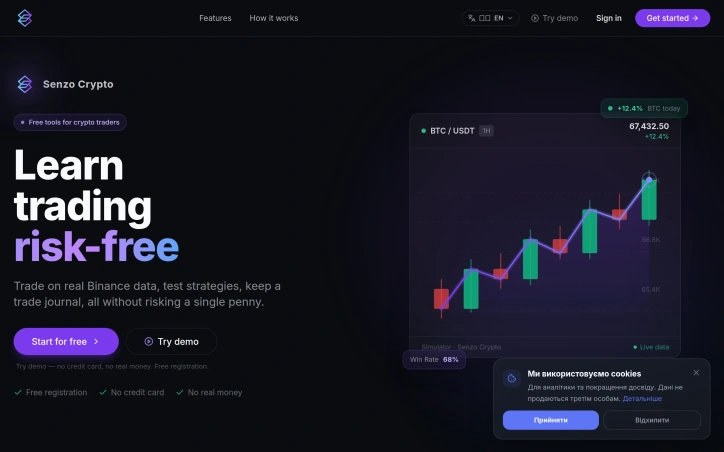
Many traders enter live markets before developing a coherent strategy, a gap that Senzo Crypto Lab directly addresses. The platform emerged from the founder's personal trading practice needs in late 2025 and has evolved into a comprehensive environment for beginner and intermediate traders seeking to build discipline without risking capital prematurely. The offering integrates tools typically scattered across different applications: a market replay simulator for practicing entries and exits on historical price data, backtesting capabilities, a trading journal for analyzing decisions, portfolio tracking, goal-setting, and an AI assistant tailored to crypto markets and trading education. Rather than abandoning practice tools once ready for live trading, users remain in one ecosystem throughout their progression. What distinguishes Senzo is its recognition that expense creates friction. Many early-stage traders avoid professional-grade tools due to cost, leading them to either skip practice entirely or rely on random signals instead of tested strategies. By positioning itself as accessible training, Senzo removes financial barriers to deliberate practice. The bar replay and backtesting features allow users to stress-test strategies against actual market conditions without deploying real capital. The journal functionality serves dual purposes: capturing the psychology and decision logic behind trades while creating records for pattern recognition. The AI assistant integration suggests personalized guidance beyond generic education, though its scope remains unclear. The platform launched recently as a personal tool. This origin story—built by someone solving their own problem—often indicates strong product-market fit for core users, though early-stage status means room for expansion. No pricing details are disclosed, leaving monetization unclear. For traders accustomed to free crypto tools and paid platforms costing hundreds monthly, Senzo's positioning will significantly influence adoption. What remains certain is that the target audience—traders who recognize discipline matters more than capital size—should find value in a platform explicitly designed for that philosophy.

Many traders enter live markets before developing a coherent strategy, a gap that Senzo Crypto Lab directly addresses. The platform emerged from the founder's personal trading practice needs in late 2025 and has evolved into a comprehensive environment for beginner and intermediate traders seeking to build discipline without risking capital prematurely. The offering integrates tools typically scattered across different applications: a market replay simulator for practicing entries and exits on historical price data, backtesting capabilities, a trading journal for analyzing decisions, portfolio tracking, goal-setting, and an AI assistant tailored to crypto markets and trading education. Rather than abandoning practice tools once ready for live trading, users remain in one ecosystem throughout their progression. What distinguishes Senzo is its recognition that expense creates friction. Many early-stage traders avoid professional-grade tools due to cost, leading them to either skip practice entirely or rely on random signals instead of tested strategies. By positioning itself as accessible training, Senzo removes financial barriers to deliberate practice. The bar replay and backtesting features allow users to stress-test strategies against actual market conditions without deploying real capital. The journal functionality serves dual purposes: capturing the psychology and decision logic behind trades while creating records for pattern recognition. The AI assistant integration suggests personalized guidance beyond generic education, though its scope remains unclear. The platform launched recently as a personal tool. This origin story—built by someone solving their own problem—often indicates strong product-market fit for core users, though early-stage status means room for expansion. No pricing details are disclosed, leaving monetization unclear. For traders accustomed to free crypto tools and paid platforms costing hundreds monthly, Senzo's positioning will significantly influence adoption. What remains certain is that the target audience—traders who recognize discipline matters more than capital size—should find value in a platform explicitly designed for that philosophy.

Senzo Crypto Lab preview

Key features

  • Market Replay Simulator: Practice entries and exits on historical price data without risking capital.
  • Backtesting Engine: Stress-test trading strategies against actual market conditions with real historical data.
See full listing
Bocto - All-in-one web3/web2 community Discord bot

Discord communities in the web3 space face a fragmentation problem: they need to manage token-gated access, track NFT activity, distribute rewards, and handle security—often requiring multiple bot integrations. Bocto consolidates these functions into a single bot, targeting community managers and builders who want to streamline Discord operations without juggling numerous point-solution tools. The appeal lies in breadth. Rather than piecemeal functionality, Bocto attempts to cover the full stack of community management demands within the web3/web2 context. It handles NFT and token-gated role assignment, monitors mints and sales activity across popular blockchains, processes token transfers and tips, and manages airdrops and raffles. The bot also displays collection statistics and includes security-focused guard features to protect servers from common exploits. Beyond blockchain-specific tasks, it offers a lightweight task manager built directly into Discord, making it genuinely useful for non-crypto community needs as well. What distinguishes Bocto from its competitors—assuming they exist and focus on narrower use cases—is the cross-chain support. Rather than locking communities into a single blockchain, the bot works across multiple popular networks, reducing friction for communities that operate across ecosystems or plan to expand. This flexibility addresses a real pain point in the current web3 landscape, where fragmentation across chains is the norm. The business model reflects pragmatism about its market. A free tier with generous limits recognizes that many communities are small or newly formed and shouldn't face artificial paywalls immediately. The premium tier accepts both fiat and cryptocurrency payments, a dual-payment approach that demonstrates real understanding of the audience—many web3 communities prefer on-chain transactions and may not have easy fiat payment mechanisms. This removes friction for potential paying customers and suggests the founders understand their user base beyond surface-level demographics. The primary limitation evident from available information is the sparse public presence: the website content is minimal, offering little transparency into adoption, performance, security audits, or technical reliability. For a bot handling token gating and blockchain interactions—inherently security-sensitive functions—this lack of transparency is notable. Community managers considering adoption would need more substantial documentation and proof points before integrating Bocto into production Discord servers. Bocto addresses a legitimate market gap and offers a coherent feature set. Whether it executes at the quality required for serious web3 communities remains unclear from the available information.
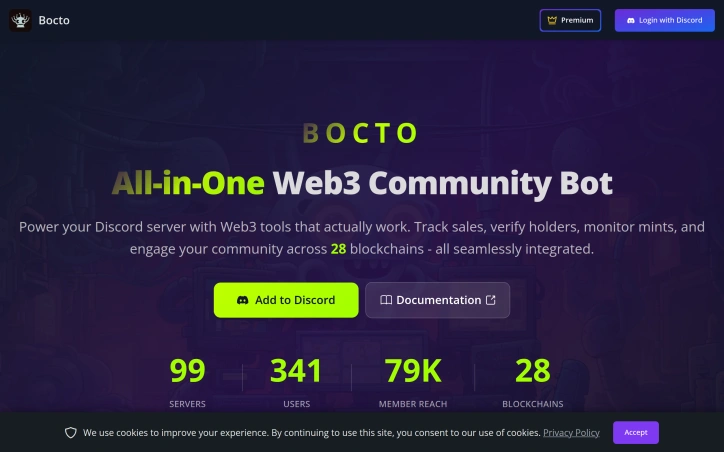

Discord communities in the web3 space face a fragmentation problem: they need to manage token-gated access, track NFT activity, distribute rewards, and handle security—often requiring multiple bot integrations. Bocto consolidates these functions into a single bot, targeting community managers and builders who want to streamline Discord operations without juggling numerous point-solution tools. The appeal lies in breadth. Rather than piecemeal functionality, Bocto attempts to cover the full stack of community management demands within the web3/web2 context. It handles NFT and token-gated role assignment, monitors mints and sales activity across popular blockchains, processes token transfers and tips, and manages airdrops and raffles. The bot also displays collection statistics and includes security-focused guard features to protect servers from common exploits. Beyond blockchain-specific tasks, it offers a lightweight task manager built directly into Discord, making it genuinely useful for non-crypto community needs as well. What distinguishes Bocto from its competitors—assuming they exist and focus on narrower use cases—is the cross-chain support. Rather than locking communities into a single blockchain, the bot works across multiple popular networks, reducing friction for communities that operate across ecosystems or plan to expand. This flexibility addresses a real pain point in the current web3 landscape, where fragmentation across chains is the norm. The business model reflects pragmatism about its market. A free tier with generous limits recognizes that many communities are small or newly formed and shouldn't face artificial paywalls immediately. The premium tier accepts both fiat and cryptocurrency payments, a dual-payment approach that demonstrates real understanding of the audience—many web3 communities prefer on-chain transactions and may not have easy fiat payment mechanisms. This removes friction for potential paying customers and suggests the founders understand their user base beyond surface-level demographics. The primary limitation evident from available information is the sparse public presence: the website content is minimal, offering little transparency into adoption, performance, security audits, or technical reliability. For a bot handling token gating and blockchain interactions—inherently security-sensitive functions—this lack of transparency is notable. Community managers considering adoption would need more substantial documentation and proof points before integrating Bocto into production Discord servers. Bocto addresses a legitimate market gap and offers a coherent feature set. Whether it executes at the quality required for serious web3 communities remains unclear from the available information.

Bocto - All-in-one web3/web2 community Discord bot preview

Key features

  • Token-Gated Access: Assigns roles based on NFT and token holdings for Discord communities
  • Cross-Chain Support: Operates across multiple popular blockchain networks
See full listing
Jeetdrops Airdrops

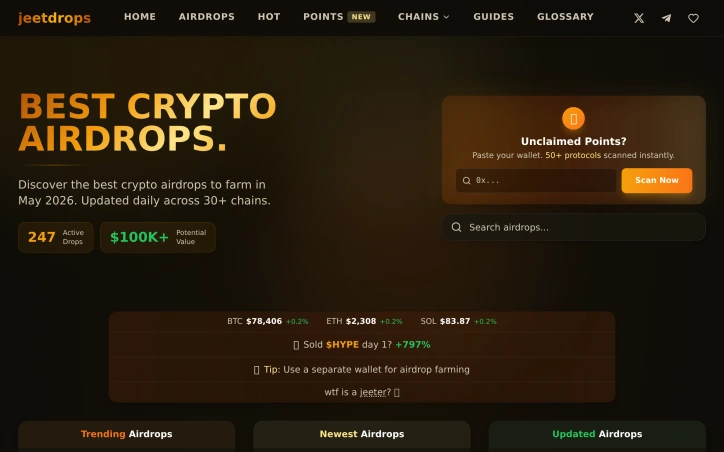
Cryptocurrency airdrop farming has emerged as a way for early protocol adopters to earn tokens, but identifying legitimate opportunities across dozens of blockchains and protocols remains a fragmented, time-consuming task. JeetDrops addresses this pain point for retail crypto users and active DeFi participants who want to maximize their airdrop eligibility without falling victim to scams or missing valuable distributions. The platform's core offering is straightforward: curated discovery of airdrop opportunities paired with portfolio scanning. Users can paste their wallet address to instantly scan activity across 50+ protocols, surfacing any unclaimed token allocations. The service monitors over 30 blockchain networks and claims to update its curated list daily, reducing the research burden typically required to stay informed about emerging token launches. What differentiates JeetDrops from a simple airdrop calendar is its tier-based rating system. The team assigns opportunity ratings (S, A, B, C) based on multiple dimensions: the project's funding credibility, the quality of the team behind it, and the difficulty level of the required farming activity. This structured evaluation framework makes subjective credibility assessments rather than treating all opportunities equally. The inclusion of team and credibility analysis acknowledges a real concern in the airdrop space—distinguishing legitimate projects with capable founders from speculative or fraudulent schemes. The platform's educational component merits attention as well. The FAQ addresses common farming questions and explicitly warns against scams, emphasizing that legitimate airdrops are always free and that users should verify official claim pages rather than clicking unsolicited links. This guidance-first approach indicates the team recognizes that many users are new to airdrop farming and vulnerable to basic fraud tactics. The product appeals to a specific segment: active DeFi users and crypto-native individuals who already possess multiple wallets and engage with protocols regularly. For these users, JeetDrops functions as both a discovery and verification tool, potentially saving significant time across daily chain-jumping and protocol interactions. The multi-chain approach acknowledges the fragmented reality of modern DeFi, where valuable opportunities span Ethereum, Arbitrum, Solana, Base, and dozens of other networks. Rather than forcing users to check each network individually, the platform consolidates airdrop discovery into a single interface, addressing one of the primary friction points in airdrop farming.
Crypto-tools
M
Mo Jeet

Cryptocurrency airdrop farming has emerged as a way for early protocol adopters to earn tokens, but identifying legitimate opportunities across dozens of blockchains and protocols remains a fragmented, time-consuming task. JeetDrops addresses this pain point for retail crypto users and active DeFi participants who want to maximize their airdrop eligibility without falling victim to scams or missing valuable distributions. The platform's core offering is straightforward: curated discovery of airdrop opportunities paired with portfolio scanning. Users can paste their wallet address to instantly scan activity across 50+ protocols, surfacing any unclaimed token allocations. The service monitors over 30 blockchain networks and claims to update its curated list daily, reducing the research burden typically required to stay informed about emerging token launches. What differentiates JeetDrops from a simple airdrop calendar is its tier-based rating system. The team assigns opportunity ratings (S, A, B, C) based on multiple dimensions: the project's funding credibility, the quality of the team behind it, and the difficulty level of the required farming activity. This structured evaluation framework makes subjective credibility assessments rather than treating all opportunities equally. The inclusion of team and credibility analysis acknowledges a real concern in the airdrop space—distinguishing legitimate projects with capable founders from speculative or fraudulent schemes. The platform's educational component merits attention as well. The FAQ addresses common farming questions and explicitly warns against scams, emphasizing that legitimate airdrops are always free and that users should verify official claim pages rather than clicking unsolicited links. This guidance-first approach indicates the team recognizes that many users are new to airdrop farming and vulnerable to basic fraud tactics. The product appeals to a specific segment: active DeFi users and crypto-native individuals who already possess multiple wallets and engage with protocols regularly. For these users, JeetDrops functions as both a discovery and verification tool, potentially saving significant time across daily chain-jumping and protocol interactions. The multi-chain approach acknowledges the fragmented reality of modern DeFi, where valuable opportunities span Ethereum, Arbitrum, Solana, Base, and dozens of other networks. Rather than forcing users to check each network individually, the platform consolidates airdrop discovery into a single interface, addressing one of the primary friction points in airdrop farming.

Jeetdrops Airdrops preview

Key features

  • Curated Discovery: Daily-updated airdrop opportunities with curated lists across 30+ blockchain networks.
  • Wallet Scanner: Paste wallet address to scan activity across 50+ protocols for unclaimed token allocations.
See full listing