
ClickToGuide

- No match
Machine translation — the English original is authoritative.
The Story
As a software engineer, I constantly see how much time gets wasted across tech teams—especially in QA, user onboarding, and customer support—when people have to manually take screenshots, crop them, and type out step-by-step instructions. It is a massive bottleneck for productivity.
I wanted to engineer a seamless way to completely automate this process. However, I knew that for many companies working with internal tools or customer accounts, data privacy is non-negotiable.
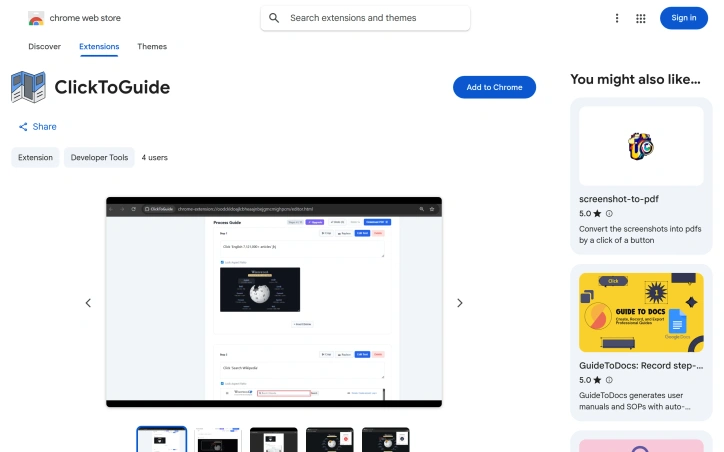
That is why I built ClickToGuide. It is a Chrome extension that auto-generates step-by-step PDF guides from your clicks, but with a strict focus on security. I intentionally designed it without a backend database; everything operates entirely via local storage. This means no sensitive data ever leaves the user's browser. You just hit record, navigate the site normally, and it instantly generates a clean PDF document. I built it to give teams their time back while keeping their workflows 100% secure.
AI Overview
AI-generatedAutomating the tedious process of documenting workflows, this Chrome extension captures user interactions and transforms them into PDF guides complete with annotated screenshots. The tool addresses a genuine pain point: professionals across support, quality assurance, training, and product documentation spend considerable time manually taking screenshots, pasting them into documents, and writing descriptions for each step. ClickToGuide eliminates this friction by recording clicks and automatically generating corresponding visual content.
The extension markets itself to a diverse audience. QA teams can quickly generate evidence for bug reports, HR departments can assemble onboarding materials, customer support representatives can create visual troubleshooting guides, and developers can document features before handoff. This multi-use positioning reflects a well-understood problem that spans multiple job functions within organizations.
Several design choices set this apart from generic screen recording tools. The interface emphasizes simplicity: users record a workflow, review and edit the captured steps, then export directly to PDF. The extension highlights where users clicked with a red box, providing context without cluttering the visual. A built-in crop tool lets users focus on specific UI elements, and standard keyboard shortcuts for undo, redo, and clipboard image insertion keep the workflow fast. The editing interface is built for quick iteration rather than deep customization.
The privacy model represents a conscious architectural decision. All processing happens locally in the browser rather than on remote servers, meaning users never transmit screen data to company infrastructure. For teams handling sensitive information or operating under strict data governance, this is a meaningful differentiator from cloud-dependent competitors.
The business model centers on a lifetime license with cosmetic unlocks—removing watermarks and supporting unlimited steps. A launch promotion offered $5 off the license price. The extension remains early-stage; the Chrome Web Store listing shows only two users and the most recent version update dates to February 2026. The small user base suggests limited market penetration so far, though the product addresses real workflow problems that users across industries encounter daily.
Founder Diary
DevlogThe maker hasn't posted a diary entry yet.
Key Features
Automated Screenshot Capture
Records user interactions and automatically captures corresponding screenshots
PDF Guide Generation
Transforms captured workflow steps into annotated PDF documents
Local Browser Processing
All data processing occurs locally without transmitting data to remote servers
Click Highlighting
Marks user clicks with red boxes to provide visual context
Built-in Editing Tools
Includes crop functionality and standard keyboard shortcuts for quick iteration
Use Cases
-
1
QA Teams
Generate evidence and step-by-step documentation for bug reports quickly
-
2
Customer Support
Create visual troubleshooting guides for users experiencing issues
-
3
HR and Training
Assemble comprehensive onboarding and training materials
-
4
Developers
Document features and workflows before handing off to other teams
FAQ
Does ClickToGuide store my screenshots in the cloud? ▾
What file format does ClickToGuide export to? ▾
Can I edit the captured steps before exporting? ▾
What does ClickToGuide cost? ▾
Pricing
Lifetime license with cosmetic unlocks; a launch promotion offered $5 off the regular price.
Tech Stack & Tags
Discussion
No comments yet — be the first!
Join the conversation — sign up to comment.
Sign up freeCommunity Support
Boost this project on Sell With boost
Meet the Founder

More in Screenshots and screen recording apps

iOS Live Face Cam Screen Recorder
Demo Scope is a mobile screen recorder with a li...
AppScreenshoot
We saw app creators spending hours resizing and...
ScreenGlimpse
Trying to find quick screen recording tool that...

Website Scroll Video
I created Website Scroll Video because manually...
Soundtest
We built Soundtest because noise disputes withou...

Cloakshot
Cloakshot is a screenshot redaction app for iPho...