Creeper SEO Audit – Technical SEO & Real User Monitoring

- No match
Machine translation — the English original is authoritative.
The Story
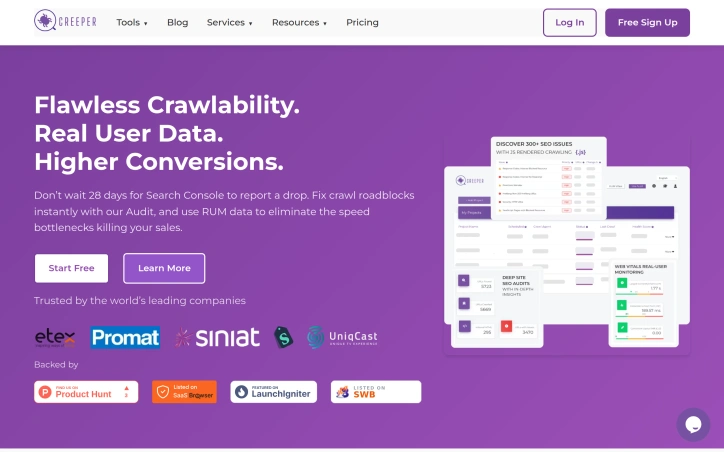
Run powerful technical SEO audits and track real user data (RUM) in real time. Fix crawl issues, boost site speed, and increase conversions with Creeper.
AI Overview
AI-generatedTechnical SEO auditing has long suffered from a fundamental mismatch: tools measure lab-based scores that don't correlate with what actual users experience or whether a business makes money. Creeper tackles this disconnect by pairing automated site audits with real user monitoring, giving teams both the technical roadmap and the conversion data they need.
The product identifies over 300 technical SEO issues—crawl errors, indexability problems, on-page structure flaws—that traditional audits cover. But the differentiator is its emphasis on real user data. Rather than chasing artificial 100/100 lab scores, teams monitor the Web Vitals that matter: largest contentful paint, interaction to next paint, and cumulative layout shift, measured across actual devices and locations. This grounds optimization work in what users experience, not what simulators predict.
Creeper explicitly positions itself against the health score trap that dominates the SEO tool market. That framing works because many site owners have chased perfect scores only to watch conversions stagnate. The core insight is sound: real users and real conversions matter more than algorithm-pleasing metrics.
The product operates as both self-service and services-led. The self-service layers include site audits and RUM dashboards. For teams that prefer outsourced work, Creeper offers done-for-you speed optimization and SEO audit implementation, both backed by guarantees. Case studies demonstrate results: one small software vendor saw organic traffic climb 458 percent over six months; a construction materials company recovered 73 percent of decayed traffic and fixed over 130 technical issues in the same timeframe.
The value proposition is clear for mid-market and enterprise sites struggling with technical debt or performance. Small startups with minimal traffic might find the RUM component less critical, but any site running meaningful user volumes stands to benefit. The integration of audit and monitoring under one roof beats forcing teams to manage separate tools.
Pricing is handled through direct contact, a consultative approach that suits the done-for-you services but creates friction for self-serve buyers wanting a quick trial.
Founder Diary
Devlog-
RUM data on the beta site itself: our own LCP was 3.4s on mid-tier mobile. Fixed by inlining the critical CSS. Down to 1.9s. Practicing what we preach.
-
Client onboarding revealed a real gap: our audit surfaces 300+ issues but does not rank-order by likely impact. Users had to guess what to fix first. Building a lightweight scoring model that weighs by page traffic + change effort. Beta next week.
Discussion
No comments yet — be the first!
Join the conversation — sign up to comment.
Sign up freeCommunity Support
Boost this project on Sell With boost
Meet the Founder

More in SEO tools

LinkNest
I noticed SEO professionals and independent blog...

Daybreaker.ai
Stop tracking random prompts. Find the exact pro...

Ai Visibility Audit
Businesses increasingly appear in AI-powered sea...

SubmitMap
I kept losing evenings to directory forms that w...

ClaroRank
I built ClaroRank to provide honest SEO tool rev...

Free GSC Keyword Analyzer — AI-Powered SEO Insights in 60 Seconds
Over the past few years, the digital landscape h...