
IndieRoadmaps
- No match
Machine translation — the English original is authoritative.
The Story
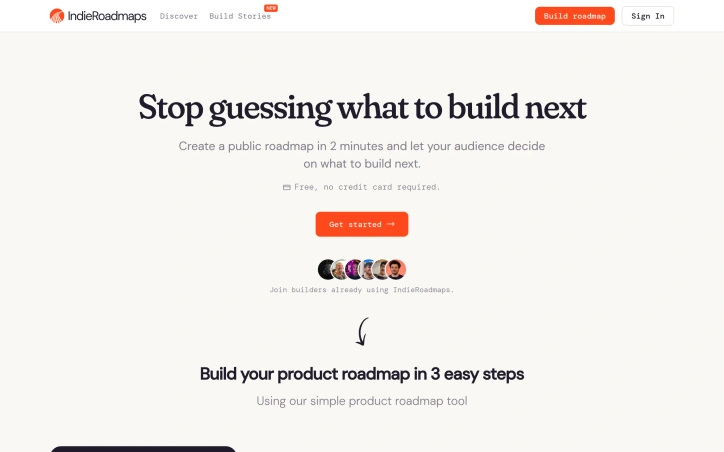
I built IndieRoadmaps to help indie makers share their product vision and get real feedback from their community before and after launch. Create a public roadmap, collect feature votes, and gather input from people who care about what you're building.
AI Overview
AI-generatedBuilding in public has become a defining trend among indie makers, but most lack an organized way to involve their community in product decisions. IndieRoadmaps addresses this gap by providing a dedicated platform where solo founders and small teams can publish their product roadmaps, collect feature requests through voting, and gather feedback from a community of people genuinely invested in their success.
The platform targets indie hackers explicitly, recognizing that this audience operates differently from venture-backed startups. They're building for themselves first, iterating quickly, and often making decisions based on direct community input rather than internal product roadmaps. By centralizing roadmaps in one place, IndieRoadmaps creates a discoverable ecosystem where makers can showcase their direction and potential users can find products aligned with their needs.
What distinguishes IndieRoadmaps is its focus on the indie maker community as both its audience and its value proposition. The site showcases successful indie products across multiple categories—everything from AI tools and productivity software to developer tools and design apps. This curatorial approach positions IndieRoadmaps not just as a feature-tracking tool but as a community hub. The voting mechanism lets users express genuine demand for features, providing founders with real-time market validation before investing engineering resources.
The platform itself practices what it preaches. IndieRoadmaps runs its own public roadmap on the site, allowing users to see upcoming features like multiple roadmaps per user, public roadmap pages, and Google OAuth integration. This transparency about their own development reinforces the building-in-public philosophy they're promoting.
The feature set remains straightforward and focused. Users can create roadmaps, collect votes on planned features, enable community comments, and sign in via Google. There's no mention of advanced collaboration features, custom branding, or enterprise pricing tiers—suggesting the product is designed for individual makers rather than larger organizations. This clarity of purpose is a strength, not a limitation.
For indie makers seeking validation and community engagement before launch, IndieRoadmaps provides a purpose-built solution embedded within a supportive ecosystem of peers. It's a platform that understands its audience's workflows and philosophy, built by people navigating the same challenges.
Founder Diary
DevlogThe maker hasn't posted a diary entry yet.
Key Features
Public Roadmaps
Founders can publish product roadmaps to share their development direction with the community.
Feature Voting
Users vote on planned features to signal demand and provide real-time market validation.
Community Comments
Enable discussion and feedback on roadmap items from the community.
Google OAuth
Sign in via Google for seamless account authentication.
Community Hub
A discoverable ecosystem showcasing indie products across multiple categories.
Use Cases
-
1
Indie Makers
Solo founders and small teams can gather direct community input on product decisions instead of relying on internal roadmaps.
-
2
Product Users
Potential customers can discover indie products and vote on features they want to see prioritized.
-
3
Market Validation
Founders can test demand for features before investing engineering resources into development.
-
4
Building in Public
Indie hackers practicing transparent development can showcase progress and engage their audience directly.
FAQ
How do users vote on roadmap features? ▾
Who is IndieRoadmaps designed for? ▾
What authentication methods does it support? ▾
Tech Stack & Tags
Discussion
No comments yet — be the first!
Join the conversation — sign up to comment.
Sign up freeCommunity Support
Boost this project on Sell With boost
Meet the Founder

More by Chris X

More in Project management software
Snippetly
Snippetly helps developers and teams capture, or...

Chatquick AI
Create audiobooks, podcasts, and interactive aud...

Focus Session by SyncTasks
Select your tasks and enter a distraction-free m...

Dropstone
Dropstone: World's first generational recursive...

Krisp AI Note Taker Mobile
Meetings don’t wait. Neither should your notes....
Stash
Capture anything on your Mac with Stash. This sm...