Locations Code
- No match
Machine translation — the English original is authoritative.
The Story
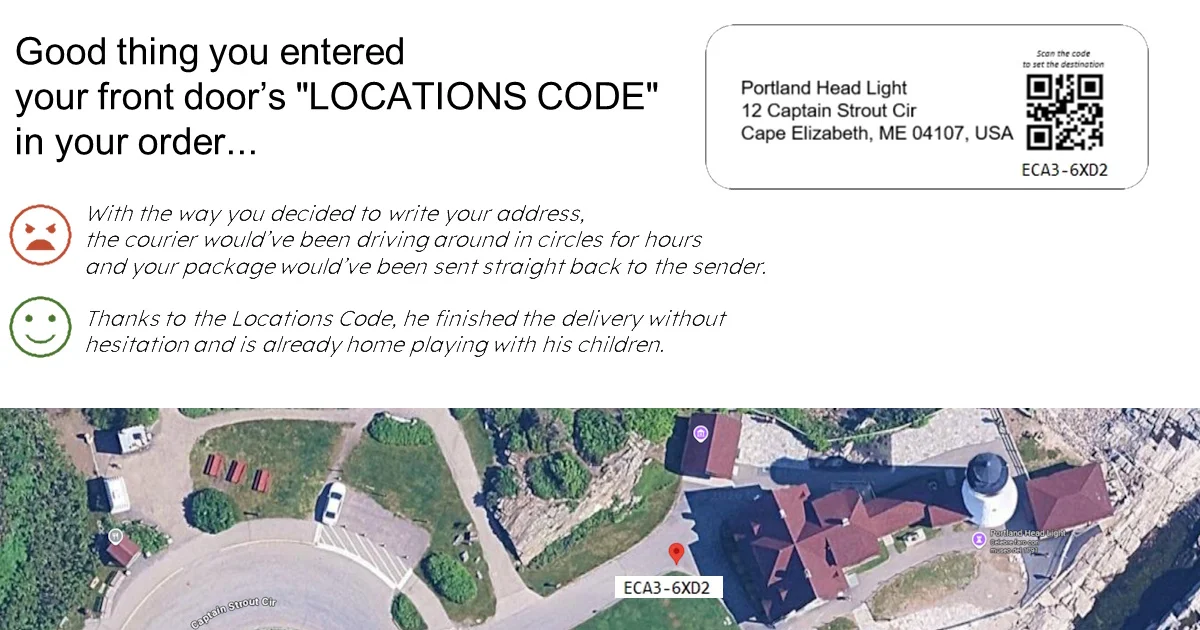
Locations Code solves a fundamental problem in modern logistics: the lack of a universal, open, and deterministic method for identifying any point on Earth with a short, human-readable code. Most existing systems are proprietary, inconsistent, or too complex for large-scale automation. Locations Code provides a stable 8-character geocode that works offline, integrates easily into any stack, and eliminates dependence on closed geospatial platforms. It enables precise and reliable location identification for last-mile delivery, supply chain, robotics, drones, IoT devices, and emergency situations.
AI Overview
AI-generatedInefficient last-mile delivery is a major pain point for e-commerce companies, with inaccurate addresses being the primary cause of logistics failures. Locations Code tackles this issue head-on by introducing an open standard for supply chain and last-mile delivery. The company's solution replaces traditional addressing systems with an 8-character encoding of GPS coordinates, providing a stable and secure way to identify delivery points.
What stands out about Locations Code is its commitment to being open source and independent of proprietary databases or administrative frameworks. This sets it apart from competitors like What3words and Google's Plus Code, which rely on closed systems. By providing a simple, technologically validated element, Locations Code eliminates ambiguities in address descriptions, making it easier to automate logistics processes.
The product's key features include its ability to work offline, ease of integration into any tech stack, and its application in various industries beyond logistics, such as robotics, drones, and IoT devices. The company provides detailed documentation, available on GitHub, YouTube, and Medium, making it easier for developers to understand and implement the solution.
Locations Code is designed for businesses struggling with logistics inefficiencies, particularly those in the e-commerce sector. By adopting this open standard, companies can reduce delivery failures and associated costs, improving overall customer satisfaction. Notably, the product's open-source nature means that there are no licensing fees or proprietary restrictions, although the website does not explicitly mention pricing or business model details. Overall, Locations Code presents a compelling solution to a pressing problem, and its open and interoperable design makes it an attractive option for businesses seeking a reliable and scalable logistics solution.
Founder Diary
DevlogThe maker hasn't posted a diary entry yet.
Key Features
Offline Capability
Works offline without requiring internet connectivity
Simple Integration
Can be integrated into any tech stack
Technological Validation
Eliminates ambiguities in address descriptions
Detailed Documentation
Provides detailed documentation on GitHub, YouTube, and Medium
Use Cases
-
1
E-commerce Companies
Reduces delivery failures and associated costs
-
2
Logistics Businesses
Improves overall customer satisfaction by automating logistics processes
-
3
Robotics and Drones
Applicable in various industries beyond logistics
-
4
IoT Devices
Can be used with IoT devices for precise location identification
FAQ
Is Locations Code open source? ▾
How does Locations Code identify delivery points? ▾
Is Locations Code dependent on proprietary databases? ▾
Tech Stack & Tags
Discussion
No comments yet — be the first!
Join the conversation — sign up to comment.
Sign up freeCommunity Support
Boost this project on Sell With boost
Meet the Founder

More in Ecommerce platforms

SSENSELESS
Tariffs got you down? Now everyone can become SS...

CShop | Complete Operational SaaS for e-Commerce, Bars, and Restaurants
Complete end to end business management SaaS for...

UCP
When Google and Shopify announced the Universal...

Xitoss
I built xitoss-distributor for suppliers, wholes...

Artik Mart
We built Artik Mart to solve the problem of over...
eLabelCropper
We built eLabelCropper to eliminate the tedious...