
Print Production Lab
- No match
Machine translation — the English original is authoritative.
The Story
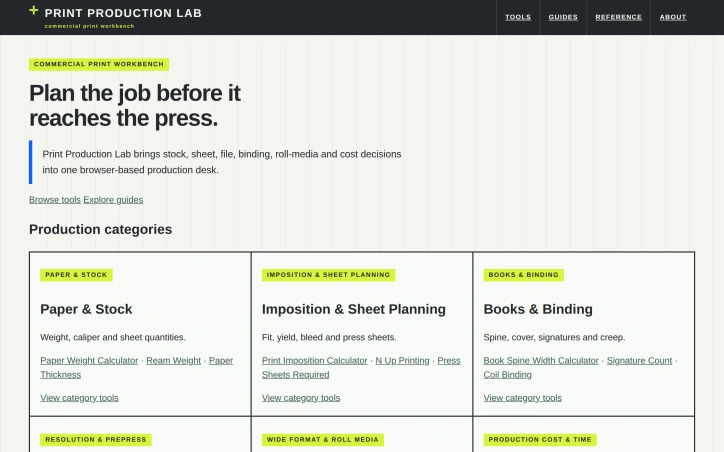
We built Print Production Lab to help commercial printers and designers eliminate guesswork when planning print jobs. Our browser-based calculator consolidates paper specifications, imposition planning, binding calculations, and cost estimation into one transparent, easy-to-use production workbench.
AI Overview
AI-generatedCoordinating the dozens of specifications required for commercial printing—stock weight, sheet layout, binding method, file resolution, production costs—forces designers and printers to juggle separate tools or work from memory. Print Production Lab consolidates these decisions into a single browser-based workbench, eliminating the need to toggle between spreadsheets and vendor specs.
The platform targets commercial printers and graphic designers who need to plan jobs before they reach the press. It addresses a genuine gap: while design and prepress software handles file preparation, nothing bridges the practical production planning phase—translating a job's requirements into executable specifications across paper, layout, binding, and cost.
The product stands out through deliberate restraint. It requires no signup, offers transparent formulas that users can audit and modify, and provides dual metric-imperial contexts where relevant. Rather than hiding assumptions, Print Production Lab invites users to adjust parameters based on supplier tolerances or equipment constraints. A clear disclaimer reinforces this: these are informational estimates, not guaranteed specifications—users must verify final specs with their printer.
The calculator suite is comprehensive without overwhelming users. Six production categories—paper and stock, imposition, binding, resolution, wide-format media, and cost estimation—contain targeted tools addressing specific problems. The Print Imposition Calculator and Book Spine Width Calculator solve problems without obvious solutions elsewhere. A workflow diagram guides users through planning: define stock, plan layout, prepare files, check resolution, plan binding, estimate cost.
Supporting infrastructure includes 14 production guides and 9 quick-reference sheets, positioning the site as a production reference rather than a one-off calculator. This educational layer distinguishes it from simpler tools.
The business model is not stated. No pricing, account requirements, or premium tiers appear in available materials, suggesting a free service or model not yet publicly detailed.
For production teams already juggling spreadsheet variants and multiple tabs, Print Production Lab offers genuine consolidation value through transparency. It won't replace vendor-specific systems or integrate into existing workflows automatically, but as a straightforward reference workbench, it fills a recognizable gap in the production planning space.
Founder Diary
DevlogThe maker hasn't posted a diary entry yet.
Key Features
Browser-Based Workbench
Consolidates printing specifications for paper, layout, binding, and cost in a single interface
No Signup Required
Free access without account creation or authentication
Transparent Formulas
Users can audit and modify calculation parameters based on supplier tolerances or equipment constraints
Production Calculators
Specialized tools for imposition, binding, resolution, wide-format media, and cost estimation
Reference Library
Includes 14 production guides and 9 quick-reference sheets for comprehensive planning
Dual Metrics
Supports both metric and imperial measurements throughout the platform
Use Cases
-
1
Commercial Printers
Plan job requirements and executable specifications before sending to press
-
2
Graphic Designers
Coordinate dozens of specifications without toggling between separate tools and spreadsheets
-
3
Production Teams
Consolidate spreadsheet variants and multiple browser tabs into a single reference workbench
FAQ
Do I need to sign up for Print Production Lab? ▾
Can I customize the printing calculations? ▾
Are these calculations guaranteed to work with my printer? ▾
What production tools does Print Production Lab include? ▾
Tech Stack & Tags
Discussion
No comments yet — be the first!
Join the conversation — sign up to comment.
Sign up freeCommunity Support
Boost this project on Sell With boost
Meet the Founder

More by canghun13




More in Project management software
Snippetly
Snippetly helps developers and teams capture, or...

Chatquick AI
Create audiobooks, podcasts, and interactive aud...

Focus Session by SyncTasks
Select your tasks and enter a distraction-free m...

Dropstone
Dropstone: World's first generational recursive...

Krisp AI Note Taker Mobile
Meetings don’t wait. Neither should your notes....
Stash
Capture anything on your Mac with Stash. This sm...