
semantic-release-npm-github-publish
- No match
Machine translation — the English original is authoritative.
The Story
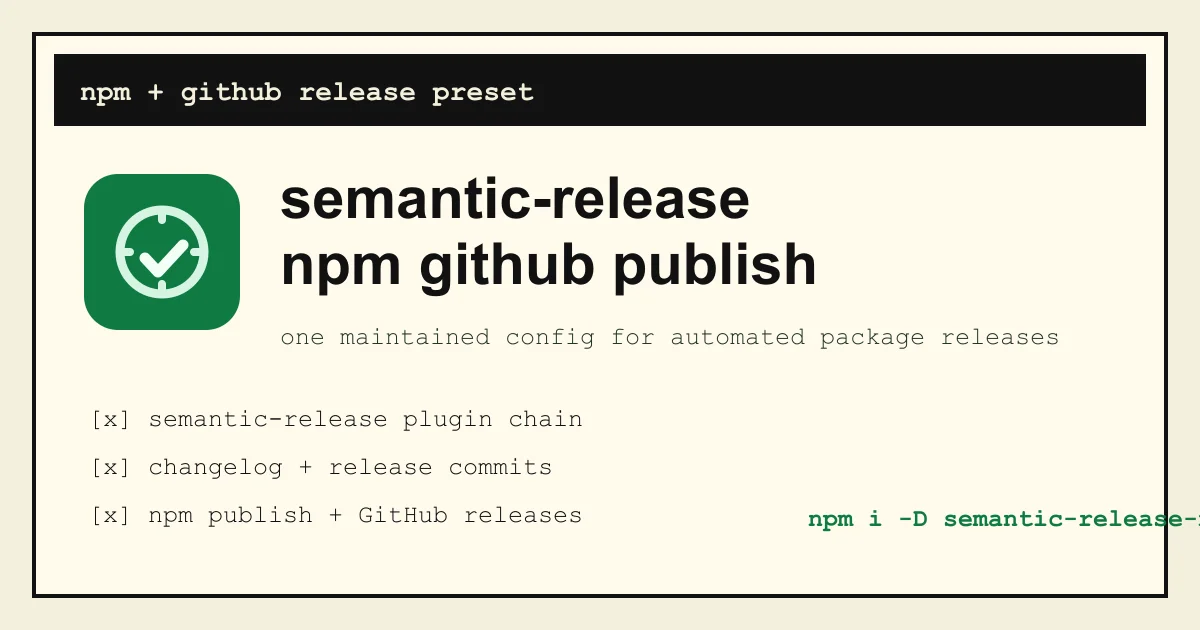
I open-source and maintain projects but got tired of juggling ten separate semantic-release plugins every time I needed to ship. This single preset wraps everything—from commit analysis and changelog generation to npm publishing and GitHub releases—into one plug-and-play configuration so you can focus on coding instead of plumbing your release pipeline. It’s the workflow I built to save my own sanity and now share with the Node community.
AI Overview
AI-generatedRelease automation for Node.js developers typically demands orchestrating numerous plugins and configurations—a process that becomes tedious when repeated across multiple projects. This semantic-release preset consolidates the most common components of an automated release workflow into a single, reusable configuration that handles commit analysis, changelog generation, version bumping, npm publishing, and GitHub release management without requiring developers to wire them together manually.
The target audience is JavaScript developers who maintain open-source projects or applications that need reliable, standards-based release automation. The preset implements conventional commit semantics out of the box, mapping commit types (feat, fix, refactor, docs, etc.) to semver version increments automatically. Breaking changes trigger major version bumps, while feature commits produce minor increments and patch fixes advance patch versions—eliminating manual version management entirely.
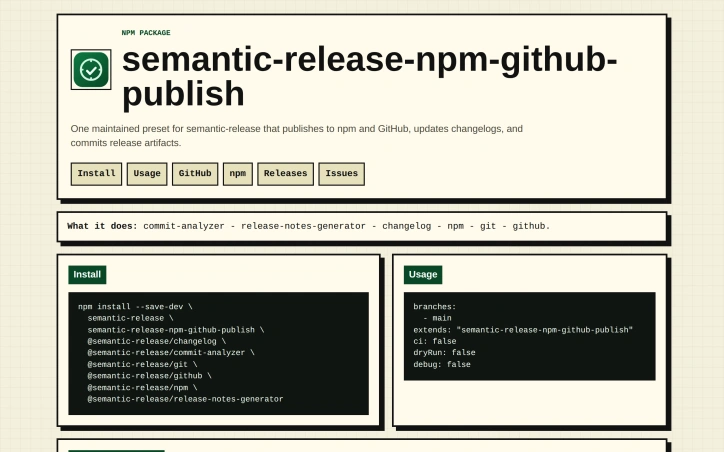
What distinguishes this preset is its comprehensiveness. Rather than asking developers to select, install, and configure five to ten separate semantic-release plugins independently, it presents a single drop-in configuration that orchestrates the full pipeline. The setup is straightforward—installing a few npm packages and writing a minimal .releaserc file—and the release logic follows conventions that most JavaScript developers already understand. This reduction in configuration friction directly addresses a genuine pain point for open-source maintainers repeating this setup across projects.
The preset covers the essential release operations: analyzing commits to determine version increments, generating release notes and changelogs, publishing packages to npm, pushing release commits back to git, and creating GitHub releases. The workflow operates on the main branch by default and supports dry-run and debug modes during development. The configuration is opinionated but functional, reducing decision-making without restricting typical use cases.
Built from the founder's own maintenance workflow, the preset reflects practical priorities—eliminating repetitive scaffolding so developers focus on writing code rather than managing release infrastructure. The project is open-source and free to use, making it accessible to teams of any size. For Node.js projects adopting conventional commits and needing automated releases, this preset removes a significant setup burden and operational complexity from the development lifecycle.
Founder Diary
DevlogThe maker hasn't posted a diary entry yet.
Key Features
Automated Version Bumping
Maps commit types to semantic version increments automatically
Changelog Generation
Generates release notes and changelogs without manual effort
npm Publishing
Publishes packages to npm as part of the automated workflow
GitHub Release Management
Creates GitHub releases automatically
Conventional Commits
Implements conventional commit semantics out of the box
Single Configuration
Consolidates multiple plugins into one drop-in configuration
Use Cases
-
1
Open-source Maintainers
Eliminates repetitive release setup scaffolding across multiple projects
-
2
Node.js Developers
Provides automated releases for projects using conventional commits
-
3
Development Teams
Reduces setup burden and operational complexity in the release lifecycle
FAQ
How does semantic-release handle version bumping? ▾
What does this preset consolidate? ▾
Do I need to configure multiple plugins? ▾
Pricing
Open-source and free to use for teams of any size
Tech Stack & Tags
Discussion
No comments yet — be the first!
Join the conversation — sign up to comment.
Sign up freeCommunity Support
Boost this project on Sell With boost
Meet the Founder

"10+ years shipping fintech APIs, AI features & OSS Lead engineer · open: full-time, fractional, f..."
More by Oleg Koval
dcli - docker and git workflows, stremlined
I kept repeating the same tedious Docker-reset a...
SaaS scaffold
One command. Auth, payments, database, email, Ta...

queryd - slow query detection for Node.js
Latency budgets for the SQL your Node app actual...

prompt-ctl.com
Structures every prompt for max signal, min wast...