
SaaS scaffold
- No match
Machine translation — the English original is authoritative.
The Story
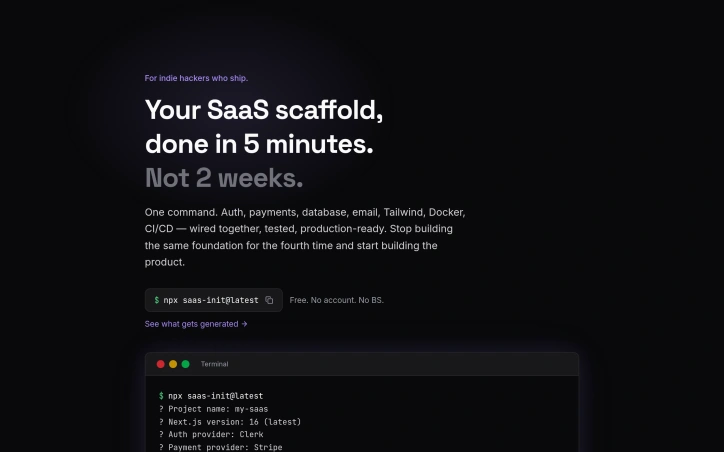
One command. Auth, payments, database, email, Tailwind, Docker, CI/CD — wired together, tested, production-ready. Stop building the same foundation for the fourth time and start building the product.
AI Overview
AI-generatedIndie developers encounter a recurring trap: after shipping the third or fourth SaaS product, they find themselves rebuilding authentication flows, subscription billing logic, database migrations, and CI/CD pipelines from scratch. Paid boilerplates promise to solve this by offering pre-built scaffolds, but they often lock developers into black-box abstractions that require archaeological investigation to customize. Free open-source starters suffer the opposite problem—abandoned projects with outdated dependencies and incomplete implementations that skip the genuinely difficult parts like webhook handling and billing lifecycle management.
This scaffolding tool addresses that friction by automating the entire foundational setup in a single command. Rather than selling a templated solution, it generates a production-ready Next.js application with authentication, payments processing, transactional email, database schema, and CI/CD configuration already integrated and tested. The process completes in approximately 4.5 minutes.
What distinguishes this approach is its breadth. Most boilerplates stop after providing a login page and a basic database schema. This offering includes the components that developers typically find most tedious to wire together: Stripe webhook handling for subscription lifecycle events, multi-provider flexibility (Clerk or NextAuth for authentication, Postgres, SQLite, or Supabase for data storage, Stripe or Lemon Squeezy for payments), and a testing suite of over 250 tests covering core flows. The generated code runs on Next.js 14 with the App Router, includes Tailwind and shadcn/ui components pre-configured, and packages production infrastructure as a Docker container with GitHub Actions workflows.
The tool operates as an interactive CLI that prompts developers to select their preferred provider for each major component at initialization time, then generates a fully functional codebase based on those choices. Rather than forcing abstraction layers, the generated code is intended to be readable and modifiable—on the explicit premise that developers should understand and customize their own foundation rather than fight against prescribed patterns.
Financially, the product is offered free under an MIT license with no account requirement and no commercial upsell. This positioning directly opposes the typical paid-boilerplate model and targets developers who prioritize speed to first deployment and transparency over premium support.
For teams shipping consumer or B2B SaaS applications, the time savings from bootstrapping infrastructure are substantial. The real limitation is whether generated code remains maintainable through real-world scaling scenarios and customization demands beyond the initialization phase.
Founder Diary
DevlogThe maker hasn't posted a diary entry yet.
Key Features
One-Command Setup
Generates a production-ready Next.js application in approximately 4.5 minutes.
Multi-Provider Selection
Choose between Clerk or NextAuth, Postgres/SQLite/Supabase, and Stripe or Lemon Squeezy.
Webhook Integration
Includes Stripe webhook handling for subscription lifecycle management.
Comprehensive Testing
Includes over 250 tests covering core application flows.
Pre-Configured Stack
Next.js 14 with App Router, Tailwind, and shadcn/ui components.
Production Infrastructure
Docker container and GitHub Actions workflows for deployment.
Use Cases
-
1
Indie Developers
Eliminates repetitive setup work when building multiple SaaS products.
-
2
First-Time SaaS Builders
Provides complete foundation with authentication, payments, and email integrated.
-
3
Consumer or B2B SaaS Teams
Significantly reduces time from initialization to first production deployment.
-
4
Developers Seeking Transparency
Readable and modifiable generated code without opaque abstractions.
FAQ
How long does it take to generate a new SaaS project? ▾
What payment and authentication providers are supported? ▾
Is there a cost to use this tool? ▾
Can I modify and customize the generated code? ▾
Pricing
Free and open source under MIT license with no account requirement or commercial upsell.
Tech Stack & Tags
Discussion (1)

Hey world! 👋 Just shipped saas-init v1.1.0 with Next.js version selection. **What changed:** You now pick your Next.js version at init time — 15 or 16 — and the scaffold is generated with the exact dependencies for your choice. No manual package.json edits. **What saas-init does:** One command generates a production-ready SaaS scaffold: → Auth: Clerk, NextAuth, or Supabase → Payments: Stripe or Lemon Squeezy (full webhook handling) → Database: Postgres, SQLite, or Supabase (Drizzle ORM, migrations ready) → Email: Resend or Postmark → Tailwind + shadcn/ui, Docker, GitHub Actions CI/CD → 272 tests included — auth, billing, API routes, E2E No boilerplate to buy. No config to copy-paste. Free, open source, MIT. npx saas-init@latest
Join the conversation — sign up to comment.
Sign up freeCommunity Support
Boost this project on Sell With boost
Meet the Founder
"10+ years shipping fintech APIs, AI features & OSS Lead engineer · open: full-time, fractional, f..."
More by Oleg Koval
dcli - docker and git workflows, stremlined
I kept repeating the same tedious Docker-reset a...

queryd - slow query detection for Node.js
Latency budgets for the SQL your Node app actual...

prompt-ctl.com
Structures every prompt for max signal, min wast...

Trembita - a lightweight TypeScript HTTP client
I built Trembita to simplify consuming third-par...
More in AI Workflow Automation

Vehla
I'm building a Mac command center to streamline...

Vora IQ
I built Vora IQ to help entrepreneurs build real...

Zoye
The CRM You Never Need to Open. The AI Native...
prompt-ctl.com
Structures every prompt for max signal, min wast...

MOOGH
We built MOOGH to bring intelligent task automat...

SpokenPost
As a builder, my best ideas rarely hit me when I...