#community Startups & Tools
Discover the best community startups, tools, and products on SellWithBoost.

Uniting anime enthusiasts under one roof is the driving force behind Anitroves AI Hub, a comprehensive directory that tackles the issue of dispersed resources for otaku AI tools. The platform is designed for fans seeking a more immersive and personalized anime experience. By consolidating various AI-powered tools, Anitroves AI Hub caters to a diverse audience, from casual viewers to dedicated enthusiasts. What stands out about Anitroves AI Hub is its focus on creating a one-stop-shop for anime-related AI tools, providing users with a wide range of features that enhance their interaction with the anime community. The inclusion of tools like Otaku AI Chat, a personal intelligent anime chat assistant, and AniPick AI Suggest, a smart engine for discovering new anime, demonstrates the platform's commitment to enriching the user experience. The presence of RolePlay AI Characters featuring popular anime personalities further adds to the site's appeal, allowing users to engage with their favorite characters in a more interactive manner. Key features of the platform include the ability to generate stunning anime art from text prompts using Vision AI Image, and access to a variety of role-playing characters from popular anime series. The platform also invites users to join its community, allowing them to save their history and like content, which suggests a level of personalization and user engagement. While the pricing or business model details are not explicitly stated, the invitation to "Sign Up" and "Log In" implies that the platform is working towards creating a membership or subscription-based model, potentially offering both free and premium features to its users. Overall, Anitroves AI Hub is a promising initiative that streamlines access to various anime and otaku AI tools, making it a valuable resource for the anime community.
Launched in 2016, Ownmates combines social networking with cross-border tools to address persistent friction points in international connection. The platform targets two core problems: language barriers that limit natural conversation across speakers, and the complexity and cost of sending money to friends and family abroad. The built-in real-time translator enables genuine cross-cultural interaction—users can chat, post, and engage with speakers of different languages without the awkwardness of traditional messaging apps. This serves diaspora communities, international travelers, and families spread across continents. Equally practical is the integrated remittance feature, which streamlines personal money transfers within the app rather than forcing users to manage separate banking and payment services. Beyond these core features, Ownmates positions itself as an alternative to algorithm-driven social networks. The platform supports interest-based communities, media-rich posts (photos, videos, audio, documents), and a global feed designed to surface genuine connections and cultural discovery rather than endless engagement metrics. The combination of translation and integrated payments in a single social platform is relatively uncommon. Most social networks treat international accessibility and remittances as afterthoughts or separate services entirely. Ownmates builds them as fundamental features, reflecting its explicit focus on removing friction for internationally-connected communities. Available across iOS, Android, and web, the platform has operated for multiple years. The deliberate focus on borderless connection and practical financial tools distinguishes it from mainstream social networks. Whether it can compete with entrenched platforms that have added translation and payments as secondary features remains an open question, but Ownmates addresses a real and specific need for users maintaining relationships and families across borders. Its integrated approach to both communication barriers and financial friction represents its strongest differentiator.
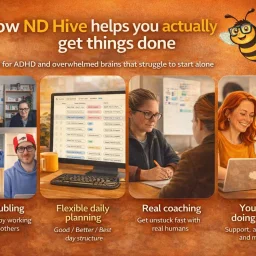
Burnout and task paralysis plague millions of adults with ADHD and autism spectrum traits, yet most productivity solutions ignore the neurodivergent brain entirely. ND Hive addresses this gap by centering on a deceptively simple mechanism: body doubling—the measurable boost in focus and task completion that comes from working alongside others in real time. The platform operates as a daily coworking community with live sessions led by human coaches. Members join drop-in sessions, pick a task to complete, and work through it with accountability from both coaches and fellow participants. No complex app tutorials, no 47-step setup process. The simplicity is intentional. ADHD and autism often coexist with executive dysfunction that makes navigating byzantine software interfaces itself a barrier to use. What distinguishes ND Hive is its explicit design for neurodivergent needs rather than neurotypical defaults. The accompanying "Hub" provides structured tools—capacity planners, task breakdowns, emotion check-ins, and a completion tracker—built around how divergent brains actually operate. Sessions accommodate 58 hours per week of access, but participation is fluid. Members can attend one session or many, with no penalty for inconsistency. The company makes a specific empirical claim worth noting: its own data shows meaningful behavioral shifts by day three for most users, with larger transformations reported by day seven. Testimonials from the site reflect this pattern. A therapist reported reduced burnout within 72 hours. A college student moved from feeling paralyzed by workload to managing coursework effectively. A working parent progressed from chronic task avoidance to career advancement. These aren't outlier claims—body doubling is an established phenomenon in ADHD literature, and the company leverages it directly. The target audience is clear: working professionals, students, parents, and founders who recognize their difficulty isn't laziness or broken executive function, but rather isolation and lack of accountability structures suited to their neurology. For this cohort, the friction of traditional goal-setting apps or generic coworking spaces is real. ND Hive eliminates that friction by removing onboarding complexity and designing every interaction around neurodivergent cognition. The model includes a seven-day free trial, suggesting a subscription foundation, though specific pricing isn't disclosed in the available materials.

Product launches scatter across social media, newsletters, and obscure forums, leaving both builders and discovery-hungry enthusiasts struggling to find emerging technology worth their attention. GreenRocket addresses this fragmentation by creating a dedicated hub where makers can showcase new products and users can explore the next generation of innovation in one place. The platform operates as a marketplace for visibility—a way for founders to break through the noise and reach people actively seeking novel tech rather than passively scrolling feeds. The positioning is straightforward: GreenRocket functions as a launchpad, emphasizing the active moment when products enter the market. This specificity matters. Unlike broad product directories or review sites that catalog anything and everything, GreenRocket narrows its focus to launches themselves, suggesting curated timing and momentum rather than a static library. That framing appeals to founders timing announcements strategically and to users who prefer discovery that carries editorial weight—the sense that products appearing here are actually worth noticing. The dual-sided marketplace is the core design. On one side, builders gain a venue to announce their work to an audience already primed for discovery. On the other, users looking for the next promising tool or service can browse launches in one destination rather than hunting across disparate channels. This two-way exchange creates network effects: better products attract more discoverers, which in turn incentivizes more quality launches, which brings back discoverers seeking fresh innovations. What the platform does well is solve a real visibility problem without overcomplicating the solution. Product launches are time-sensitive moments; capturing them in a structured, accessible format gives them shelf life beyond a single tweet or Product Hunt appearance. Builders get another distribution channel, and early adopters get a concentrated feed of what is actually new rather than what algorithms happen to surface. The simplicity of the value proposition—share and discover launches—is clean. There are no false claims about building community or replacing existing channels. The site understands its lane: it is a launchpad, not a ranking system, not a review platform, not a social network. That clarity is refreshing and grounded. For founders in crowded markets, an additional venue to announce their work has real utility. For users hunting fresh technology, a dedicated feed beats algorithmic feeds designed for engagement over relevance. The product fills a legitimate gap in how emerging tech reaches its audience.

Keeping pace with artificial intelligence developments has become a legitimate challenge for developers, business leaders, and curious technologists alike. The sheer volume of breakthroughs, research papers, and incremental improvements across the AI ecosystem makes it nearly impossible for individuals to separate signal from noise without dedicating significant time to curation. AIApplePie addresses this head-on by functioning as a community-driven aggregator that consolidates the latest AI advancements into a digestible format, positioning itself as essential infrastructure for anyone needing to stay current in a rapidly evolving field. The platform's core strength lies in its recognition that understanding AI developments requires more than raw information—it demands context and perspective. Rather than simply collecting headlines, AIApplePie empowers its community to contribute authentic analysis and interpretation, transforming passive consumption into collaborative learning. This approach distinguishes it from generic news feeds by introducing human judgment into the curation process, ensuring that featured content carries genuine insight about what developments matter and why. The target audience spans technical professionals seeking comprehensive AI coverage, decision-makers evaluating AI's relevance to their organizations, and enthusiasts who want to move beyond surface-level understanding of the field's trajectory. For this group, AIApplePie serves as both a time-saving tool and a community hub where conversations around emerging technologies can flourish. What emerges from the platform's philosophy is a recognition of a real gap in how AI information reaches people. Rather than competing with individual sources like ArXiv or major tech publications, AIApplePie occupies a unique middle ground—it's neither an academic repository nor a mainstream news outlet, but instead a practical gathering place where shared curation creates value. Community members collectively decide what's worth discussing, and this distributed intelligence model creates a self-correcting system that responds to genuine interests rather than editorial biases. The service demonstrates clear product-market fit with its audience: people overwhelmed by AI's pace of change who want both broad coverage and trusted opinions. By making discovery social and contextualized rather than algorithmic, AIApplePie transforms information overload into community-driven clarity.
For entrepreneurs and small business owners, repetitive tasks can be a significant drag on productivity. Super Intern aims to alleviate this burden by delegating busywork to AI, allowing users to focus on high-value activities. What stands out about Super Intern is its unique approach to task delegation. Rather than offering a range of tools or workflows, the platform provides a self-evolving AI intern that can learn and adapt to specific tasks and skills. This means users don't need to invest time in training or configuring the system – they simply delegate their work to the AI, which can then evolve to handle increasingly complex tasks. Key features worth noting include instant expertise across 1000+ domain-expert skills, seamless integration with popular apps and platforms (such as Discord, Telegram, and Slack), and a flexible plans structure that allows users to customize their needs. The platform also boasts impressive credentials, backed by top venture capital firms. Pricing details are straightforward: users can choose from various plans that offer different credit allocations for daily usage, or create custom plans tailored to their specific requirements. For small projects and quick turnarounds, the Starter plan offers 2000 credits per month at $16/month, billed yearly. The Project Space plan is ideal for frequent use and team collaboration, offering unlimited skills and an extra 5000 credits per month at $160/month. Overall, Super Intern's innovative approach to task delegation makes it an attractive solution for entrepreneurs and small business owners looking to streamline their workflow and boost productivity.