#mental health Startups & Tools
Discover the best mental health startups, tools, and products on SellWithBoost.

Habit tracking has become unnecessarily complex. Most popular apps bury their core function—simple daily logging—beneath feature-heavy dashboards that overwhelm rather than motivate. 66 Streaks corrects this by stripping away the noise and building around a single, research-supported principle: it takes 66 days, not 21, for a behavior to become automatic. The app's foundation rests on a 2009 study from University College London by Dr. Phillippa Lally and colleagues, published in the European Journal of Social Psychology. Their work tracked 96 participants and found that habit formation averaged 66 days, with a range between 18 and 254 days. This contradicts the widely repeated "21-day rule," often misattributed to Maxwell Maltz's 1960 book, which lacks scientific backing. Follow-up research from King's College London reinforced that real behavioral change requires consistent repetition far beyond three weeks. By anchoring the entire product around this precise timeframe, 66 Streaks gives users a legitimate finish line rather than an arbitrary target. The feature set reflects this philosophy of restraint. Users can track up to four habits simultaneously through a combination of visible streak counters, a 66-day progress grid, and daily reminders. The app includes a rounds system to preserve history across multiple habit cycles. Critically, it operates entirely offline—no account creation, no login requirement, and all data remains on the user's device. This privacy-first approach eliminates friction at the point of entry and addresses legitimate concerns about data handling. The product is positioned as free on the Apple App Store with no subscription component. This pricing structure removes another barrier to adoption while betting that simplicity itself becomes the retention mechanism. 66 Streaks targets people fatigued by overengineered productivity tools who want a focused, daily check-in system backed by actual behavioral science. The execution suggests the founders understood what makes habit trackers fail in practice: complexity and endless targets. By solving for those specific pain points rather than competing on feature count, the app addresses a genuine gap in the market where most competitors prioritize comprehensiveness over usability.
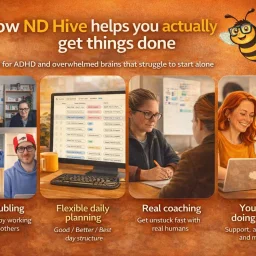
Burnout and task paralysis plague millions of adults with ADHD and autism spectrum traits, yet most productivity solutions ignore the neurodivergent brain entirely. ND Hive addresses this gap by centering on a deceptively simple mechanism: body doubling—the measurable boost in focus and task completion that comes from working alongside others in real time. The platform operates as a daily coworking community with live sessions led by human coaches. Members join drop-in sessions, pick a task to complete, and work through it with accountability from both coaches and fellow participants. No complex app tutorials, no 47-step setup process. The simplicity is intentional. ADHD and autism often coexist with executive dysfunction that makes navigating byzantine software interfaces itself a barrier to use. What distinguishes ND Hive is its explicit design for neurodivergent needs rather than neurotypical defaults. The accompanying "Hub" provides structured tools—capacity planners, task breakdowns, emotion check-ins, and a completion tracker—built around how divergent brains actually operate. Sessions accommodate 58 hours per week of access, but participation is fluid. Members can attend one session or many, with no penalty for inconsistency. The company makes a specific empirical claim worth noting: its own data shows meaningful behavioral shifts by day three for most users, with larger transformations reported by day seven. Testimonials from the site reflect this pattern. A therapist reported reduced burnout within 72 hours. A college student moved from feeling paralyzed by workload to managing coursework effectively. A working parent progressed from chronic task avoidance to career advancement. These aren't outlier claims—body doubling is an established phenomenon in ADHD literature, and the company leverages it directly. The target audience is clear: working professionals, students, parents, and founders who recognize their difficulty isn't laziness or broken executive function, but rather isolation and lack of accountability structures suited to their neurology. For this cohort, the friction of traditional goal-setting apps or generic coworking spaces is real. ND Hive eliminates that friction by removing onboarding complexity and designing every interaction around neurodivergent cognition. The model includes a seven-day free trial, suggesting a subscription foundation, though specific pricing isn't disclosed in the available materials.

Modern habit-tracking apps have created an unexpected problem: the anxiety of maintaining perfect daily streaks. A new entrant in the productivity space takes direct aim at this phenomenon by replacing the all-or-nothing streak model with a more forgiving monthly framework. The product is designed for people who want to build genuine habits but get discouraged when life inevitably gets in the way—missing a day shouldn't derail months of progress. SetHabits positions itself explicitly around psychological sustainability rather than gamification. Where traditional trackers emphasize consecutive-day chains, this tool sets monthly targets (like completing a habit 20 out of 30 days) and visualizes progress through a clean calendar interface. The approach reflects a fundamental understanding of behavior change: consistency matters more than perfectionism, and shame typically undermines long-term progress rather than motivating it. The product philosophy centers on aggressive simplicity. Habits can be added and logged in seconds, and the interface resists the feature bloat that plagues most productivity software. Users see their monthly progress at a glance through visual calendar data without navigating graphs or reports. The free tier supports up to five habits alongside monthly calendar views, basic statistics, and daily reminders. A weekly habit-tips email is included across all plans. The business model employs a straightforward freemium structure. The Premium tier costs $3.99 monthly or $29.99 annually and adds unlimited habits, AI-powered insights, weekly summary emails, detailed statistics, and custom habit colors. A lifetime access option at $59.99 exists with supply intentionally capped at 100 licenses—a transparent scarcity strategy targeting early adopters. The pricing is genuinely accessible for individual users while providing credible upgrade incentives. What distinguishes this product most sharply is its counter-cultural positioning. Rather than amplifying the perfectionism baked into most habit software, it explicitly rejects streak anxiety in favor of a more realistic, sustainable approach. The execution matches the philosophy: minimal interface, limited features, and transparent pricing all signal that the team grasps what struggling habit-builders actually need. For people burned out on guilt-driven productivity tools, this represents a genuinely different value proposition grounded in behavioral realism rather than motivational hype.