#coaching Startups & Tools
Discover the best coaching startups, tools, and products on SellWithBoost.

Managing a coaching practice involves juggling multiple moving parts—client files, session notes, appointment scheduling, follow-up exercises—that often pull attention away from actual coaching. CoachPro Tools consolidates these functions into a single platform designed specifically for the realities of coaching work. Built by a coach for coaches, the platform addresses the administrative overhead that fractures focus during and between sessions. The core value proposition is straightforward: coaches open a single tool when a client issue surfaces, work through it interactively in real time, and have everything saved to the client's file automatically. A coach using the system notes that session documentation happens live in the platform rather than requiring after-call transcription into notes. The feature set reflects this practice-focused design. Each client gets a dedicated workspace with session history, agreements tracked on a Kanban board, a timeline of progress and milestones, and access to over 249 built-in interactive tools—frameworks like the Wheel of Life and SWOT analysis, all integrated into the interface. Coaches can run tools during screen-shared sessions or send them via link for clients to complete between appointments. The platform also includes a calendar, video calling, public booking links, and practice statistics. A notable addition is WhatsApp integration powered by an AI agent. Coaches connect their WhatsApp number to the platform, configure it with their own pricing, hours, FAQs, and booking link, and an AI agent responds to client inquiries automatically. The coach continues to see and manage every conversation from within the platform. The AI can run on Claude, OpenAI, or Gemini, with the coach providing their own information so responses stay grounded in the coach's actual offerings. The onboarding claim promises zero setup time requiring no technical knowledge. The platform operates on a subscription model with plans available and a 30-day money-back guarantee, though the marketing material does not specify pricing. The company mentions lifetime access options, suggesting confidence in long-term retention. The target audience concentrates in Latin America and Spain. The integration of session tools, client management, scheduling, and AI-assisted support in one interface addresses a real operational gap for coaches managing multiple clients while handling administrative workflows.
Visual learning is gaining traction in education, yet many educators lack the technical infrastructure to monetize their expertise. Pathmind addresses this gap by allowing creators to convert mind maps directly into sellable courses without requiring video production, editing expertise, or complex course-building knowledge. The platform targets course creators, educators, and subject matter experts who want to package and distribute knowledge through a visual-first format rather than traditional lectures or text-heavy materials. The core innovation lies in its simplicity: creators map out topics as interactive nodes, enrich them with text, videos, images, and documents, then publish the entire structure as a course. Learners navigate these mind maps as interactive learning paths, creating an engaging alternative to linear course formats. This approach eliminates the high friction points that prevent many experts from becoming educators—no recording sessions, no post-production editing, no platform complexity. The setup process takes approximately fifteen minutes, a deliberately low barrier designed to encourage adoption among non-technical users. Pathmind's node-based system extends beyond basic mind mapping. The platform includes an interactive scripting layer that allows creators to add conditional logic and dynamic functionality to their maps, enabling more sophisticated course design than static diagrams alone. This technical depth is concealed beneath an accessible interface, allowing both non-technical content creators and those seeking advanced customization to work within the same tool. The business model reflects a creator-friendly philosophy. The platform operates free of charge, supporting both free course distribution and paid offerings. Creators retain full control over pricing and access, with the revenue model supporting recurring income as new learners discover and purchase courses. This removes financial barriers to entry for emerging educators while enabling established instructors to reach audiences without expensive course development platforms. The founder's evolution from browser-based productivity extension to education-focused platform indicates iterative customer discovery and willingness to pivot toward market demand. The transition to Pathmind Courses in July 2025 suggests stronger market validation in online education than in general productivity tools. Pathmind faces competition from established players like MindMeister and Miro, which offer broader collaboration features, though neither emphasizes course monetization. The platform's focus on educational content packaging distinguishes it, though may limit adoption among users seeking general-purpose diagramming tools. The interactive node system with scripting capabilities provides genuine product depth, yet market education will be crucial—users must understand how this visual approach meaningfully differs from and improves upon traditional course platforms.
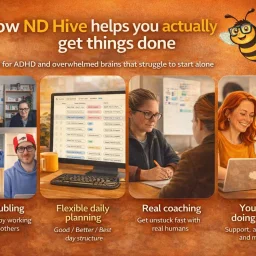
Burnout and task paralysis plague millions of adults with ADHD and autism spectrum traits, yet most productivity solutions ignore the neurodivergent brain entirely. ND Hive addresses this gap by centering on a deceptively simple mechanism: body doubling—the measurable boost in focus and task completion that comes from working alongside others in real time. The platform operates as a daily coworking community with live sessions led by human coaches. Members join drop-in sessions, pick a task to complete, and work through it with accountability from both coaches and fellow participants. No complex app tutorials, no 47-step setup process. The simplicity is intentional. ADHD and autism often coexist with executive dysfunction that makes navigating byzantine software interfaces itself a barrier to use. What distinguishes ND Hive is its explicit design for neurodivergent needs rather than neurotypical defaults. The accompanying "Hub" provides structured tools—capacity planners, task breakdowns, emotion check-ins, and a completion tracker—built around how divergent brains actually operate. Sessions accommodate 58 hours per week of access, but participation is fluid. Members can attend one session or many, with no penalty for inconsistency. The company makes a specific empirical claim worth noting: its own data shows meaningful behavioral shifts by day three for most users, with larger transformations reported by day seven. Testimonials from the site reflect this pattern. A therapist reported reduced burnout within 72 hours. A college student moved from feeling paralyzed by workload to managing coursework effectively. A working parent progressed from chronic task avoidance to career advancement. These aren't outlier claims—body doubling is an established phenomenon in ADHD literature, and the company leverages it directly. The target audience is clear: working professionals, students, parents, and founders who recognize their difficulty isn't laziness or broken executive function, but rather isolation and lack of accountability structures suited to their neurology. For this cohort, the friction of traditional goal-setting apps or generic coworking spaces is real. ND Hive eliminates that friction by removing onboarding complexity and designing every interaction around neurodivergent cognition. The model includes a seven-day free trial, suggesting a subscription foundation, though specific pricing isn't disclosed in the available materials.