
Best AI Chatbots Startups & Tools

Modern assistants that write, code, analyze, and execute tasks across apps.

Recently Listed

28 launches

Sort
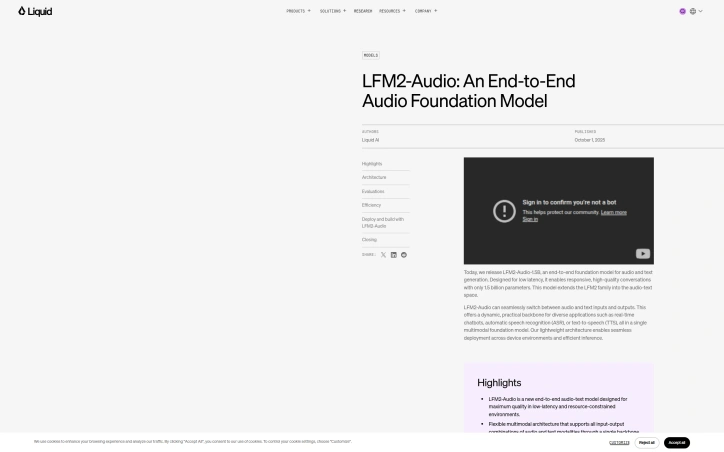
LFM2-Audio

Multimodal audio and text processing has long demanded specialized models or resource-intensive systems that struggle with real-time performance. Liquid AI's LFM2-Audio-1.5B addresses this constraint by packaging conversational AI, speech recognition, text-to-speech, and audio classification into a single, lightweight foundation model designed for deployment across consumer and edge devices. The model's central innovation lies in how it handles the audio modality itself. Rather than forcing audio through discrete tokenization on the input side—a common approach that introduces artifacts—LFM2-Audio preserves continuous embeddings for audio input while outputting discrete tokens for generation. This asymmetry means the model ingests rich audio representations without discretization loss while maintaining the training efficiency of next-token prediction during generation. The approach sidesteps a trade-off that has plagued larger multimodal models, which typically compromise either input fidelity or generation quality. At 1.5 billion parameters, LFM2-Audio achieves inference speeds roughly ten times faster than competing models of comparable quality. The architecture performs this feat through a tokenizer-free input path that chunks raw waveforms into 80-millisecond segments, projecting them directly into the model's embedding space. This design eliminates unnecessary processing overhead and keeps latency low enough for genuine real-time interaction, a requirement for voice applications that larger models frequently miss. The product's flexibility is notable: it handles all permutations of audio and text inputs and outputs through a single backbone, making it genuinely versatile rather than a specialized tool masquerading as general-purpose. A developer can build a voice assistant, transcription service, or audio classifier without maintaining separate inference pipelines or model weights. The technical specifics suggest careful engineering. The distinction between audio input and output representations avoids the brittle trade-offs that plague other end-to-end audio models. The tokenizer-free input strategy preserves signal quality while keeping computational cost modest. These design choices reflect an understanding of real-world deployment constraints where latency, memory, and power consumption directly impact viability. The model extends Liquid AI's existing LFM2 language model lineage, leveraging an established backbone and presumably benefiting from lessons learned across the LFM2 family. For teams building voice-forward applications on phones, embedded devices, or privacy-sensitive infrastructure, this represents a meaningfully different tradeoff than existing options—trading some absolute capability ceiling for deployability and speed that larger models cannot match.

Ai-chatbots

Multimodal audio and text processing has long demanded specialized models or resource-intensive systems that struggle with real-time performance. Liquid AI's LFM2-Audio-1.5B addresses this constraint by packaging conversational AI, speech recognition, text-to-speech, and audio classification into a single, lightweight foundation model designed for deployment across consumer and edge devices. The model's central innovation lies in how it handles the audio modality itself. Rather than forcing audio through discrete tokenization on the input side—a common approach that introduces artifacts—LFM2-Audio preserves continuous embeddings for audio input while outputting discrete tokens for generation. This asymmetry means the model ingests rich audio representations without discretization loss while maintaining the training efficiency of next-token prediction during generation. The approach sidesteps a trade-off that has plagued larger multimodal models, which typically compromise either input fidelity or generation quality. At 1.5 billion parameters, LFM2-Audio achieves inference speeds roughly ten times faster than competing models of comparable quality. The architecture performs this feat through a tokenizer-free input path that chunks raw waveforms into 80-millisecond segments, projecting them directly into the model's embedding space. This design eliminates unnecessary processing overhead and keeps latency low enough for genuine real-time interaction, a requirement for voice applications that larger models frequently miss. The product's flexibility is notable: it handles all permutations of audio and text inputs and outputs through a single backbone, making it genuinely versatile rather than a specialized tool masquerading as general-purpose. A developer can build a voice assistant, transcription service, or audio classifier without maintaining separate inference pipelines or model weights. The technical specifics suggest careful engineering. The distinction between audio input and output representations avoids the brittle trade-offs that plague other end-to-end audio models. The tokenizer-free input strategy preserves signal quality while keeping computational cost modest. These design choices reflect an understanding of real-world deployment constraints where latency, memory, and power consumption directly impact viability. The model extends Liquid AI's existing LFM2 language model lineage, leveraging an established backbone and presumably benefiting from lessons learned across the LFM2 family. For teams building voice-forward applications on phones, embedded devices, or privacy-sensitive infrastructure, this represents a meaningfully different tradeoff than existing options—trading some absolute capability ceiling for deployability and speed that larger models cannot match.

LFM2-Audio preview

Key features

  • Lightweight Foundation Model: 1.5B parameters designed for efficient deployment on consumer and edge devices.
  • Multimodal Capabilities: Single model handles conversational AI, speech recognition, text-to-speech, and audio classification.
See full listing
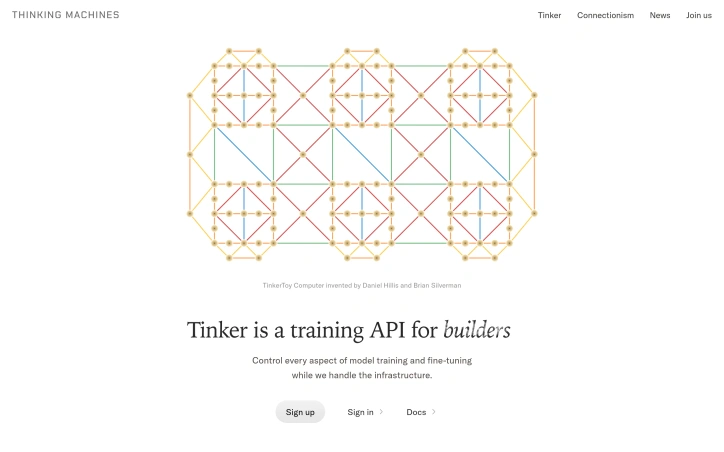
Tinker

Researchers spend considerable time wrestling with infrastructure rather than focusing on the work that matters—fine-tuning models and designing algorithms. Tinker addresses this friction by offering a lightweight API that handles the operational burden of model training while keeping researchers in control of their data and experimental approach. The platform targets an audience that values research velocity over infrastructure flexibility: academics, laboratories, and independent researchers exploring large language model training without wanting to manage compute clusters, scheduler complexity, or resource allocation manually. The core value proposition hinges on LoRA, an efficient fine-tuning technique that updates a trainable adapter layer rather than the full model weights. This approach reduces computational demands while maintaining learning performance comparable to traditional fine-tuning. For researchers with limited hardware budgets, this matters considerably. Tinker abstracts away scheduling, hardware management, and infrastructure reliability entirely, offering a deliberately minimal API surface: four core operations handle forward passes and gradient accumulation, weight updates, token generation, and state persistence. This simplicity contrasts sharply with the complexity of self-managed training pipelines. The platform's model roster demonstrates genuine breadth. Tinker supports dense and mixture-of-experts variants across multiple architectures—Qwen, Llama, DeepSeek, Kimi, and NVIDIA's Nemotron—ranging from 1B to 397B parameters. This range suggests the infrastructure can scale to serious research workloads while remaining accessible to those working with smaller models. What distinguishes Tinker from ad-hoc cloud compute solutions is the engineering philosophy reflected in user testimonials. Researchers emphasize that the platform lets them "focus on research rather than spending time on engineering overhead," that "infrastructure abstraction makes focusing on data and evals far easier," and that it enables "quick iteration without worrying about hardware." These aren't marginal improvements—they describe a fundamental shift in attention from operational concerns to scientific ones. The testimonials come from academics and practitioners actively working in reinforcement learning and model training, lending credibility to these claims. The platform appears designed specifically for the researcher segment that finds existing options unsatisfying: cloud GPUs require babysitting, on-premise infrastructure demands expertise, and managed services often impose opinionated constraints on training workflows. Tinker occupies a narrower niche but serves it deliberately. Access requires signup or organizational outreach, and pricing details remain undisclosed publicly. For researchers prioritizing iteration speed and research focus over cost optimization or total architectural control, the trade-off appears worth making.

Ai-chatbots

Researchers spend considerable time wrestling with infrastructure rather than focusing on the work that matters—fine-tuning models and designing algorithms. Tinker addresses this friction by offering a lightweight API that handles the operational burden of model training while keeping researchers in control of their data and experimental approach. The platform targets an audience that values research velocity over infrastructure flexibility: academics, laboratories, and independent researchers exploring large language model training without wanting to manage compute clusters, scheduler complexity, or resource allocation manually. The core value proposition hinges on LoRA, an efficient fine-tuning technique that updates a trainable adapter layer rather than the full model weights. This approach reduces computational demands while maintaining learning performance comparable to traditional fine-tuning. For researchers with limited hardware budgets, this matters considerably. Tinker abstracts away scheduling, hardware management, and infrastructure reliability entirely, offering a deliberately minimal API surface: four core operations handle forward passes and gradient accumulation, weight updates, token generation, and state persistence. This simplicity contrasts sharply with the complexity of self-managed training pipelines. The platform's model roster demonstrates genuine breadth. Tinker supports dense and mixture-of-experts variants across multiple architectures—Qwen, Llama, DeepSeek, Kimi, and NVIDIA's Nemotron—ranging from 1B to 397B parameters. This range suggests the infrastructure can scale to serious research workloads while remaining accessible to those working with smaller models. What distinguishes Tinker from ad-hoc cloud compute solutions is the engineering philosophy reflected in user testimonials. Researchers emphasize that the platform lets them "focus on research rather than spending time on engineering overhead," that "infrastructure abstraction makes focusing on data and evals far easier," and that it enables "quick iteration without worrying about hardware." These aren't marginal improvements—they describe a fundamental shift in attention from operational concerns to scientific ones. The testimonials come from academics and practitioners actively working in reinforcement learning and model training, lending credibility to these claims. The platform appears designed specifically for the researcher segment that finds existing options unsatisfying: cloud GPUs require babysitting, on-premise infrastructure demands expertise, and managed services often impose opinionated constraints on training workflows. Tinker occupies a narrower niche but serves it deliberately. Access requires signup or organizational outreach, and pricing details remain undisclosed publicly. For researchers prioritizing iteration speed and research focus over cost optimization or total architectural control, the trade-off appears worth making.

Tinker preview

Key features

  • Lightweight API: Handles operational burden of model training while keeping researchers in control of their data
  • LoRA Fine-Tuning: Efficient fine-tuning technique that updates adapter layers rather than full model weights, reducing computational demands
See full listing
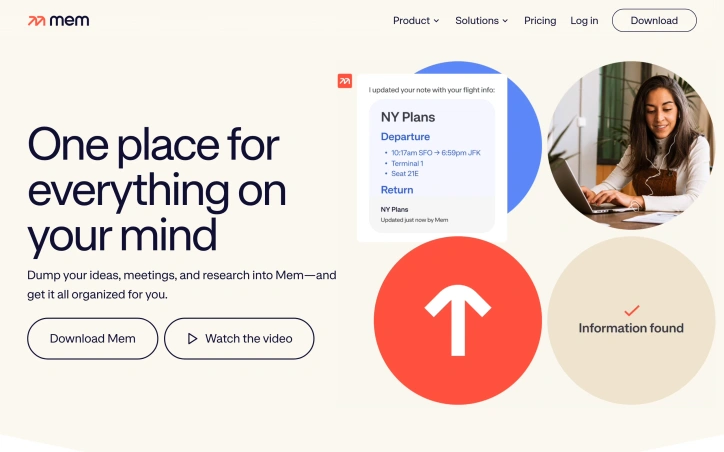
Mem 2.0

For individuals who spend a significant amount of time in meetings, conducting research, and juggling multiple projects simultaneously, managing one's thoughts and ideas can be a daunting task. Mem 2.0 aims to alleviate this burden by capturing these ephemeral moments and presenting them when needed. What stands out about Mem is its straightforward approach. Unlike some AI-powered productivity tools that promise more than they deliver, Mem's pitch is refreshingly honest: it helps you remember key points from meetings and research sessions. This focus on a specific pain point suggests that the developers understand their target audience's needs and have crafted a solution tailored to those requirements. Mem 2.0 is available across multiple platforms – Mac, Windows, Web, and iOS – making it accessible to users who prefer different environments. This broad compatibility also implies that Mem can integrate with various workflows and existing tools. While specific features or capabilities are not explicitly mentioned in the provided content, the promise of capturing ideas "exactly when you need them" suggests a sophisticated approach to information retrieval and organization. It's likely that Mem utilizes some form of natural language processing (NLP) and machine learning algorithms to identify key points and prioritize relevant information. The website does mention the necessity of an updated browser version to function properly, implying that the application relies on JavaScript for its core functionality. This may be a turn-off for users who prefer to stick with older browsers or have concerns about compatibility. No pricing details are mentioned in the provided content.

Ai-chatbots

For individuals who spend a significant amount of time in meetings, conducting research, and juggling multiple projects simultaneously, managing one's thoughts and ideas can be a daunting task. Mem 2.0 aims to alleviate this burden by capturing these ephemeral moments and presenting them when needed. What stands out about Mem is its straightforward approach. Unlike some AI-powered productivity tools that promise more than they deliver, Mem's pitch is refreshingly honest: it helps you remember key points from meetings and research sessions. This focus on a specific pain point suggests that the developers understand their target audience's needs and have crafted a solution tailored to those requirements. Mem 2.0 is available across multiple platforms – Mac, Windows, Web, and iOS – making it accessible to users who prefer different environments. This broad compatibility also implies that Mem can integrate with various workflows and existing tools. While specific features or capabilities are not explicitly mentioned in the provided content, the promise of capturing ideas "exactly when you need them" suggests a sophisticated approach to information retrieval and organization. It's likely that Mem utilizes some form of natural language processing (NLP) and machine learning algorithms to identify key points and prioritize relevant information. The website does mention the necessity of an updated browser version to function properly, implying that the application relies on JavaScript for its core functionality. This may be a turn-off for users who prefer to stick with older browsers or have concerns about compatibility. No pricing details are mentioned in the provided content.

Mem 2.0 preview

Key features

  • Idea Capture: Captures thoughts and ideas from meetings and research sessions
  • Multi-Platform Support: Available on Mac, Windows, Web, and iOS
See full listing
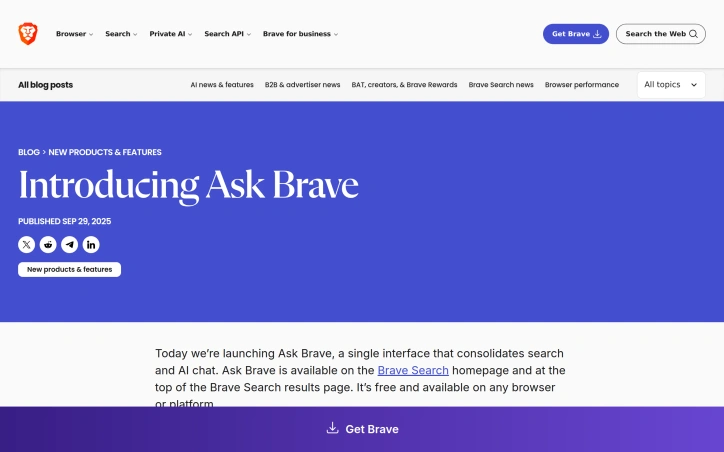
Ask Brave

Search engines have traditionally presented users with a list of links and summaries in response to their queries. This approach often leaves room for improvement, as users are forced to navigate between different tools or copy-paste results to get the information they need. Brave's latest innovation, Ask Brave, addresses this issue by integrating AI chat and web search into a single interface. Ask Brave is designed to cater to users who want more comprehensive answers to their queries, along with actionable follow-ups such as videos, web pages, and products. This product is ideal for those seeking an all-in-one solution that combines the simplicity of traditional search engines with the convenience of AI-generated responses. The platform's ability to determine the level of resolution needed for each query and provide users with both answers and follow-up actions makes it particularly useful for exploratory searches. What stands out about Ask Brave is its commitment to user privacy. Brave ensures that conversations are encrypted, ephemeral, and expire after 24 hours of inactivity, without retaining IP addresses or using them for training purposes. This approach aligns with the company's values and provides users with an added layer of security. Key features worth noting include the platform's ability to provide grounded answers based on web search results, ensuring that AI responses are relevant and accurate. Users can type simple search queries or ask nuanced questions, with Ask Brave adapting its response accordingly. The product is available in addition to AI Answers, which offer quick answers to users' queries. Ask Brave is free and accessible on any browser or platform, making it a valuable resource for anyone looking to streamline their search experience. With over 15 million AI-generated responses served daily, Brave's commitment to providing comprehensive answers and follow-up actions sets it apart in the market. As a result, Ask Brave has become an essential tool for those seeking a more efficient and private way to navigate the web.

Ai-chatbots

Search engines have traditionally presented users with a list of links and summaries in response to their queries. This approach often leaves room for improvement, as users are forced to navigate between different tools or copy-paste results to get the information they need. Brave's latest innovation, Ask Brave, addresses this issue by integrating AI chat and web search into a single interface. Ask Brave is designed to cater to users who want more comprehensive answers to their queries, along with actionable follow-ups such as videos, web pages, and products. This product is ideal for those seeking an all-in-one solution that combines the simplicity of traditional search engines with the convenience of AI-generated responses. The platform's ability to determine the level of resolution needed for each query and provide users with both answers and follow-up actions makes it particularly useful for exploratory searches. What stands out about Ask Brave is its commitment to user privacy. Brave ensures that conversations are encrypted, ephemeral, and expire after 24 hours of inactivity, without retaining IP addresses or using them for training purposes. This approach aligns with the company's values and provides users with an added layer of security. Key features worth noting include the platform's ability to provide grounded answers based on web search results, ensuring that AI responses are relevant and accurate. Users can type simple search queries or ask nuanced questions, with Ask Brave adapting its response accordingly. The product is available in addition to AI Answers, which offer quick answers to users' queries. Ask Brave is free and accessible on any browser or platform, making it a valuable resource for anyone looking to streamline their search experience. With over 15 million AI-generated responses served daily, Brave's commitment to providing comprehensive answers and follow-up actions sets it apart in the market. As a result, Ask Brave has become an essential tool for those seeking a more efficient and private way to navigate the web.

Ask Brave preview

Key features

  • AI Chat Integration: Combines AI chat and web search into a single interface for comprehensive results
  • Privacy Protection: Conversations are encrypted, ephemeral, and expire after 24 hours without IP tracking or data retention
See full listing
Vibe Coding Award

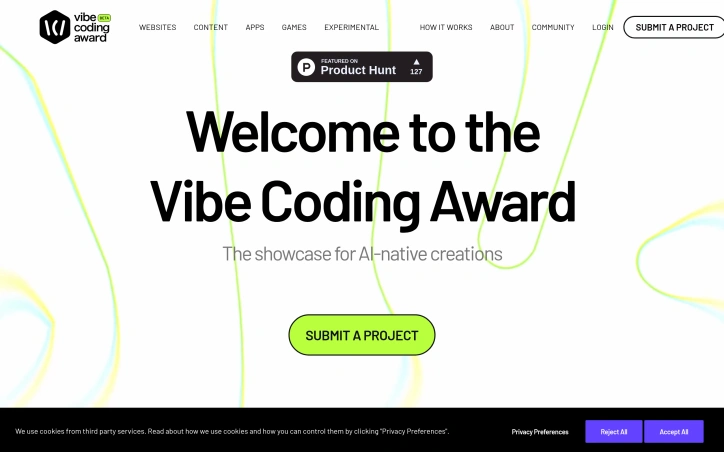
The Vibe Coding Award offers a platform for coders and creatives to showcase their innovative projects in AI-native development. It fills a gap by providing a dedicated stage for recognizing excellence in this emerging field, catering specifically to individuals or teams pushing the boundaries of human-machine collaboration. What stands out about the Vibe Coding Award is its clear vision and manifesto-driven approach. The platform proudly proclaims itself as a "showcase for AI-native creations," which implies that it's not just a recognition ceremony but an active curator of the most groundbreaking work in this space. By creating a dedicated category for experimental projects, it also encourages innovation without boundaries. The award boasts a diverse and experienced jury composed of senior design leaders from top tech companies like Google and Lyft. This suggests a high level of credibility and expertise in evaluating AI-driven creations. Key features worth noting include the five distinct categories (websites, apps, content, games, and experimental) that cater to different types of projects. The platform also explicitly mentions its mission to provide recognition, visibility, and community impact – implying a focus on both personal and professional development for its winners. While pricing information is not provided, it seems that the Vibe Coding Award operates as an award ceremony, likely relying on entry fees or sponsorships to sustain itself. Despite the lack of explicit details, the platform's commitment to innovation and creative expression in AI-native development is evident throughout its content.

Ai-chatbots

The Vibe Coding Award offers a platform for coders and creatives to showcase their innovative projects in AI-native development. It fills a gap by providing a dedicated stage for recognizing excellence in this emerging field, catering specifically to individuals or teams pushing the boundaries of human-machine collaboration. What stands out about the Vibe Coding Award is its clear vision and manifesto-driven approach. The platform proudly proclaims itself as a "showcase for AI-native creations," which implies that it's not just a recognition ceremony but an active curator of the most groundbreaking work in this space. By creating a dedicated category for experimental projects, it also encourages innovation without boundaries. The award boasts a diverse and experienced jury composed of senior design leaders from top tech companies like Google and Lyft. This suggests a high level of credibility and expertise in evaluating AI-driven creations. Key features worth noting include the five distinct categories (websites, apps, content, games, and experimental) that cater to different types of projects. The platform also explicitly mentions its mission to provide recognition, visibility, and community impact – implying a focus on both personal and professional development for its winners. While pricing information is not provided, it seems that the Vibe Coding Award operates as an award ceremony, likely relying on entry fees or sponsorships to sustain itself. Despite the lack of explicit details, the platform's commitment to innovation and creative expression in AI-native development is evident throughout its content.

Vibe Coding Award preview

Key features

  • AI-Native Showcase: Dedicated platform for recognizing excellence in AI-native development projects.
  • Five Project Categories: Accepts submissions in websites, apps, content, games, and experimental projects.
See full listing
Granola Recipes

The notion of leveraging AI to streamline work processes has been gaining traction in recent years, but the vast majority of tools on the market lack a crucial component: context. Granola's new feature, Recipes, seeks to address this limitation by combining expert-written prompts with real-time meeting notes and conversations. For professionals who rely heavily on collaboration and feedback, Granola's solution offers a significant advantage. The platform can now provide tailored guidance and support during critical work phases, such as brainstorming sessions or sales meetings. This is particularly beneficial for teams that struggle to integrate AI into their workflow due to the lack of contextual understanding. What sets Recipes apart from other AI-powered tools is its ability to bring together expertise and context in a seamless manner. The platform's incorporation of prompts written by industry experts, such as Lenny Rachitsky and Matt Mochary, provides users with actionable advice and recommendations that are grounded in real-world experience. Key features worth noting include the "Coach me" and "Prep me" functions, which utilize meeting notes to offer personalized guidance and support. The platform's flexibility also allows users to create their own custom Recipes or share them with colleagues. As for pricing and business model details, there is no explicit mention in the provided content. It appears that Granola operates on a subscription-based model, but further information would be necessary to confirm this assumption.


Ai-chatbots

The notion of leveraging AI to streamline work processes has been gaining traction in recent years, but the vast majority of tools on the market lack a crucial component: context. Granola's new feature, Recipes, seeks to address this limitation by combining expert-written prompts with real-time meeting notes and conversations. For professionals who rely heavily on collaboration and feedback, Granola's solution offers a significant advantage. The platform can now provide tailored guidance and support during critical work phases, such as brainstorming sessions or sales meetings. This is particularly beneficial for teams that struggle to integrate AI into their workflow due to the lack of contextual understanding. What sets Recipes apart from other AI-powered tools is its ability to bring together expertise and context in a seamless manner. The platform's incorporation of prompts written by industry experts, such as Lenny Rachitsky and Matt Mochary, provides users with actionable advice and recommendations that are grounded in real-world experience. Key features worth noting include the "Coach me" and "Prep me" functions, which utilize meeting notes to offer personalized guidance and support. The platform's flexibility also allows users to create their own custom Recipes or share them with colleagues. As for pricing and business model details, there is no explicit mention in the provided content. It appears that Granola operates on a subscription-based model, but further information would be necessary to confirm this assumption.

Granola Recipes preview

Key features

  • Expert-Written Prompts: Combines prompts from industry experts like Lenny Rachitsky and Matt Mochary with meeting context
  • Coach Me Guidance: Provides personalized guidance using meeting notes to support professionals during work
See full listing
Genspark Photo Genius

In today's world of smartphone photography, photo editing has become a crucial aspect of our digital lives. With the proliferation of social media and online sharing, people want to present their best selves in front of others. However, not everyone has an eye for editing or the patience to learn its intricacies. Genspark Photo Genius attempts to address this problem by bringing AI-powered photo editing to the masses through voice control. This innovative approach allows users to edit photos just by speaking their mind, making it an attractive solution for those who don't have time or technical expertise to wield complex editing software. What stands out about Genspark Photo Genius is its unique blend of OpenAI's Realtime voice technology and Nano-Banana image AI. This fusion enables the app to understand users' spoken commands and apply the desired edits with remarkable speed and accuracy. The product claims a range of features, including perfecting makeup, hair, and outfit styling, as well as rescuing photo fails. Some key features worth noting are the voice-controlled beauty and instant style changes, which promise to revolutionize the way people edit their photos on-the-go. Additionally, the app's Magic Scene Swaps feature suggests it can transform the background of a photo with just a voice command. The Photo Rescue Mode is another notable aspect, implying that even damaged or poorly taken photos can be salvaged. However, I couldn't find any information about pricing or business models beyond the availability on iOS and Android platforms through the Genspark App.


Ai-chatbots

In today's world of smartphone photography, photo editing has become a crucial aspect of our digital lives. With the proliferation of social media and online sharing, people want to present their best selves in front of others. However, not everyone has an eye for editing or the patience to learn its intricacies. Genspark Photo Genius attempts to address this problem by bringing AI-powered photo editing to the masses through voice control. This innovative approach allows users to edit photos just by speaking their mind, making it an attractive solution for those who don't have time or technical expertise to wield complex editing software. What stands out about Genspark Photo Genius is its unique blend of OpenAI's Realtime voice technology and Nano-Banana image AI. This fusion enables the app to understand users' spoken commands and apply the desired edits with remarkable speed and accuracy. The product claims a range of features, including perfecting makeup, hair, and outfit styling, as well as rescuing photo fails. Some key features worth noting are the voice-controlled beauty and instant style changes, which promise to revolutionize the way people edit their photos on-the-go. Additionally, the app's Magic Scene Swaps feature suggests it can transform the background of a photo with just a voice command. The Photo Rescue Mode is another notable aspect, implying that even damaged or poorly taken photos can be salvaged. However, I couldn't find any information about pricing or business models beyond the availability on iOS and Android platforms through the Genspark App.

Genspark Photo Genius preview

Key features

  • Voice-Controlled Editing: Edit photos by speaking commands instead of using traditional manual tools.
  • Beauty Enhancement: Perfect makeup, hair, and outfit styling with voice-activated adjustments.
See full listing
Sora 2

The AI-generated video landscape has expanded with Sora 2, an innovative tool that leverages OpenAI's models to turn written prompts and images into captivating, hyperreal videos. With a single sentence as its starting point, users can craft cinematic scenes, anime shorts, or even remix existing content. Sora 2's user-centric interface makes it accessible to creators of various skill levels, from writers experimenting with new formats to videographers looking for AI-driven editing assistance. The platform's capabilities extend beyond basic video generation, allowing users to refine and customize their creations with precision controls. While the quality and coherence of generated content can vary depending on input complexity and model calibration, Sora 2 consistently demonstrates impressive narrative potential. As an artistic tool, it offers unprecedented freedom for creatives to explore new storytelling possibilities, pushing the boundaries of medium and genre. Sora 2's true value lies in its capacity to democratize high-end video production, empowering individuals without extensive experience or resources to produce visually stunning content.

Ai-chatbots

The AI-generated video landscape has expanded with Sora 2, an innovative tool that leverages OpenAI's models to turn written prompts and images into captivating, hyperreal videos. With a single sentence as its starting point, users can craft cinematic scenes, anime shorts, or even remix existing content. Sora 2's user-centric interface makes it accessible to creators of various skill levels, from writers experimenting with new formats to videographers looking for AI-driven editing assistance. The platform's capabilities extend beyond basic video generation, allowing users to refine and customize their creations with precision controls. While the quality and coherence of generated content can vary depending on input complexity and model calibration, Sora 2 consistently demonstrates impressive narrative potential. As an artistic tool, it offers unprecedented freedom for creatives to explore new storytelling possibilities, pushing the boundaries of medium and genre. Sora 2's true value lies in its capacity to democratize high-end video production, empowering individuals without extensive experience or resources to produce visually stunning content.

Sora 2 preview

Key features

  • Text-to-Video Generation: Uses OpenAI models to convert written prompts into dynamic, hyperreal videos.
  • Image Input Support: Accepts images alongside text prompts as a starting point for generating scenes.
See full listing