Catalyst Healthspan Audit
Personal trainers typically sell training sessions. This startup reversed the equation by building assessment first, mak...
Launchory
We built Launchory to solve the discoverability problem for startups. Our platform offers instant approval, permanent do...
Best AI Chatbots Startups & Tools
Modern assistants that write, code, analyze, and execute tasks across apps.
Recently Listed
23 launches
Divination has traditionally been gated behind expensive appointments and limited availability, leaving people seeking practical guidance with few accessible options. Lenormand Live addresses this by offering an AI-powered Lenormand card reading platform available 24/7 with support for 15 languages. The platform focuses on Lenormand rather than Tarot, a deliberately practical choice. Lenormand's 36-card system emphasizes concrete, actionable guidance over psychological symbolism, making it better suited for questions about love, career, and life direction. The product offers ten different spreads ranging from simple three-card layouts to nine-by-nine grids for comprehensive analysis, ensuring both beginners and experienced practitioners find suitable options. What distinguishes Lenormand Live is its implementation of contextual card interpretation through what the platform calls adjacency—reading neighboring cards as semantic units rather than in isolation. This approach mirrors how professional readers work. AI-powered, it applies this technique consistently and instantly. The interface guides users to focus their intention before selecting cards, and the AI generates interpretable guidance based on both card positions and the user's specific question. The business model reflects thoughtful design. Users access free basic readings and standard card meanings without friction. Detailed AI interpretations that synthesize card positions with question context unlock through payment, creating a straightforward freemium structure. Payment options include Stripe and Alipay, acknowledging the platform's international audience. Privacy considerations receive explicit attention. Card selection occurs entirely in the browser, and the platform only sends question text and spread data to interpretation services when users explicitly request AI reports. Without login or payment, reading history isn't retained long-term. This transparency about data handling stands out in a space where divination platforms often operate with little scrutiny around user privacy. The product exists within a broader ecosystem. The founder operates related platforms for geomancy, Mayan calendar guidance, tarot, and traditional astrology, suggesting both conviction in AI-assisted divination and recognition that different systems serve different user needs. Lenormand Live targets practical people seeking accessible guidance who value both transparency and convenience. The execution demonstrates understanding that AI can enhance rather than replace divination's appeal when applied thoughtfully to established methodologies.

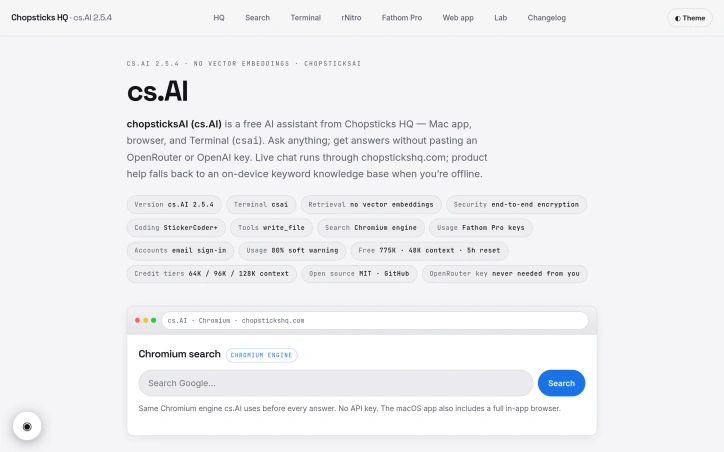
Eliminating API key friction remains a persistent pain point for Mac users exploring AI tools. Chopsticks HQ addresses this with chopsticksAI (cs.AI), a free AI assistant available across macOS, browser, and terminal that requires no key setup to get started. The product targets developers and general users alike who want accessible AI assistance without the overhead of configuring third-party services. What distinguishes cs.AI is its committed approach to removing barriers. The free tier provides 775,000 tokens with 48,000 context window, resetting every five hours—substantial enough for daily exploration without paywalls. The product spans three distinct interfaces: a native macOS app with integrated Chromium browser, a web application, and a full-screen terminal CLI invoked via csai command. This multi-surface design reflects genuine consideration for how users interact with their tools across different workflows. The technical architecture reveals thoughtful engineering choices. Every answer is grounded in a live Chromium web search before generation. A dual-model pipeline handles responses: NVIDIA's Nemotron 3 Ultra drafts the answer, then Google's Gemma 4 26B reviews, corrects, and eliminates redundancy without introducing unsupported facts. This review stage adds quality control at generation time rather than as an afterthought. End-to-end encryption protects conversations, while an offline mode with keyword-based knowledge base ensures partial functionality without connectivity. cs.AI's knowledge base encompasses Chopsticks HQ's product suite, making it particularly useful for users within their ecosystem. The MIT open-source license and reliance on Fathom Pro keys rather than third-party API credentials signal a self-contained infrastructure strategy. Pricing remains flexible and transparent. Free users encounter a soft warning at eighty percent usage. Credit tiers escalate capacity: two credits unlock 800,000 tokens with 64K context; five credits reach 900,000 tokens and 96K context; ten credits top out at one million tokens with 128K context. This credit-based model avoids the subscription fatigue of many competitors. The product successfully executes on a specific thesis: capable AI assistance without friction. For Mac users and developers seeking straightforward access without vendor lock-in or setup complexity, cs.AI removes legitimate obstacles to adoption. The combination of generous free allowances, multiple access points, and offline resilience makes it a credible alternative for those fatigued by API key management and service sprawl.
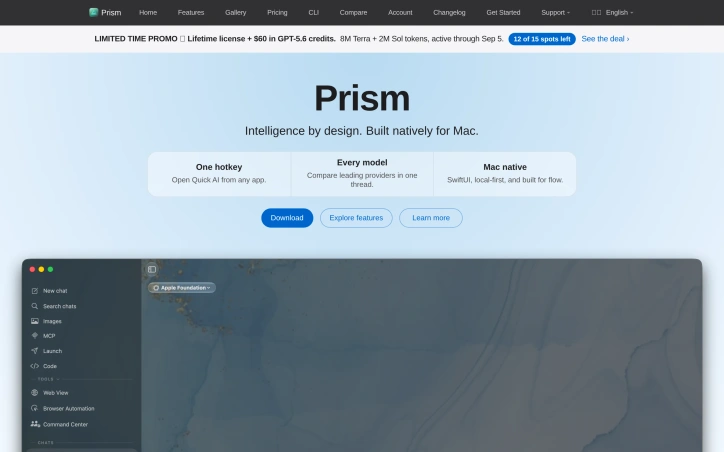
Scattered AI tools fracture workflows, forcing users to juggle browser tabs, separate applications, and disconnected windows just to access different models. Prism consolidates this chaos into a unified macOS workspace, eliminating the friction of context-switching and letting users stay focused on their actual work. Built natively in SwiftUI for macOS, Prism brings together multiple AI models, code assistance, local model support, and agent automation into one integrated environment. Users invoke the application via a single hotkey from any app, gaining instant access to a suite of tools without leaving their current workspace. The product targets knowledge workers and developers who rely on AI for writing, coding, and analysis—anyone drowning in scattered tools who wants a streamlined alternative. The standout capabilities center on flexibility and consolidation. Prism allows users to compare leading AI providers within a single thread, switching between models mid-conversation without disrupting context. This is a practical solution to the lock-in problem: users aren't forced to commit to one provider but can instead evaluate and swap based on task requirements. The application also supports local GGUF models with minimal setup friction, appealing to privacy-conscious users or those with specific model preferences. Beyond chat, Prism includes a native code companion with an integrated terminal, bringing development workflows into the same environment. The platform's agent features—AI that watches, summarizes, and acts automatically—suggest a system designed to anticipate user needs rather than simply respond to them. Integration with MCP and custom tools enables connections to files, databases, and APIs, expanding what users can accomplish without leaving the application. User testimonials highlight the experience as seamless integration with macOS itself. One key differentiator is the frictionless interaction model: hitting a hotkey, asking a question, and returning to work creates a flow that respects user attention rather than demanding it. The ability to swap models mid-session without breaking conversation context directly addresses a common pain point in multi-model workflows. Prism operates under a paid licensing model, with promotional messaging around limited-time lifetime access offers paired with cloud credits. Specific pricing details remain behind a link, though the site references tiered options. For macOS users struggling with AI tool fragmentation, Prism presents a consolidated alternative that prioritizes native integration, model flexibility, and minimal friction in the core interaction loop.
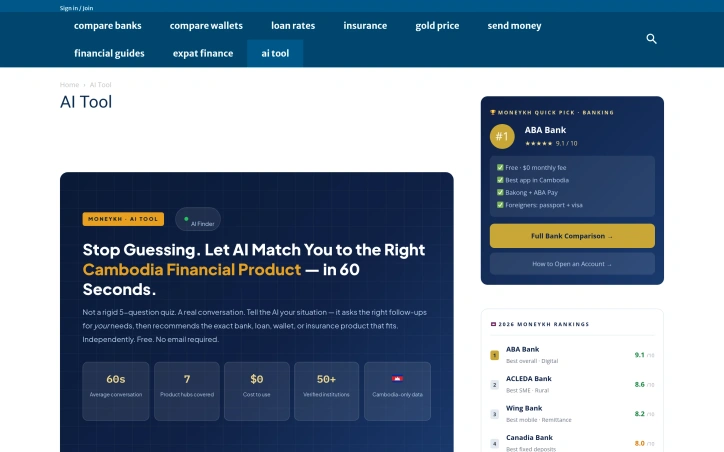
Finding the right financial product in Cambodia can be a daunting task, especially with numerous options available. The MoneyKH AI Tool is designed to simplify this process by engaging users in a conversational interface that recommends suitable financial products based on their specific needs. The tool is particularly useful for individuals seeking financial products such as savings accounts, loans, wallets, insurance, and remittance services. It is tailored to the Cambodian market, drawing on data from over 50 verified institutions across seven product hubs. What sets the MoneyKH AI Tool apart is its adaptive questioning process. Unlike traditional quizzes that follow a fixed script, this AI-driven advisor asks follow-up questions based on the user's input, allowing for a more nuanced understanding of their requirements. The tool then provides a personalized recommendation, explaining why a particular product is suitable and offering a link to compare it with other options on the MoneyKH platform. The AI Tool's capabilities are noteworthy. It covers a wide range of financial products and is backed by directly verified data from institutions, rather than relying on scraped marketing information. The conversation is free, and users do not need to provide their email address to receive a recommendation. The average conversation lasts around 60 seconds, making it a quick and convenient solution for those seeking financial guidance. Notably, the tool's conversational nature allows users to ask follow-up questions and delve deeper into their financial options. The developer's goal is to provide an intuitive and user-friendly experience, moving away from rigid, pre-scored matrices that fail to account for individual circumstances. The service is offered at no cost to the user, with the cost to use being explicitly stated as $0.

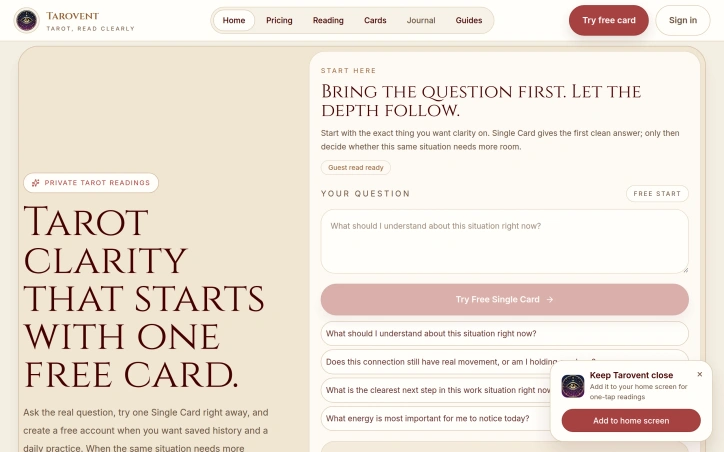
Seeking clarity without commitment, Tarovent offers a streamlined tarot reading experience that reduces the friction between curiosity and insight. The service addresses a specific frustration among tarot users: the need to determine whether a question requires a full reading before investing time and money into it. The product targets people navigating personal questions across relationships, career shifts, and daily decision-making. Rather than forcing users into lengthy readings or subscriptions, Tarovent allows anyone to pull a single card for free, answer a specific question, and decide whether deeper exploration makes sense. This low-stakes entry point works against the perception that tarot requires significant commitment or belief. What distinguishes Tarovent is its structured approach to question formation. Before selecting a spread, users articulate what they actually want to know rather than receiving generic readings. The interface offers entry points organized by context: love and relationship patterns, career pressures and transitions, crossroads requiring directional clarity, and daily mood checks. This specificity moves the reading away from fortune-telling theater toward directed self-reflection. The product depth mirrors this philosophy. Three spread options exist: the single card for immediate answers, the three-card spread for examining present dynamics, and the ten-card Celtic Cross for complex situations. Users who want to save readings and maintain a daily practice can create an account, receiving one free card daily while retaining full control over when and whether to pay for additional spreads. Transparency about tarot's limitations stands out in the interface itself. The product acknowledges that readings support personal guidance and self-reflection but cannot verify hidden facts, make promises, or reveal another person's private thoughts. This honesty counters the inflated claims that typically cloud tarot spaces, positioning the tool as genuinely useful rather than miraculous. The business model avoids subscription friction altogether. Users pay once per deeper reading if needed, keeping their relationship to the tool optional and exploratory. Combined with the daily free card for registered users, this approach removes pressure while sustaining revenue from people who find genuine value in the service. Tarovent ultimately succeeds because it respects user skepticism and autonomy, letting the experience justify itself through a single card rather than demanding upfront faith or commitment.

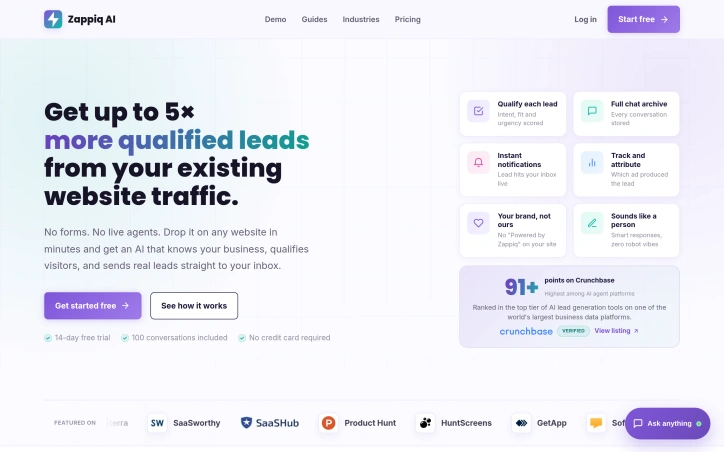
Capturing qualified leads from existing website traffic remains one of the biggest challenges for businesses of all sizes. Most websites squander visitor interactions—traditional contact forms create friction that drives prospects away, while generic chatbots fail to understand business context or identify which visitors actually warrant follow-up. Zappiq AI addresses this gap with a conversational AI that deploys directly onto any website in minutes. Rather than forcing visitors through forms, the chatbot engages naturally, learns the specifics of the business, and evaluates whether each prospect meets basic qualification criteria. When someone shows genuine intent and fit, the system captures their information and notifies the business immediately, eliminating the delays that plague traditional lead pipelines. The product shines in how it handles the operational side of lead capture. Every conversation gets stored with full context—visitor questions, responses, contact details, and lead sources all appear in one unified dashboard. This context eliminates the scattered note-taking and email chains that typically derail follow-up. The system scores leads by intent, fit, and urgency so sales teams know which prospects to prioritize. It also tracks attribution, showing which marketing channel or ad actually drove each lead, giving businesses clarity on where their traffic originates. The conversational quality matters here too. The AI generates responses that feel human rather than robotic, which shapes how visitors perceive the business itself. Zappiq AI also respects brand ownership—there's no "Powered by Zappiq" footer on customer sites, keeping the interaction feel native to the business. Third-party validation backs the product's positioning. It has earned a 91-plus Crunchbase score, the highest rating among AI agent platforms, and appears on multiple industry shortlists including Capterra, GoodFirms, and Product Hunt. These don't guarantee product-market fit, but they indicate sustained recognition within the lead generation tool category. The business model is straightforward: a 14-day free trial with 100 conversations included and no credit card upfront. This removes friction for businesses testing whether conversational lead capture actually works for their traffic volume and visitor types. Zappiq AI targets small to mid-market businesses tired of watching website traffic evaporate. The value proposition is direct—convert more of the people who visit you already. For companies with meaningful web traffic but weak lead capture infrastructure, it's worth testing.

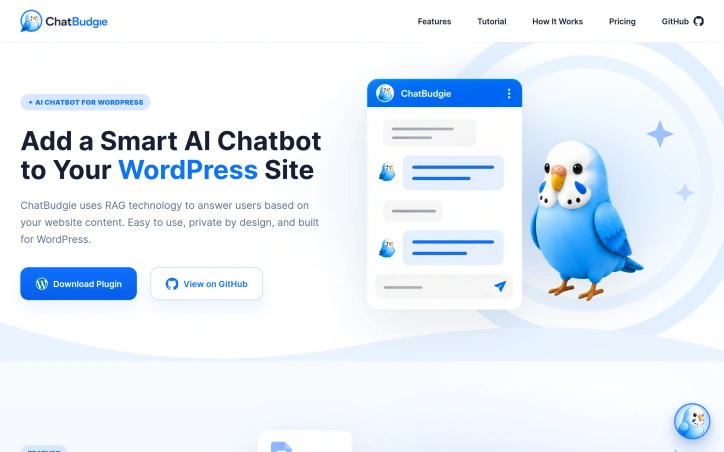
WordPress site owners constantly wrestle with the dual challenge of providing responsive customer support while keeping visitors engaged. Traditional AI chatbot solutions compound this problem by demanding complex API integrations, ongoing maintenance, and technical expertise that most website administrators lack. This plugin addresses that friction directly. Rather than pulling answers from the general internet, it uses retrieval-augmented generation (RAG) to ground responses in a site's actual content, delivering answers that are both accurate and contextually relevant to the business. This architecture shift eliminates the accuracy problems that come with generic AI responses while building customer trust through transparent sourcing. The implementation philosophy prioritizes simplicity over feature complexity. Setup takes minutes without requiring API key management or external service coordination. The chatbot automatically maintains its knowledge base as site content updates, removing the burden of manual retraining or version management that plagues other solutions. There is no server to configure, no backend infrastructure to oversee. Privacy by design is another differentiator. Because the system works within a WordPress site's own ecosystem and relies on its own content rather than third-party AI services, data handling remains under the site owner's control. This matters for businesses with privacy-conscious audiences or compliance requirements. The business model reflects this accessibility-first approach. Rather than adopting the software-as-a-service subscription model that dominates the chatbot space, the product uses one-time token purchases. A light-usage tier starts at $4.95 for five million tokens, with mid-range and high-volume options at $19.50 and $95 respectively. These purchases do not expire, and there are no hidden recurring fees. For WordPress operators with limited budgets or unpredictable chatbot usage, this removes the calculus of committing to monthly subscriptions. The product targets a specific underserved segment: small to medium WordPress sites that need support automation but lack the technical resources or budget for enterprise solutions. It does not promise to replace human support entirely, but rather to handle routine inquiries, reduce response time pressure on small teams, and create a more polished visitor experience. For that narrow use case, it presents a genuinely different approach to a common pain point.

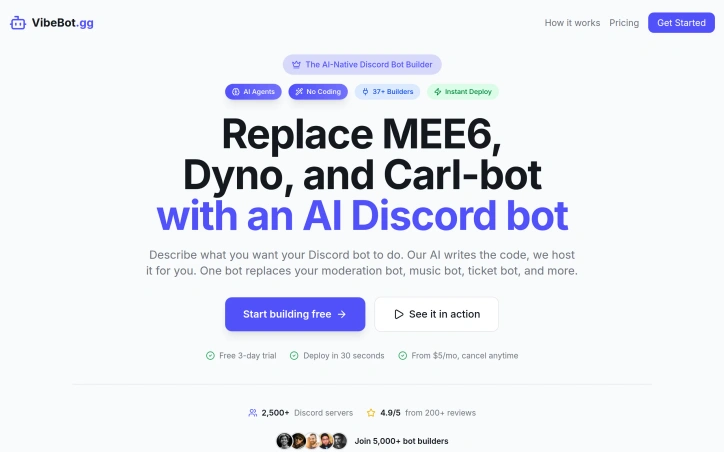
Creating and managing Discord bots can be a daunting task, especially for those without coding knowledge. VibeBot addresses this issue by providing a platform that allows users to build and deploy AI-powered Discord bots without requiring any programming expertise. The target audience is clearly Discord server administrators who struggle with managing multiple bots for various tasks such as moderation, music, and custom commands. What stands out about VibeBot is its innovative use of AI technology to simplify the bot creation process. Users can simply describe what they want their bot to do in plain English, and the AI will generate the necessary features and deploy the bot in under 30 seconds. This autonomous AI technology is a game-changer, enabling users to create complex bots with ease. The platform offers a range of key features, including AI moderation, music players, economy systems, and ticket handlers. The AI moderation agent is particularly noteworthy, as it can detect toxicity in real-time and take smart actions such as warning, muting, or banning users based on context. Additionally, VibeBot offers 18+ integrations, allowing users to connect their bot to various services. VibeBot offers a free 3-day trial, and its pricing starts at $5 per month, with the option to cancel at any time. The platform is hosted 24/7, ensuring zero maintenance and auto-scaling. With over 2,500 Discord servers already using VibeBot and a 4.9/5 rating from 200+ reviews, it's clear that the platform is delivering on its promise to simplify Discord bot creation. Overall, VibeBot is an impressive solution that is sure to appeal to Discord server administrators looking to streamline their bot management.

Users seeking more depth and personalization in astrology and tarot readings have a new option with Astic. The creator's motivation stems from a desire to move beyond generic, cookie-cutter horoscopes and offer users a more meaningful and tailored experience. Astic is geared towards individuals looking for introspective insights and guidance on various aspects of their lives, such as love, career, and personal growth. What stands out about Astic is its holistic approach, blending astrology and tarot archetypes to provide users with nuanced and multi-faceted readings. The platform's emphasis on user input and honest reflection creates a sense of agency and ownership over the reading process. The various reading options, such as open question, love compatibility, and year ahead, cater to different user needs and preferences. The reading process is transparent, with three distinct steps that prioritize user input, thoughtful analysis, and personalized interpretation. Users are encouraged to ask real questions and receive a customized report that is both informative and thought-provoking. The resulting readings are designed to be revisitable, with users able to save a representative image and revisit their insights at a later time. One user testimonial highlights the impact of Astic's readings, with Aria24 sharing a powerful emotional response to the hidden pattern section of her love compatibility reading. While pricing details are not explicitly stated, the overall tone suggests a product that is designed to provide lasting value to users. By focusing on the user's personal journey and offering a rich, interpretive experience, Astic distinguishes itself in the realm of astrology and tarot readings.


For individuals seeking clarity on life's complexities, TarotGuide offers a unique solution by providing AI-powered tarot readings. The platform caters to those navigating love, career, and personal growth, making ancient tarot wisdom accessible to a modern audience. By leveraging advanced technology, TarotGuide bridges the gap between traditional mysticism and contemporary needs. The founder's vision is to democratize tarot readings, making them available to everyone. What stands out about TarotGuide is its dual approach to tarot readings. The platform features two distinct AI-powered tarot readers, Moonlight and Stella, each specializing in different areas. Moonlight focuses on love, relationships, and emotional growth, offering empathetic guidance, while Stella provides insight into career, finance, and major life decisions with a more analytical approach. This distinction allows users to choose the reader that best suits their query. The platform offers a range of tarot spreads and readings, including one-card draws, love readings, and more complex spreads like the Celtic Cross. Users can explore the meanings of all 78 tarot cards, browsing through the Major and Minor Arcana. The interface allows for both manual card selection and auto-draw options, catering to different user preferences. Upon signing up, users receive 20 free credits, enabling them to try various readings without initial commitment. The platform performs over 10,000 readings daily, indicating a level of engagement and trust among its user base. While specific pricing details for additional credits beyond the initial free allocation are not provided, the variety of free and paid options suggests a freemium model, allowing users to experience the service before potentially purchasing more credits.


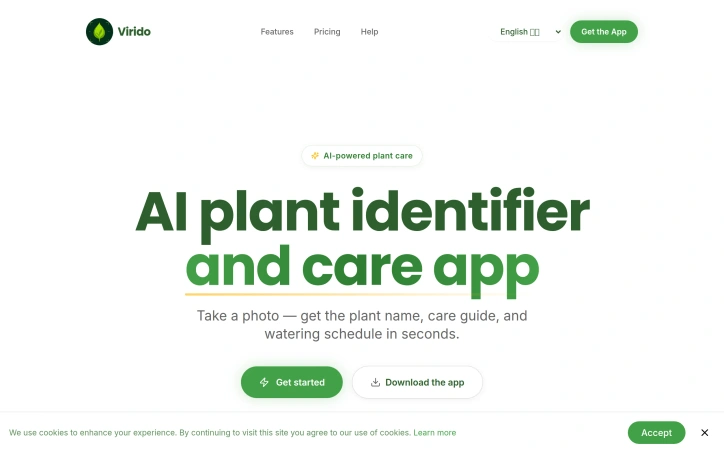
Caring for plants can be a daunting task, especially for those new to the world of indoor gardening. Forgetfulness and uncertainty often plague plant enthusiasts, leading to neglect and a lack of confidence in their ability to nurture their plants. Virido addresses this issue head-on by providing a comprehensive solution for plant care. The app is designed for anyone looking to simplify the process of caring for their plants, regardless of their level of experience. What sets Virido apart is its reliance on AI technology to power its plant identification and care features. By taking a photo of a plant, users can instantly receive information on the plant's species, care requirements, and watering schedule. The app's AI-powered expert also offers personalized advice and diagnoses potential issues, providing users with a trusted resource for all their plant care needs. The app's features are geared towards making plant care as seamless as possible. Users can set up smart reminders to ensure they never forget to water or tend to their plants. For more advanced users, the Pro version unlocks additional tools and features, including unlimited plant identifications and access to a comprehensive plant library. For those looking to take their plant care to the next level, Virido offers a robust set of capabilities. While the specifics of the pricing model are not entirely clear, the distinction between the standard and Pro versions suggests that the app operates on a freemium model, with certain features reserved for paid users. Overall, Virido has the potential to be a valuable resource for plant enthusiasts, providing a one-stop-shop for all their plant care needs.

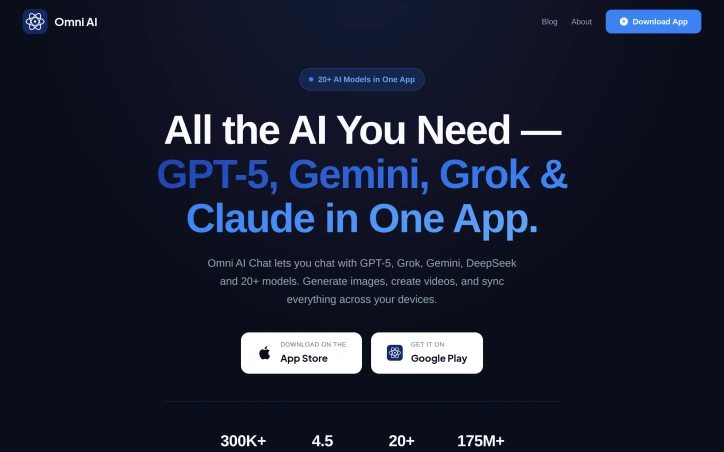
Switching between ChatGPT, Gemini, Grok, and half a dozen other AI apps takes a toll on productivity and your wallet. Omni AI consolidates access to more than 20 leading AI models into a single iOS and Android application, positioning itself as the one-stop solution for users who want to leverage multiple AI systems without maintaining separate subscriptions. The app's core appeal is straightforward: rather than juggling tabs or apps, users can access GPT-5.2, Claude Sonnet 4.5, Grok 4.1, Gemini 3, DeepSeek R1, Mistral Large 3, Llama 4 Scout, Perplexity Sonar, and others all in one place. The real differentiation comes in how the app handles model selection. Omni AI displays the strengths and optimal use cases for each model, helping users understand which one to choose for coding, writing, math, research, or creative tasks. More importantly, the app allows mid-conversation model switching, letting users compare outputs directly without starting over. Beyond chat, Omni AI bundles image generation, video creation, and AI-powered web search into the same interface. Cross-device sync means conversations and preferences carry across phones and tablets, while organizational features like chat folders and specialized "expert AI assistants" for specific tasks bring structure to what could otherwise feel chaotic. The numbers suggest adoption is gaining traction. The app has reached 200,000 downloads, maintains a 4.5-star rating, and has processed over 175 million messages. These figures sit well within the range of a serious mobile application gaining early momentum, though still short of mainstream penetration. Pricing is approachable. The app is free to download with a freemium model; premium plans start at $5.99 per week, $9.99 per month, or $59.99 per year. This positions Omni AI as cheaper than maintaining subscriptions to OpenAI, Google, and xAI separately, though the exact cost-benefit depends on which models a user actually needs and how often they access premium features. For developers, researchers, writers, and anyone who regularly switches between different AI models, Omni AI removes friction. The real test will be whether the consolidated experience actually improves workflow quality or simply trades one form of switching—between apps—for another.

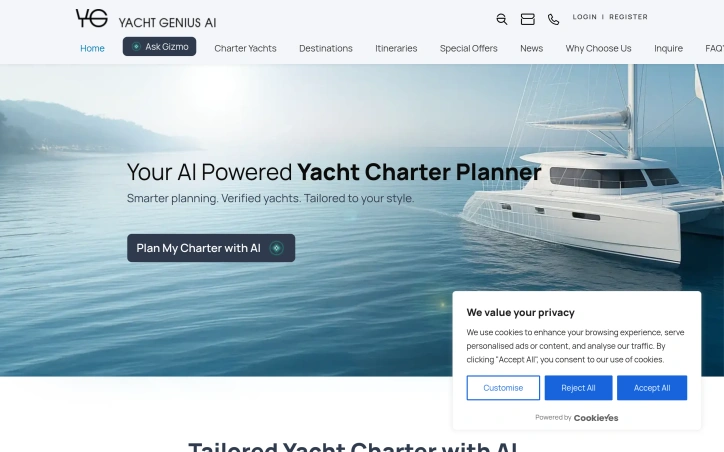
Planning a yacht charter typically requires navigating scattered databases, contacting multiple brokers, and piecing together information from various sources—a process that can be both time-consuming and opaque. Yacht Genius AI addresses this friction by combining a searchable yacht database with an AI-powered assistant to help prospective charterers find and compare vessels across multiple destinations and travel styles. The platform targets both novice sailors exploring their first charter and experienced mariners seeking specific regional expertise. The breadth of destinations matters here: the site lists nearly 1,400 Mediterranean yachts alone, alongside substantial inventories in the Caribbean, Greek islands, and other popular cruising grounds. Rather than presenting yachts as interchangeable commodities, the platform attempts to organize the search around travel intent—whether that's a family-friendly cruise, an adventure-focused passage, or a specialized deep-sea fishing expedition. What distinguishes Yacht Genius AI from a basic charter booking site is its emphasis on curation and transparency. The company claims to verify yacht specifications and provide curated data, reducing the information asymmetry that often characterizes the charter market. The on-page AI assistant, branded as "Gizmo," functions as a search companion rather than a standalone booking engine, helping users navigate destinations through conversation rather than traditional form-filling. This conversational layer is meaningful in a market where customers often lack the technical vocabulary to articulate their preferences—saying "I want relaxed island hopping" is different from specifying catamaran length and tonnage. The destination guides move beyond simple listings, offering contextual information about sailing conditions, geography, and experience profiles. The Bahamas section, for instance, emphasizes shallow-water suitability for catamarans, while the Windwards are positioned for sailors seeking trade winds and adventure. This interpretive layer suggests the platform is building knowledge about regional sailing characteristics rather than simply aggregating listings. A notable gap is the absence of explicit pricing information in the visible content. For a market where charter costs vary dramatically based on season, yacht class, and itinerary, clarity around pricing mechanisms—whether base rates, deposit structures, or per-day valuations—would strengthen customer decision-making. The platform does highlight special offers and last-minute deals, suggesting a dynamic pricing model, but lacks transparency about how these are calculated or what discounts actually mean in practical terms.

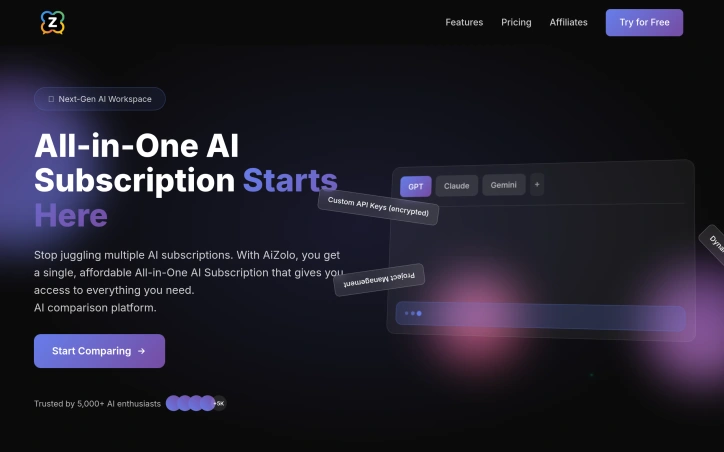
Consolidating disparate AI tool subscriptions into a single unified platform, AiZolo targets creators and power users fatigued by the escalating costs and friction of managing multiple AI service accounts simultaneously. At its core, the product addresses a real pain point: the typical workflow of toggling between ChatGPT, Claude, Gemini, and other leading models across separate browser tabs and billing accounts. The value proposition hinges on two main elements. First, pricing compression—bundling access to GPT-4, Claude, Gemini Pro, Perplexity Sonar Pro, and Grok into a single $9.90 monthly subscription, positioned against the $110 baseline of maintaining individual subscriptions. Second, functionality consolidation that extends beyond mere aggregation. The platform enables direct side-by-side comparison of responses from multiple models, allowing users to query several AI systems simultaneously and evaluate outputs without manual copying and switching. Beyond the comparison interface, AiZolo packages a suite of generative creation tools. An AI video generator claims to produce professional-quality content from text prompts, complemented by image generation drawing from DALL-E and Midjourney-style models, and audio synthesis for voiceovers and music composition. A prompt library feature lets users save and organize templates for reuse across the connected AI models. The architecture also supports custom API key integration, which adds flexibility for users with existing subscriptions or free tier accounts they wish to continue utilizing. The platform encrypts these keys and claims unlimited token usage, effectively allowing a hybrid approach where users can mix AiZolo's bundled services with their own API keys. The breadth of the offering—claiming 2,000+ AI tools with weekly additions—suggests ambitions toward becoming a comprehensive AI workspace rather than a simple proxy service. For creators, developers, and AI researchers who genuinely use multiple models regularly, the cost savings alone make the premise compelling. The comparison features particularly differentiate the product; objectively evaluating which model produces the best output for a given task, without manual transcription between tabs, streamlines workflows considerably. What remains unclear from the public positioning is the technical depth of model access, exact response latencies compared to direct API usage, or how frequently the tool library actually expands. The free trial removes one barrier to testing these claims empirically.

The demand for high-quality, multilingual text-to-speech solutions has been on the rise in recent years, driven by the increasing need for accessibility and seamless user experience across diverse languages. For companies operating globally or catering to linguistically diverse audiences, finding a reliable solution has become essential. Hume AI's Octave 2 stands out as a notable offering in this space, boasting a significant improvement over its predecessor with a considerable increase in speed - 40% faster than before. This upgrade is particularly noteworthy for applications where real-time conversion and efficient processing are critical. One of the standout features of Octave 2 is its language support, claiming fluency in over 11 languages. This broadens its appeal to companies operating globally or catering to specific linguistic markets. The emphasis on speed and multilingual capabilities positions it as a valuable tool for businesses seeking to enhance user experience without compromising performance. Key to its success will be the quality of its output - whether it can effectively convey nuances and emotions across languages, thereby enhancing the user's interaction with digital interfaces. Given the lack of detailed specifications or usage examples on the provided page, this remains an area where more information would be beneficial for prospective users. Pricing details are not explicitly mentioned on the website. For those interested in leveraging Octave 2's capabilities within their operations, further research into pricing models and subscription packages will likely be necessary. Overall, Hume AI's Octave 2 is a noteworthy entry in the text-to-speech market, particularly for its speed improvements and multilingual support. Its success hinges on delivering high-quality conversions that enhance user experience across diverse linguistic backgrounds.

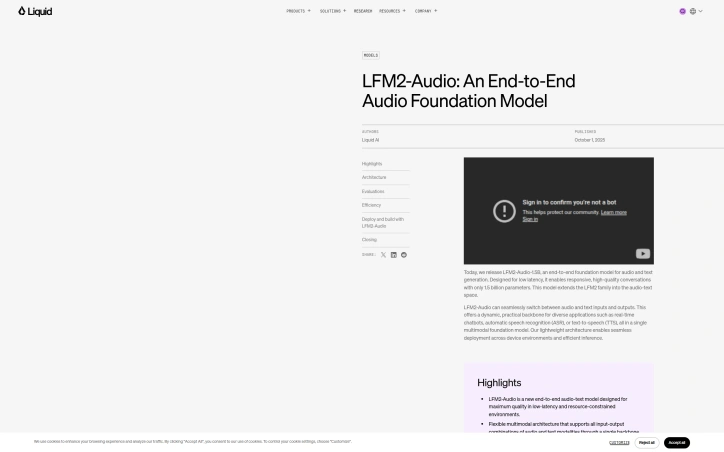
Multimodal audio and text processing has long demanded specialized models or resource-intensive systems that struggle with real-time performance. Liquid AI's LFM2-Audio-1.5B addresses this constraint by packaging conversational AI, speech recognition, text-to-speech, and audio classification into a single, lightweight foundation model designed for deployment across consumer and edge devices. The model's central innovation lies in how it handles the audio modality itself. Rather than forcing audio through discrete tokenization on the input side—a common approach that introduces artifacts—LFM2-Audio preserves continuous embeddings for audio input while outputting discrete tokens for generation. This asymmetry means the model ingests rich audio representations without discretization loss while maintaining the training efficiency of next-token prediction during generation. The approach sidesteps a trade-off that has plagued larger multimodal models, which typically compromise either input fidelity or generation quality. At 1.5 billion parameters, LFM2-Audio achieves inference speeds roughly ten times faster than competing models of comparable quality. The architecture performs this feat through a tokenizer-free input path that chunks raw waveforms into 80-millisecond segments, projecting them directly into the model's embedding space. This design eliminates unnecessary processing overhead and keeps latency low enough for genuine real-time interaction, a requirement for voice applications that larger models frequently miss. The product's flexibility is notable: it handles all permutations of audio and text inputs and outputs through a single backbone, making it genuinely versatile rather than a specialized tool masquerading as general-purpose. A developer can build a voice assistant, transcription service, or audio classifier without maintaining separate inference pipelines or model weights. The technical specifics suggest careful engineering. The distinction between audio input and output representations avoids the brittle trade-offs that plague other end-to-end audio models. The tokenizer-free input strategy preserves signal quality while keeping computational cost modest. These design choices reflect an understanding of real-world deployment constraints where latency, memory, and power consumption directly impact viability. The model extends Liquid AI's existing LFM2 language model lineage, leveraging an established backbone and presumably benefiting from lessons learned across the LFM2 family. For teams building voice-forward applications on phones, embedded devices, or privacy-sensitive infrastructure, this represents a meaningfully different tradeoff than existing options—trading some absolute capability ceiling for deployability and speed that larger models cannot match.

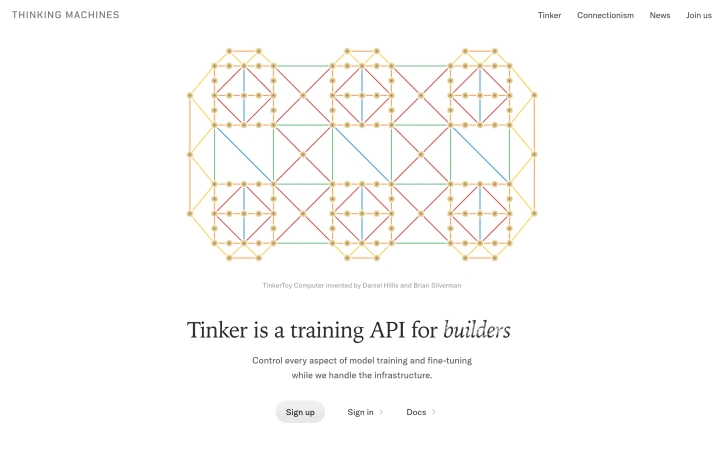
Researchers spend considerable time wrestling with infrastructure rather than focusing on the work that matters—fine-tuning models and designing algorithms. Tinker addresses this friction by offering a lightweight API that handles the operational burden of model training while keeping researchers in control of their data and experimental approach. The platform targets an audience that values research velocity over infrastructure flexibility: academics, laboratories, and independent researchers exploring large language model training without wanting to manage compute clusters, scheduler complexity, or resource allocation manually. The core value proposition hinges on LoRA, an efficient fine-tuning technique that updates a trainable adapter layer rather than the full model weights. This approach reduces computational demands while maintaining learning performance comparable to traditional fine-tuning. For researchers with limited hardware budgets, this matters considerably. Tinker abstracts away scheduling, hardware management, and infrastructure reliability entirely, offering a deliberately minimal API surface: four core operations handle forward passes and gradient accumulation, weight updates, token generation, and state persistence. This simplicity contrasts sharply with the complexity of self-managed training pipelines. The platform's model roster demonstrates genuine breadth. Tinker supports dense and mixture-of-experts variants across multiple architectures—Qwen, Llama, DeepSeek, Kimi, and NVIDIA's Nemotron—ranging from 1B to 397B parameters. This range suggests the infrastructure can scale to serious research workloads while remaining accessible to those working with smaller models. What distinguishes Tinker from ad-hoc cloud compute solutions is the engineering philosophy reflected in user testimonials. Researchers emphasize that the platform lets them "focus on research rather than spending time on engineering overhead," that "infrastructure abstraction makes focusing on data and evals far easier," and that it enables "quick iteration without worrying about hardware." These aren't marginal improvements—they describe a fundamental shift in attention from operational concerns to scientific ones. The testimonials come from academics and practitioners actively working in reinforcement learning and model training, lending credibility to these claims. The platform appears designed specifically for the researcher segment that finds existing options unsatisfying: cloud GPUs require babysitting, on-premise infrastructure demands expertise, and managed services often impose opinionated constraints on training workflows. Tinker occupies a narrower niche but serves it deliberately. Access requires signup or organizational outreach, and pricing details remain undisclosed publicly. For researchers prioritizing iteration speed and research focus over cost optimization or total architectural control, the trade-off appears worth making.

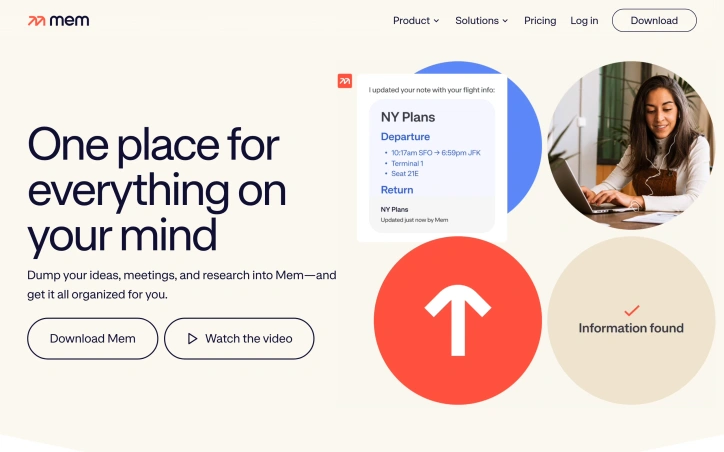
For individuals who spend a significant amount of time in meetings, conducting research, and juggling multiple projects simultaneously, managing one's thoughts and ideas can be a daunting task. Mem 2.0 aims to alleviate this burden by capturing these ephemeral moments and presenting them when needed. What stands out about Mem is its straightforward approach. Unlike some AI-powered productivity tools that promise more than they deliver, Mem's pitch is refreshingly honest: it helps you remember key points from meetings and research sessions. This focus on a specific pain point suggests that the developers understand their target audience's needs and have crafted a solution tailored to those requirements. Mem 2.0 is available across multiple platforms – Mac, Windows, Web, and iOS – making it accessible to users who prefer different environments. This broad compatibility also implies that Mem can integrate with various workflows and existing tools. While specific features or capabilities are not explicitly mentioned in the provided content, the promise of capturing ideas "exactly when you need them" suggests a sophisticated approach to information retrieval and organization. It's likely that Mem utilizes some form of natural language processing (NLP) and machine learning algorithms to identify key points and prioritize relevant information. The website does mention the necessity of an updated browser version to function properly, implying that the application relies on JavaScript for its core functionality. This may be a turn-off for users who prefer to stick with older browsers or have concerns about compatibility. No pricing details are mentioned in the provided content.

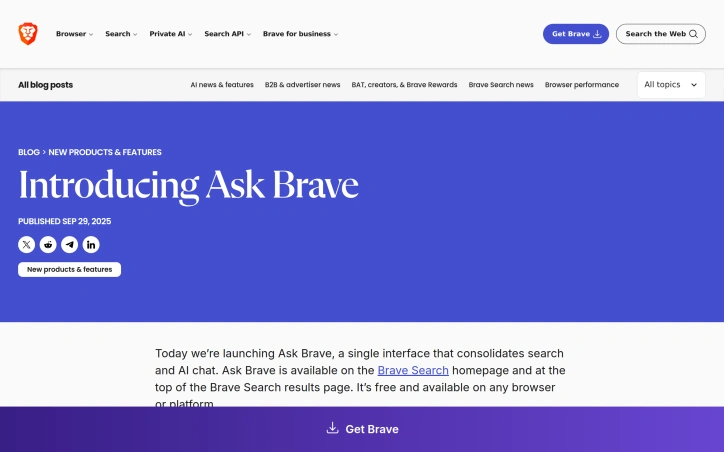
Search engines have traditionally presented users with a list of links and summaries in response to their queries. This approach often leaves room for improvement, as users are forced to navigate between different tools or copy-paste results to get the information they need. Brave's latest innovation, Ask Brave, addresses this issue by integrating AI chat and web search into a single interface. Ask Brave is designed to cater to users who want more comprehensive answers to their queries, along with actionable follow-ups such as videos, web pages, and products. This product is ideal for those seeking an all-in-one solution that combines the simplicity of traditional search engines with the convenience of AI-generated responses. The platform's ability to determine the level of resolution needed for each query and provide users with both answers and follow-up actions makes it particularly useful for exploratory searches. What stands out about Ask Brave is its commitment to user privacy. Brave ensures that conversations are encrypted, ephemeral, and expire after 24 hours of inactivity, without retaining IP addresses or using them for training purposes. This approach aligns with the company's values and provides users with an added layer of security. Key features worth noting include the platform's ability to provide grounded answers based on web search results, ensuring that AI responses are relevant and accurate. Users can type simple search queries or ask nuanced questions, with Ask Brave adapting its response accordingly. The product is available in addition to AI Answers, which offer quick answers to users' queries. Ask Brave is free and accessible on any browser or platform, making it a valuable resource for anyone looking to streamline their search experience. With over 15 million AI-generated responses served daily, Brave's commitment to providing comprehensive answers and follow-up actions sets it apart in the market. As a result, Ask Brave has become an essential tool for those seeking a more efficient and private way to navigate the web.

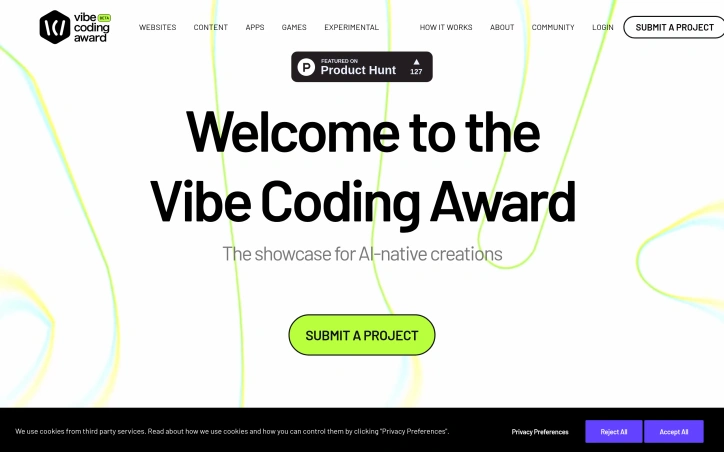
The Vibe Coding Award offers a platform for coders and creatives to showcase their innovative projects in AI-native development. It fills a gap by providing a dedicated stage for recognizing excellence in this emerging field, catering specifically to individuals or teams pushing the boundaries of human-machine collaboration. What stands out about the Vibe Coding Award is its clear vision and manifesto-driven approach. The platform proudly proclaims itself as a "showcase for AI-native creations," which implies that it's not just a recognition ceremony but an active curator of the most groundbreaking work in this space. By creating a dedicated category for experimental projects, it also encourages innovation without boundaries. The award boasts a diverse and experienced jury composed of senior design leaders from top tech companies like Google and Lyft. This suggests a high level of credibility and expertise in evaluating AI-driven creations. Key features worth noting include the five distinct categories (websites, apps, content, games, and experimental) that cater to different types of projects. The platform also explicitly mentions its mission to provide recognition, visibility, and community impact – implying a focus on both personal and professional development for its winners. While pricing information is not provided, it seems that the Vibe Coding Award operates as an award ceremony, likely relying on entry fees or sponsorships to sustain itself. Despite the lack of explicit details, the platform's commitment to innovation and creative expression in AI-native development is evident throughout its content.