Catalyst Healthspan Audit
Personal trainers typically sell training sessions. This startup reversed the equation by building assessment first, mak...
Launchory
We built Launchory to solve the discoverability problem for startups. Our platform offers instant approval, permanent do...
Best Fundraising resources Startups & Tools
Tools to prep startups to raise money: modeling, equity, communities, and matchmaking.
Recently Listed
2 launches
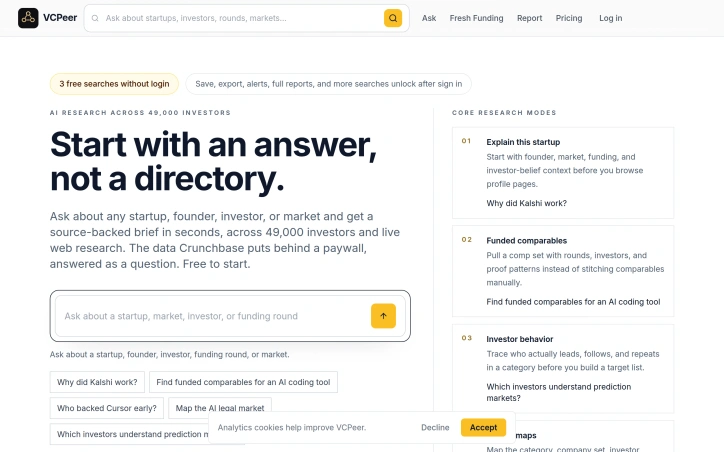
Conducting startup research typically means sifting through expensive directory subscriptions to compile comps, identify investor patterns, and understand market dynamics. VCPeer inverts this workflow by starting with a natural language question rather than database browsing. Users can ask about specific startups, founders, investors, or market segments and receive source-backed answers drawn from coverage of roughly 49,000 investors and live web research in seconds. The product targets founders conducting investor prospecting and VC professionals building investment theses. Rather than manually stitching together comparable companies from fragmented sources, users can request a funded comp set complete with funding rounds and capital patterns. Investors researching category trends get investor behavior maps showing who leads, follows, and repeats in specific domains. The interface positions question-answering as the primary research mode, with traditional directories relegated to secondary validation once the Ask engine has narrowed the most relevant records and patterns. VCPeer's architecture reflects a specific philosophy about research efficiency. The core Ask workspace centralizes the answer thread, source citations, follow-up questions, and export options in one place, reducing context switching. When a question-based answer doesn't suffice, users can escalate directly into a deeper research memo, avoiding the need to export findings into another tool. The freemium model provides three free searches without login, allowing trial users to test whether the engine answers their specific research questions before committing. The company emerged from observing that founders and investors repeatedly ask the same foundational questions: market landscape, comparative funding patterns, investor expertise in specific domains. Rather than iterating on directory design, the founders chose to build an intelligence layer that translates domain questions into evidence synthesis. This represents a genuine alternative to traditional paid research platforms, which typically require users to formulate their own queries against structured databases. Positioning as faster and more accessible compared to incumbents, VCPeer appeals to bootstrapped founders without research budgets and smaller investment firms without institutional research teams. The coverage of 49,000 investors paired with live web research suggests attempts to keep data fresher than point-in-time database snapshots. Whether the engine's answer quality matches specialized human research remains to be validated in practice, but the product architecture solves a real friction point in how startup research typically begins.

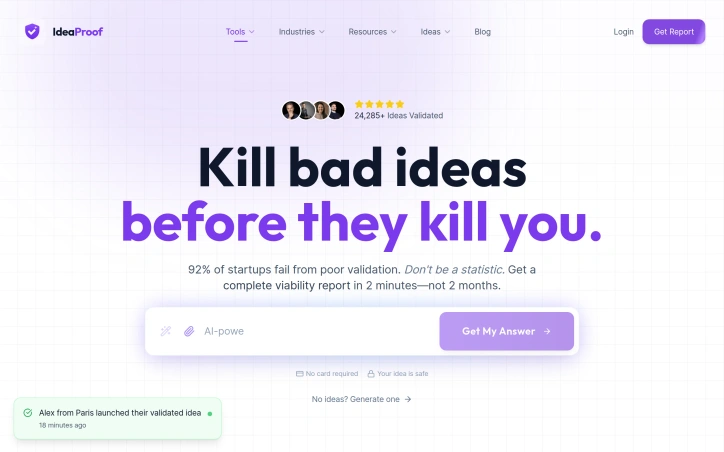
Entrepreneurs spend disproportionate amounts of time validating startup concepts before they ever pitch investors. IdeaProof addresses this friction by automating the early-stage market research process through AI analysis. The platform compresses what traditionally takes weeks of research and conversations into a two-minute workflow. The core offering combines multiple validation tools that founders typically outsource or assemble piecemeal. The platform generates market sizing frameworks, conducts competitive analysis through SWOT assessments, and produces investor-ready business plans. Beyond pure analysis, IdeaProof extends into branding and marketing tooling, which differentiates it from purely analytical competitors. This breadth positions it as an end-to-end validator rather than a single-purpose research tool. The value proposition sits between two market segments: it's more comprehensive than a simple idea generator, but faster and cheaper than hiring consultants or conducting months of manual research. For pre-launch founders with limited budgets, the ability to rapidly pressure-test multiple concept iterations has real appeal. The 120-second validation window is the product's primary marketing angle, and it directly challenges the assumption that good validation requires significant time investment. The emphasis on investor-ready outputs suggests positioning toward founders actively fundraising or serious about their concepts. By packaging analysis alongside branding and marketing recommendations, the platform positions validation as the first stage of a broader go-to-market workflow rather than an isolated research step. One practical consideration: the effectiveness of any AI-powered validation ultimately depends on input quality and interpretation. A tool that synthesizes market data is only as useful as its underlying knowledge base and reasoning. The compressed timeline, while appealing, could encourage surface-level validation if founders don't dig into the reasoning behind generated analysis. IdeaProof targets a real pain point in early-stage entrepreneurship: the analysis paralysis that delays concept testing. Whether its AI analysis matches the depth of manual research remains an empirical question, but the tool's positioning as a rapid validator rather than an exhaustive analyst is honest about its intended use case. For founders who need conviction quickly, this tradeoff may be worthwhile.