Catalyst Healthspan Audit
Personal trainers typically sell training sessions. This startup reversed the equation by building assessment first, mak...
Launchory
We built Launchory to solve the discoverability problem for startups. Our platform offers instant approval, permanent do...
Best Shopping Startups & Tools
Tools to make buying smarter: price trackers, coupons, wishlists, and niche markets.
Recently Listed
4 launches
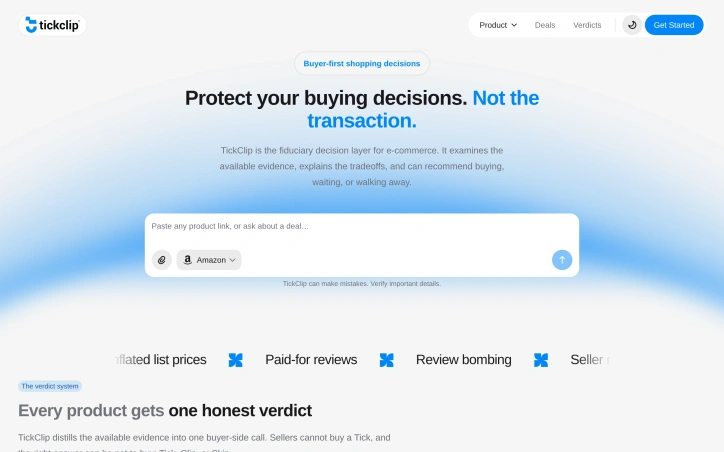
E-commerce buyers face a gauntlet of manipulation: phantom discounts, inflated list prices, fake reviews, and seller red flags designed to exploit purchasing decisions. TickClip addresses this head-on by positioning itself as a neutral decision-making layer between shoppers and retailers. The core premise is straightforward. Users paste a product link from Amazon, Walmart, or Macy's, and TickClip delivers a three-option verdict: Tick (buy now), Clip (wait and watch), or Skip (avoid). Rather than ranking products or optimizing for conversion, the platform examines price history, reviews, and seller reputation to triangulate whether a purchase makes financial sense at that moment. The differentiation is structural. TickClip earns no affiliate commission from retailer links and explicitly forbids sellers from purchasing placement or influencing verdicts. This business model choice is rare in commerce technology and sets it apart from comparison shopping tools designed to reward merchant participation. The verdict logic addresses legitimate buyer pain points. Price manipulation detection flags phantom discounts and artificially inflated list prices. Review analysis catches paid endorsements and bombing campaigns. Seller context surfaces reputation risks. Each verdict includes supporting evidence—price, timing, demand signals, confidence level, uncertainty—that buyers can inspect themselves, rejecting the black-box recommendation approach common elsewhere. TickClip's willingness to recommend not buying is noteworthy in an ecosystem optimized for transaction velocity. The product tracks ninety days of price history per item and performs independent checks on each recommendation. The simplicity of the three-option output reduces decision fatigue compared to spreadsheet-based comparison tools. The company operates with no affiliate conflicts, a constraint that limits immediate revenue but strengthens the fiduciary positioning. Open questions remain around scale and maintainability. The platform relies on triangulating multiple data sources—marketplace prices, review signals, seller ratings—which requires continuous maintenance as retailers change their systems. The product roadmap is not visible from public materials. The seller red flags feature suggests some proprietary methodology, though the details stay opaque. TickClip taps genuine frustration with e-commerce dishonesty. Its refusal of seller fees and affiliate income is refreshing in a category usually bent toward merchant interests. Whether that independence can scale into a durable business model remains to be tested.

Overpaying at the grocery store happens constantly, often without shoppers realizing it. CartLens solves this by enabling consumers to scan receipts and price tags with their phone camera, instantly surfacing whether they paid fair prices and identifying cheaper alternatives at nearby stores. The product targets price-conscious shoppers who want to maximize savings on everyday shopping without manually researching competitor pricing. This includes budget-minded households, deal-seekers, and anyone monitoring household spending efficiency. What distinguishes CartLens from generic price comparison tools is its commitment to crowdsourced data from actual shoppers rather than merchant APIs or web scrapers. This ground-truth approach captures real market conditions as they exist on store shelves, not outdated catalog information. The company layers this foundation with sophisticated computer vision powered by Gemini Embedding 2, fusing pixel-level data with semantic text into a unified vector representation. The system achieves 99.8% accuracy on receipt parsing across items, prices, and quantities. The feature set reflects comprehensive ambition for the category. Beyond price scanning, CartLens includes basket comparison across multiple stores, price spike detection for sudden local increases, direct store-to-store comparison, and an AI shopping assistant. The spending insights dashboard aggregates purchase history across categories and stores, creating visibility into money flow. The company supports 11 languages natively with automatic currency and unit adaptation when travelers cross borders. Privacy and data sovereignty are core to the product architecture. CartLens builds in GDPR and CCPA compliance, carries SOC2 Type II certification, and offers full data portability through downloadable JSON archives. Users can decommission accounts entirely, triggering automated anonymization that strips personal information while preserving price data in the network. The underlying infrastructure, which CartLens calls the Price Lattice, maps local pricing across physical retail locations in real time. The model strengthens with each scan, creating network effects where denser user concentration in a geography yields better savings potential for participants. The company positions this as ground-truth mapping of the physical economy rather than simple price comparison. No pricing model is disclosed in available materials.

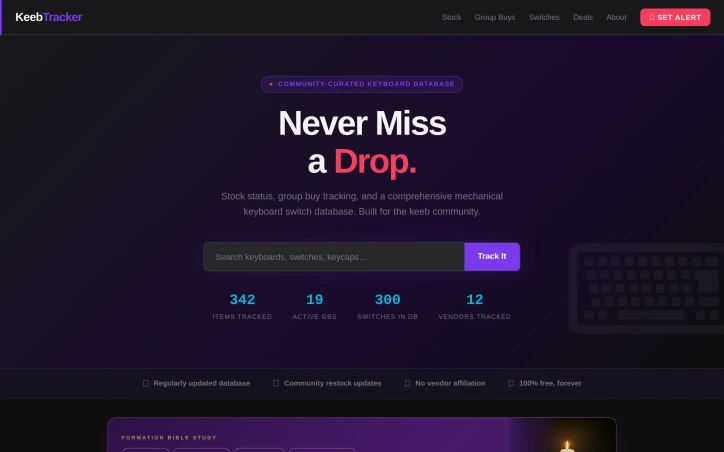
Mechanical keyboard enthusiasts often struggle to stay on top of inventory levels, group buy timelines, and switch availability. KeebTracker addresses this problem head-on by providing a centralized platform for tracking stock status, monitoring group buys, and accessing a comprehensive database of mechanical keyboard switches. The site is built with the keeb community in mind, offering a valuable resource for both novice and experienced enthusiasts. What stands out about KeebTracker is its community-driven approach. The database is curated by the community, ensuring that the information is accurate and up-to-date. The site also provides regular updates on stock levels and group buy status, helping users make informed purchasing decisions. The absence of vendor affiliation is also noteworthy, as it lends credibility to the information provided. The platform offers a range of features that cater to the needs of mechanical keyboard enthusiasts. Users can track inventory levels, monitor active group buys, and browse a extensive database of switches. The site also provides details on vendor, price, and status for each item, making it easier for users to plan their purchases. Notably, the database is regularly updated, and users can access community-driven restock updates. One of the most significant advantages of KeebTracker is that it is entirely free to use, with no sign-up required. The site is supported by advertisements, and the owner, Berean Defense L.L.C., earns revenue through Amazon Associates by promoting recommended products. This business model allows KeebTracker to maintain its independence and focus on providing a valuable service to the mechanical keyboard community.

Selling secondhand clothing on Vinted requires more than just good items—presentation matters enormously. A poorly lit or unappealing product photo can derail a sale before a buyer even reads the description. Vintedify tackles this friction point by using artificial intelligence to enhance listing images, targeting sellers who struggle to create professional-quality product photography. The core offering centers on a streamlined workflow. Sellers paste their Vinted product link, and the platform's AI automatically generates improved versions of their photos with enhanced lighting, color correction, and detail clarity. The generated images can be downloaded and uploaded directly to their Vinted listings. The platform grants three free credits upon registration, allowing new users to test the service without entering payment information. What distinguishes Vintedify from generic photo editing tools is its focus on a specific use case. The platform generates images showing items as they would appear when worn on a mannequin, rather than simply brightening flat-lay photographs. This addresses a real pain point on Vinted, where buyers want to visualize how clothing actually looks in practice. This capability differentiates it from traditional enhancement apps that merely adjust existing photos. The company positions itself around three core benefits: increased sales visibility, reduced time to sale, and the ability to price items more competitively. According to the marketing materials, optimized photos attract three times more potential buyers and reduce selling time by approximately seventy percent. The platform emphasizes that these generated images enhance rather than replace authentic product photos, positioning them as supplementary aids to strengthen listings. The user experience is designed for simplicity. The process requires minimal effort—copying a link, pasting it into the tool, and downloading the result. No complex editing steps or design skills are needed. The platform also emphasizes data security and privacy, claiming that user information and photos are never shared with third parties. Vintedify occupies a narrow but potentially valuable niche. For serious Vinted sellers looking to improve listing performance without investing in professional photography equipment or hiring photographers, the tool offers a practical shortcut. The free trial credits lower the barrier to entry, making experimentation risk-free for users uncertain about whether AI-enhanced images genuinely drive sales.