Catalyst Healthspan Audit
Personal trainers typically sell training sessions. This startup reversed the equation by building assessment first, mak...
Launchory
We built Launchory to solve the discoverability problem for startups. Our platform offers instant approval, permanent do...
Best Unified API Startups & Tools
Platforms that centralize auth, data, and AI services so apps integrate through one layer.
Recently Listed
2 launches
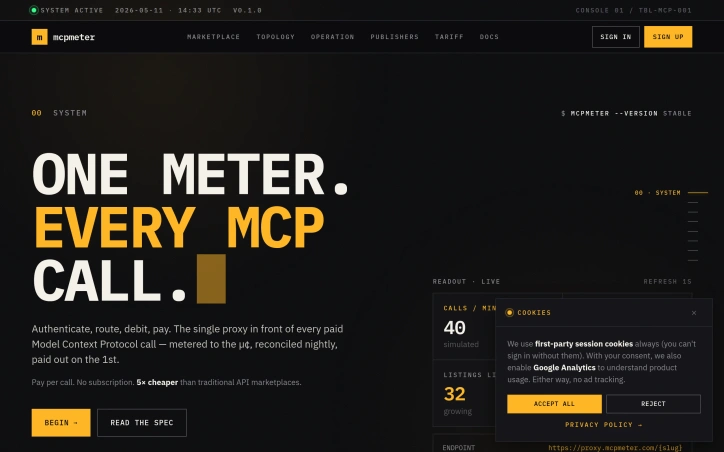
Simplifying access to multiple Model Context Protocol servers is a significant challenge for developers working with AI coding tools. Managing numerous API keys and reconciling invoices from various providers can be cumbersome. mcpmeter's solution is to offer a unified authentication and billing system, allowing users to interact with multiple MCP servers through a single proxy using one bearer key. What stands out about mcpmeter is its straightforward approach to authenticating, routing, and billing for MCP calls. The proxy sits between the agent and the publisher's MCP server, handling authentication, forwarding the JSON-RPC body, counting responses, and writing ledger rows. This pass-through design ensures that only relevant traffic is metered and billed. The proxy's performance is also noteworthy, with a P95 latency of 52ms, which is well below the target of 100ms. Key features of mcpmeter include its per-call metering and billing, with reconciliation happening nightly, and payouts made on the 1st of each month via Stripe Connect. The platform supports various AI coding tools and platforms, such as Claude, Cursor, and OpenAI. The fact that it provides a live ledger and statement, with every call recorded, adds to its transparency and auditability. mcpmeter's pricing model is based on a per-call charge, with no subscription fees, and is claimed to be 5 times cheaper than traditional API marketplaces. Publishers listing their MCP servers on the platform are charged a 10% platform fee, with payouts made monthly, subject to a $50 minimum. Overall, mcpmeter presents a compelling solution for developers and publishers looking to simplify their interactions with multiple MCP servers, offering a streamlined and cost-effective alternative to managing multiple API keys and invoices.

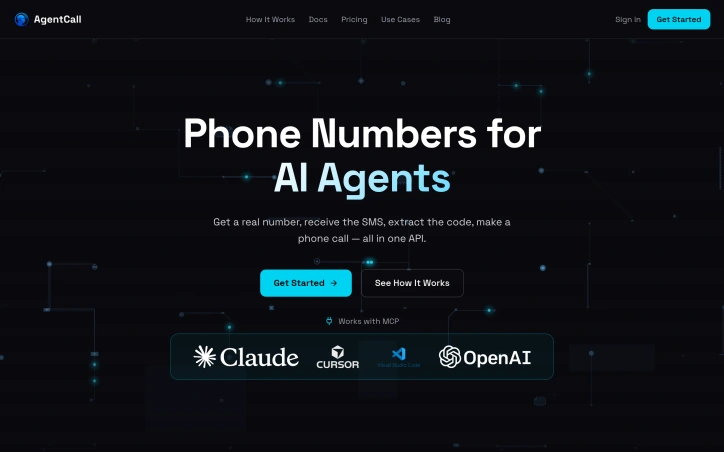
Building AI agents that can operate in the real world requires bridging the gap between digital systems and traditional communication channels. AgentCall solves a critical problem: enabling AI agents to interact via phone—both making outbound calls and receiving inbound communication—without the friction and failures that plague existing VoIP-based approaches. The core offering is elegant in scope. Developers provision real SIM-backed phone numbers through an API, connect their agents with a single API key, and receive all incoming calls and SMS messages through webhooks. The platform handles provisioning in seconds, supports country and capability selection, and guarantees that numbers pass strict platform verification checks that typically block VoIP alternatives. For AI agents, this means actually being able to register accounts, complete SMS-based verification flows, and operate in environments where traditional virtual numbers get rejected. What distinguishes AgentCall is how it handles the full communication stack. Voice calls aren't just passive; agents initiate outbound calls with AI-powered conversation using one of eight distinct voice options—from the neutral "Alloy" to the energetic "Shimmer"—each tuned for different contexts. The AI voice system accepts a system prompt and autonomously manages the conversation, returning a full transcript. This makes customer service outreach and verification workflows genuinely practical. On the messaging side, agents get a dedicated SMS inbox per number, send and receive messages, and automatically extract verification codes from incoming SMS, delivering them to webhook endpoints in real-time. The architecture reflects strong security thinking. Each agent gets its own isolated number, preventing compromise of one agent from cascading across others. The async, webhook-based design eliminates the need for persistent connections or complex state management. The platform supports diverse use cases: agents test SMS-based authentication on their own apps, run outbound calling campaigns with follow-up SMS, maintain two-way SMS conversations, and handle inbound calls through webhook forwarding. This breadth indicates the founders understood the landscape of agentic workflows rather than optimizing for a single scenario. The "Works with MCP" mention signals integration with the Anthropic Model Context Protocol, positioning AgentCall within the broader AI infrastructure stack. For developers building sophisticated AI agents that need reliable phone capabilities, AgentCall delivers what the market currently lacks—a practical alternative to the constraints and unreliability of virtual number services.