@fuck.it
Email privacy has become an afterthought at mainstream providers, which treat inboxes as data sources to be mined for ad...
Categories
Best VPN client Startups & Tools
Clients that create encrypted connections for private browsing and secure network access.
Recently Listed
3 launches
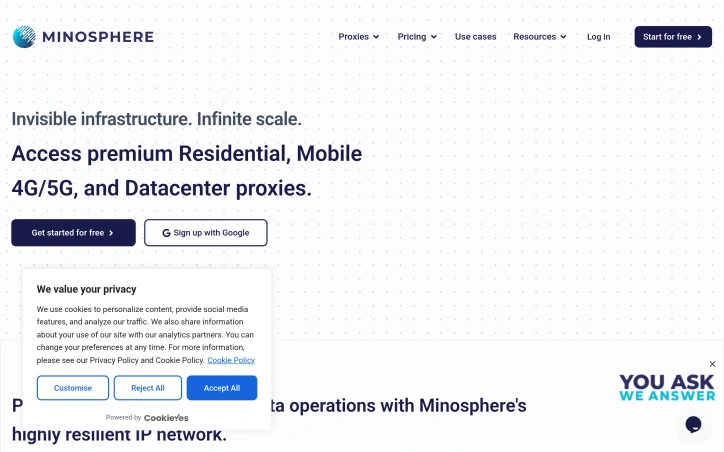
Enterprises that depend on large-scale data extraction face a persistent challenge: sourcing reliable IP infrastructure that maintains trustworthiness across global markets while handling massive concurrent requests. Minosphere addresses this by operating a distributed network of proxy services spanning residential, mobile, and datacenter IPs. The core value proposition centers on reliability and scale. The service maintains a portfolio of over 100 million residential IP addresses sourced across 190 countries, backed by claims of 99.9 to 99.99 percent uptime depending on the proxy type. For teams extracting data at enterprise scale, the reported 99.82 percent success rate and average response time of 0.41 seconds suggests infrastructure built to handle consistent, high-throughput operations without frequent bottlenecks. What differentiates Minosphere is its tiered approach to proxy types. Residential proxies leverage authentic ISP-assigned addresses to real homeowners, positioning them as the most trusted option. Mobile proxies tap into carrier-assigned IP space across 3G, 4G, and 5G networks in 30-plus countries and regions, addressing use cases requiring carrier fidelity. Datacenter proxies prioritize raw performance for scenarios where speed matters more than trust perception. Static ISP proxies represent a middle ground, offering dedicated, never-rotating addresses officially registered to consumer ISPs. The platform emphasizes operational convenience. A unified console and standardized APIs reduce friction for teams integrating multiple proxy types into existing workflows. Features like precise geotargeting, session control, and optimized routing for low-latency performance indicate thoughtful engineering around real production constraints rather than basic proxy forwarding. Pricing is granular and varies significantly by proxy type. Residential proxies start at 1.60 dollars per gigabyte, datacenter proxies at 0.54 dollars per gigabyte, while mobile proxies range from 2.49 dollars per gigabyte for USA coverage to 3.5 dollars per gigabyte for international options. Static ISP proxies offer unlimited bandwidth at a presumably different cost model. The pricing structure invites cost optimization—teams can mix proxy types based on actual use case requirements rather than overpaying for residential quality when datacenter speed suffices. The target audience is clear: data-driven enterprises conducting research, competitive intelligence, market monitoring, or other large-scale information collection that demands both reliability and geographic breadth. Whether the infrastructure and uptime claims hold under real production stress remains a question only deployment experience answers, but the architecture and feature set suggest a product designed for serious operational demands rather than casual use.

As concerns about online privacy and internet accessibility continue to grow, individuals seeking secure and unrestricted browsing have turned to virtual private network (VPN) solutions. BullVPN addresses these concerns by providing a highly secure and reliable service that masks users' IP addresses, ensuring anonymous browsing and protection from data security risks. The service is designed for individuals who encounter geographical restrictions, blocked content, and online censorship, particularly those using public networks. What stands out about BullVPN is its ability to provide unlimited bandwidth and high-speed connections, allowing users to access globally restricted websites and streaming platforms without limitations. The service operates over 300 servers across 49 countries, making it a robust solution for users worldwide. Its compatibility with a range of devices, including Windows, Mac, iOS, Android, and Android TV, ensures that users can maintain secure and anonymous internet access across all major platforms. Key features of BullVPN include its use of advanced protocols such as IKEv2 and WireGuard to ensure maximum data protection, a strict no-logs policy, and DNS Leak protection. These features guarantee that users' personal information remains private and secure. The service is also easy to use, with support available through multiple channels, including Line, Wechat, Facebook, and Live Chat. In terms of pricing, BullVPN offers various packages, including a one-month subscription for $6.86, a one-year subscription for $54.56, and a two-year subscription for $102.08. The service also offers a lifetime subscription option, with prices varying depending on the initial subscription period. For example, a one-month initial subscription offers a lifetime subscription with 30+12 days of access, while a two-year initial subscription offers a lifetime subscription with 730+12 days of access. All subscriptions allow connection to up to 4 devices.


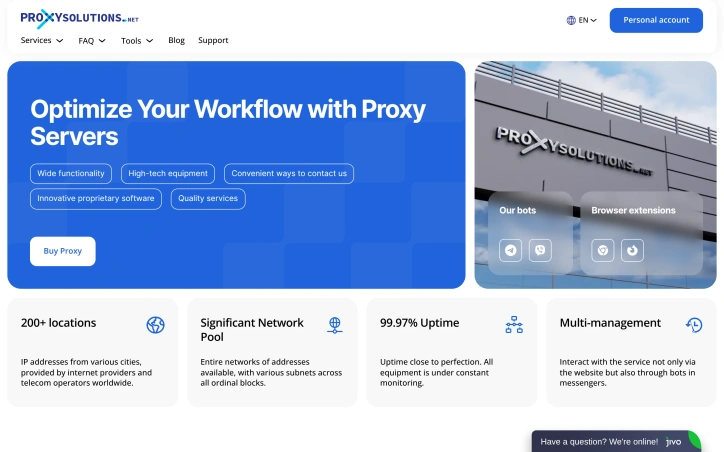
Access to region-locked content and IP masking represent core use cases that Proxy Solutions addresses through a global proxy network. The service targets developers, marketers, data researchers, and network administrators who need reliable proxy infrastructure to bypass geographic restrictions or maintain privacy in their operations. The platform distinguishes itself through breadth rather than specialization. Instead of focusing on a single proxy category, Proxy Solutions bundles personal proxies, package proxies, mobile proxies, UDP proxies, and multi-protocol options alongside VPS and dedicated server infrastructure. The company maintains 200+ global locations sourced from legitimate internet service providers and carriers worldwide, with individual endpoints distributed across different geographic regions and IP ranges. Technical execution prioritizes stability. The service claims 99.97% uptime with continuous equipment monitoring and proxy throughput reaching 100 MB/sec. Authentication supports both credential-based and IP-based approaches, with HTTP/HTTPS and SOCKS5 connection types available. This flexibility accommodates diverse integration scenarios across applications and workflows without forcing users into a single architectural choice. Automation drives user onboarding. Proxies appear in personal dashboards immediately after payment, and an API enables programmatic ordering and management for developers. Multi-channel support through website and messenger-based bots reduces friction compared to traditional ticketing systems. The platform provides round-the-clock support across issue complexities. Pricing strategy emphasizes accessibility. Purchases range from single IP addresses to tens of thousands, with subscription periods spanning one month through extended terms featuring automatic renewal. A 25% affiliate commission incentivizes reseller partnerships. A refund guarantee backs service delivery claims if proxies fail to provision. The service succeeds in consolidating infrastructure. Users seeking only proxies might explore specialists, but organizations wanting integrated proxy, VPS, and dedicated server options under one vendor find consolidated management valuable. The geographic scale and uptime metrics position this as infrastructure-grade rather than consumer-tier, though the proxy market remains crowded with competitors offering similar technical baselines. Proxy Solutions' primary differentiation rests on coverage breadth combined with automated provisioning and multi-protocol flexibility. These factors address operational complexity for organizations running distributed infrastructure, but they represent incremental improvements rather than fundamental advantages over established competitors in this category.