CryptKit
- No match
Machine translation — the English original is authoritative.
The Story
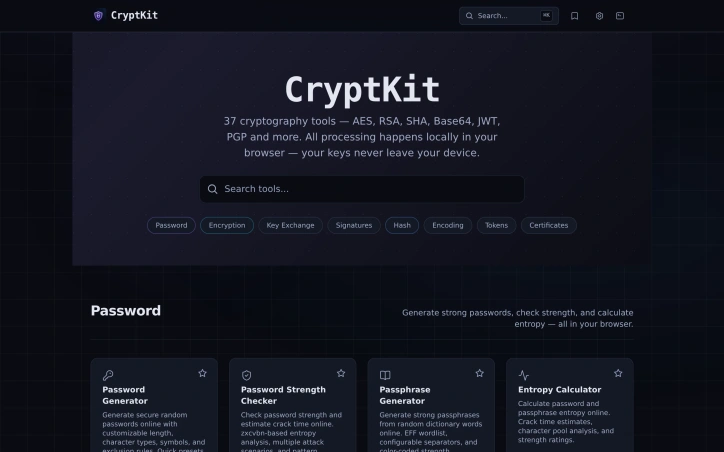
As a developer, I constantly needed to encrypt test data, verify a JWT, hash a config, or generate a key — and every time I ended up juggling five different websites, many of which quietly sent my input to a server. Pasting production secrets into an unknown backend never felt right. So I built CryptKit: a collection of 37 cryptography tools that run 100% in your browser. AES, ChaCha20, RSA, ECC, digital signatures, hashes, JWT, BIP39 mnemonics, TOTP, certificates — everything executes locally via the Web Crypto API, and no data ever leaves your device. There's no account, no tracking, and no ads. It also covers modern and post-quantum algorithms (ML-KEM, ML-DSA), works offline as an installable PWA, and is completely free. CryptKit is the toolbox I wished existed: one URL, every crypto task, and no need to trust anyone's server. If you've ever needed to encrypt, hash, sign, or generate something securely and quickly, give it a try.
AI Overview
AI-generatedDevelopers who work with cryptographic operations frequently face a frustrating dilemma: either use specialized websites that send sensitive data to remote servers, or maintain bookmarks to dozens of single-purpose tools scattered across the internet. CryptKit addresses this friction point by consolidating 37 cryptography tools into a single, locally-executed platform that prioritizes privacy by design.
The core appeal is straightforward but powerful. All processing happens client-side through the Web Crypto API, meaning encryption keys, passphrases, and test secrets never transmit to any server. For teams handling production credentials or developers working with sensitive configuration data, this distinction matters. The tool works entirely offline as a progressive web application, functions without user accounts or tracking, and carries no advertising. There is no friction to adoption and no privacy trade-off to negotiate.
The feature set spans both conventional and modern cryptographic needs. Users can generate and test passwords, derive keys using algorithms like Argon2 and Scrypt with OWASP-recommended parameters, encrypt data via AES in multiple modes, work with asymmetric systems like RSA and ECC, manage digital signatures, handle JWT and JWE tokens, and split secrets using Shamir's Secret Sharing. The tool also includes support for post-quantum algorithms such as ML-KEM and ML-DSA, positioning it ahead of most competing utilities that ignore the near-term relevance of quantum-resistant cryptography.
The execution shows careful design throughout. The password strength checker performs entropy analysis using zxcvbn-based pattern recognition. RSA and ECC key generators support multiple output formats—PEM, DER, JWK, SSH—for compatibility across different systems. The PGP tool handles encryption, decryption, signing, and verification with GnuPG compatibility. Blowfish, ChaCha20, DES, XOR, and other specialized ciphers are available for edge cases and compatibility testing.
The business model removes common friction: CryptKit is completely free with no freemium tier, no paid features, and no upsell.
For developers, security teams, and system administrators who regularly encrypt test data, verify tokens, hash configuration values, or generate keys, CryptKit collapses a tool-juggling workflow into a single, trustworthy destination. The absence of tracking combined with genuine offline capability makes it distinct in a space where many competitors ask users to place cryptographic material in the hands of remote services.
Founder Diary
DevlogThe maker hasn't posted a diary entry yet.
Key Features
Client-Side Processing
All cryptographic operations execute locally through the Web Crypto API, ensuring encryption keys and sensitive data never transmit to remote servers.
37 Cryptography Tools
Consolidates password generation, key derivation, AES encryption, RSA, ECC, JWT/JWE tokens, Shamir's Secret Sharing, and more into a single platform.
Post-Quantum Support
Includes quantum-resistant algorithms such as ML-KEM and ML-DSA.
Offline PWA
Operates as a progressive web application that functions entirely offline without accounts, tracking, or internet connectivity.
Multiple Key Formats
Generates RSA and ECC keys in PEM, DER, JWK, and SSH formats for compatibility across different systems.
Specialized Ciphers
Supports Blowfish, ChaCha20, DES, XOR, and other ciphers for edge cases and compatibility testing.
Use Cases
-
1
Developers handling cryptographic operations
Eliminates the need for specialized websites and dozens of scattered single-purpose tools.
-
2
Security teams managing production credentials
Provides a trustworthy offline solution for handling sensitive configuration data.
-
3
System administrators and security professionals
Enables password testing, key generation, token verification, and data encryption in one local tool.
FAQ
Is my encryption data sent to any servers? ▾
Can I use CryptKit without an internet connection? ▾
What encryption algorithms does it support? ▾
Does CryptKit have tracking or advertising? ▾
Pricing
Completely free with no freemium tier, paid features, or upselling.
Tech Stack & Tags
Discussion
No comments yet — be the first!
Join the conversation — sign up to comment.
Sign up freeCommunity Support
Boost this project on Sell With boost
Meet the Founder

More in Security software
Locksy - Tab Locker & Password Protection
Your browser tabs are a security disaster. Pr...
GeoPatrol
GeoPatrol is a cloud-based SaaS platform that de...

FixMyMacNow
We built FixMyMacNow because Mac users face cons...

Fraudly
We built Fraudly because too many people lose mo...

VeilDB
We built VeilDB because teams need production-li...
WinRansomProtect
Ransomware attacks are getting smarter, and most...