Fraudly
- No match
Machine translation — the English original is authoritative.
The Story
We built Fraudly because too many people lose money, data, and trust to scams, phishing, and fraudulent websites. Our mission is to give you instant, honest trust signals before you click, pay, or sign in—powered by explainable AI that never sells your browsing data.
AI Overview
AI-generatedSecuring online transactions before they happen addresses a real gap in consumer safety. Fraudly tackles the moment between seeing a link or storefront and deciding whether to trust it with money, credentials, or personal information. The product targets everyday internet users—shoppers, email checkers, QR code scanners, social media link-followers—who encounter suspicious websites constantly but lack reliable tools to evaluate legitimacy in seconds.
The core differentiator centers on explainability. Rather than hiding behind opaque risk scores, Fraudly breaks down trust signals across specific dimensions like website safety, business reputation, and shopping intelligence. Users see the reasoning behind each assessment, enabling them to make informed judgments rather than blindly accepting automated warnings. This design philosophy extends beyond marketing; the company explicitly positions itself against unnecessary fear-mongering, acknowledging that not every website fits neatly into safe or unsafe categories.
The product reaches users across multiple contexts. The web interface handles website checks with one free analysis daily, no signup required. A mobile app extends functionality to pasted links from messages and emails, QR code scanning in parking lots and cafes, and screenshot analysis—catching suspicious links embedded in images users receive. Browser extensions for Chrome and Microsoft Edge offer passive protection, warning users during normal browsing rather than forcing manual checks.
Privacy forms another stated pillar. Unlike many security tools that build detailed browsing profiles, Fraudly commits to not tracking users or commercializing their activity data. This matters because trust products themselves become targets if they collect and monetize user behavior.
The Trust Profile synthesizes analysis from multiple established security sources using AI, combining rather than inventing conclusions. The company positions this as stronger than manually researching across separate services.
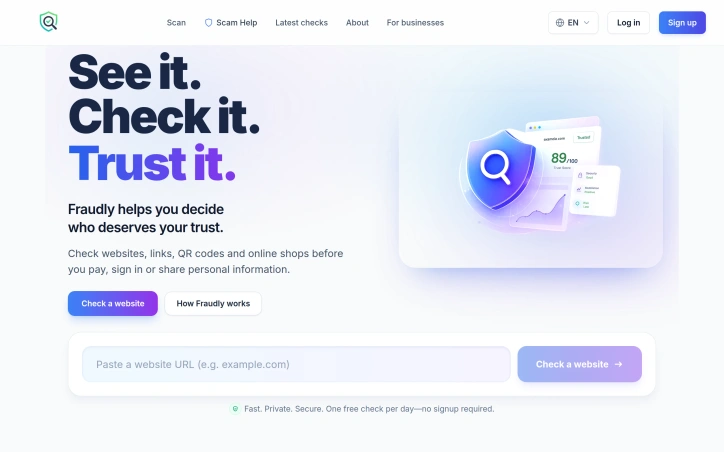
The website reveals little about accuracy rates, false positive performance, or how it handles emerging scams. A sample Trust Profile shows a four-star rating with an 84 confidence score, but public examples don't illuminate edge case handling. The free tier caps users at one daily check, which may frustrate power users or security professionals needing unlimited access. No premium pricing appears on the site.
For consumers tired of making trust decisions blindly, the product delivers focused value that explains itself.
Founder Diary
DevlogThe maker hasn't posted a diary entry yet.
Key Features
Explainable Risk Assessment
Breaks down trust signals across website safety, business reputation, and shopping intelligence instead of hiding behind opaque risk scores.
Multi-Platform Coverage
Available as a web interface, mobile app with QR code scanning, and browser extensions for Chrome and Microsoft Edge.
Privacy-First Design
Commits to not tracking users or commercializing their activity data.
AI-Synthesized Trust Analysis
Combines conclusions from multiple established security sources rather than inventing assessments.
Use Cases
-
1
Online Shoppers
Verify website legitimacy before entering payment or personal information at checkout.
-
2
Email Users
Check suspicious links from messages and emails before clicking or providing credentials.
-
3
Mobile Users
Scan QR codes in public spaces and analyze links in screenshots before interacting.
-
4
Everyday Browsers
Get passive warnings during normal web browsing with browser extension protection.
FAQ
Does Fraudly track my browsing? ▾
How does Fraudly decide if a website is safe? ▾
Can I check links on my phone? ▾
How much does Fraudly cost? ▾
Pricing
One free analysis daily on web interface; premium tier implied but not publicly priced.
Tech Stack & Tags
Discussion
No comments yet — be the first!
Join the conversation — sign up to comment.
Sign up freeCommunity Support
Boost this project on Sell With boost
Meet the Founder

More in Security software
Locksy - Tab Locker & Password Protection
Your browser tabs are a security disaster. Pr...
GeoPatrol
GeoPatrol is a cloud-based SaaS platform that de...

FixMyMacNow
We built FixMyMacNow because Mac users face cons...

VeilDB
We built VeilDB because teams need production-li...
Sentinel High-performance surveillance System
Turn webcams and IP cameras into real-time, AI-d...
CryptonQR
The Problem: > In an era of constant data breach...